A Guide to Selecting Thin Section Bearings for Your Design
Engineers often face a design challenge: how to achieve precise rotational movement within a highly constrained space. When standard bearings are too bulky or heavy, the solution is often found in Thin Section Bearings. These components are defined by a very small, constant cross-section relative to a large bore diameter, making them ideal for applications where weight and space are critical design drivers, such as in robotics, medical imaging equipment, and aerospace systems.
However, their unique geometry also means that proper selection is essential for performance and longevity. Choosing the wrong type can lead to premature wear, excessive vibration, or even catastrophic failure. This guide provides a structured approach to selecting the right bearing for your specific load conditions, drawing on my 15 years of experience in precision bearing manufacturing at BY Bearings.
Matching Load Conditions to Bearing Type: A Selection Framework
The most critical step in specifying a thin-section bearing is accurately analyzing the loads it will experience in operation. These loads can be categorized as radial, axial (thrust), and moment (tilting). Each type of load is best handled by a specific internal raceway geometry. Using the wrong bearing for the load profile is the number one cause of application failure.
We can break down the selection process into a clear, action-focused method. First, identify the primary and any secondary loads your application will generate. Then, use the following table to match those loads to the appropriate bearing type.
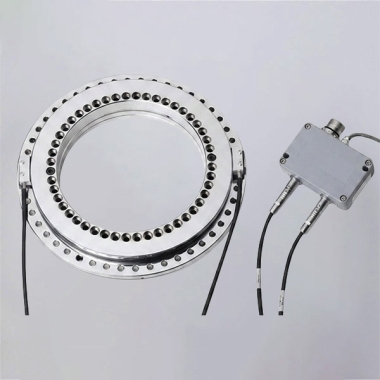
| Bearing Type | Raceway Geometry | Primary Load Capacity | Common Applications |
|---|---|---|---|
| Type C - Deep Groove | Conrad (Deep Groove) | Radial | Low-speed radar antennas, indexing tables, light-duty conveyor rollers where radial forces are dominant. |
| Type A - Angular Contact | Angular Contact | Axial (Thrust) | High-speed machine tool spindles, robotic arm joints with high thrust loads, screw jack systems. Requires preload. |
| Type X - 4-Point Contact | Four-Point Contact Gothic Arch | Radial, Axial & Moment | Robotic wrists, medical scanner gantries, and any application where a single bearing must handle a combination of loads. |
How to Apply This Framework
Let's walk through a practical decision process:
- Analyze Your Loads: Is the primary force pushing down on the bearing's radius (radial load)? Or is it a pulling/pushing force along the axis of rotation (axial load)? Will the bearing experience a tilting or overturning force (moment load)? Quantify these forces if possible.
- Select the Primary Type:
- If your application has almost exclusively radial loads, a Type C Deep Groove bearing is the most efficient and economical choice.
- If the dominant load is axial, a Type A Angular Contact bearing provides the highest thrust capacity and rigidity. Note that these are typically used in pairs to handle thrust in both directions and require precise preloading.
- If your design must handle a combination of significant radial, axial, and moment loads with a single bearing, the Type X Four Point Contact Ball Slewing Bearing is the correct choice. Its unique raceway geometry allows it to manage forces from multiple directions.
- Verify Secondary Loads: A Type C bearing can handle light, incidental thrust loads, but it is not designed for continuous axial forces. A Type X bearing is versatile but may have higher friction than a Type C in a purely radial load scenario. Always consider the full load spectrum.
For complex applications, such as a robotic joint that moves through multiple axes, more advanced solutions like Precision Crossed Roller Bearings may offer higher rigidity and load capacity in a similarly compact footprint.
Key Manufacturing Processes that Define Bearing Performance
The performance of a precision bearing is not just about its design; it's a direct result of the quality of materials and the control over manufacturing processes. At BY Bearings, we operate a 13,500 m² intelligent factory where every step is managed under an ISO 9001:2015 certified quality system to ensure consistent results.
Here are the critical factors that impact the final product:
- Raw Material Purity: We start with high-grade GCr15 (SAE 52100) bearing steel. The chemical composition of every batch is verified via spectrographic analysis to guarantee it meets standards for purity and alloy content. This prevents material inclusions that can become failure points under load.
- Controlled Heat Treatment: The durability and load-carrying capacity of a bearing are determined by its heat treatment. Our automated heat treatment line ensures a stable martensitic microstructure. We conduct metallographic examinations to confirm an optimal hardness of HRC 60-64, providing the right balance of toughness and wear resistance.
- Precision Grinding and Runout Control: For sensitive equipment, runout (deviation from a true circular path) can cause vibration and positioning errors. Our CNC grinding workshops can achieve precision up to P2 class. Critically, we perform 100% runout inspection before shipment, ensuring runout is controlled within a maximum of 1.5 μm for our highest precision grades. This level of Precision Bearings Quality Control is essential for customers in demanding fields, such as the German semiconductor equipment manufacturer we supply with crossed roller bearings.

Common Applications and Industry Examples
The unique characteristics of thin section ball bearings make them indispensable in several high-tech industries. Their ability to save space and reduce weight directly translates to better overall system performance.
Robotics and Automation
In articulated robotic arms, every gram of weight in the joints increases the motor torque required for movement, reducing payload capacity and energy efficiency. Thin section bearings provide the necessary rotational accuracy for joints in a lightweight, compact package. This is a primary reason they are specified in everything from small collaborative robots to large industrial automation systems. For more on this, see our solutions for Bearings for Industrial Robotics.
Medical and Semiconductor Equipment
Medical imaging systems like CT scanners and C-arms require smooth, quiet, and vibration-free rotation. Similarly, semiconductor wafer handling equipment demands extreme positioning accuracy. The low friction torque and high rotational precision of these bearings are essential. Our 100% pre-shipment inspection for runout and torque ensures that our bearings meet the strict requirements for these sensitive applications.
Aerospace and Defense
In satellite positioning systems, optical gimbals, and targeting systems, minimizing weight is paramount. A Type X thin section bearing can often replace a two-bearing arrangement, saving significant space and mass while still managing complex combined loads. This integration simplifies the design and reduces the component count.
Avoiding Common Specification and Sourcing Errors
Selecting the right bearing is only half the battle. Sourcing and implementation come with their own set of potential mistakes that can compromise your design's performance and budget.
Here is a checklist of common pitfalls to avoid:
- Ignoring Housing and Shaft Tolerances: The thin rings of these bearings are flexible and will conform to the shape of the housing and shaft they are mounted on. If the mounting surfaces are not machined to the recommended tolerances for roundness and concentricity, the bearing's internal clearance can be altered, leading to high friction, increased torque, and rapid failure. Always follow the manufacturer's mounting guidelines.
- Mismatched Precision Grade: Specifying a P2 precision grade when a P5 would suffice needlessly increases cost. Understand the actual runout and accuracy requirements of your system. For general industrial machinery, a standard precision grade is often sufficient. For high-speed spindles or precision optical equipment, a P4 or P2 grade is necessary. Be realistic about your needs to control costs.
- Supply Chain Bottlenecks: Relying solely on major Tier-1 brands can expose your project to significant risk from long lead times (often 4–8 months) and high costs. As a flexible manufacturer with a monthly capacity of 15,000 sets, BY Bearings offers a reliable alternative. We provide full dimensional and functional interchangeability with major brands, support OEM/ODM customization, and have no MOQ, with typical lead times of 3-6 weeks. This agility has been a key factor for our 500+ B2B customers across 65 countries.
- Improper Lubrication: The right lubricant is critical for performance and life. High-speed applications require a different grease than slow-moving, high-load systems. Consider factors like operating temperature, speed (DN value), and potential for contamination when specifying lubrication.
By carefully considering load conditions, manufacturing quality, and potential sourcing issues, you can confidently integrate thin section bearings into your design for a lightweight and precise solution. These components offer a powerful way to solve complex engineering challenges in space-constrained applications.
If you have specific load and dimensional requirements for your project, our engineering team can provide a detailed analysis and recommendation. get a quote to start the conversation.
 +8618939019135
 sales@bybearings.com
 +8618939019135