Bearing Supplier for Automation Equipment 5 Year Cost
The cheapest quote on your RFQ sheet is often the one you regret in month 14, when a joint bearing fails, the line stops, and the spare is six weeks away. If you are comparing a bearing supplier for automation equipment, the unit price is only one line of the cost. This article gives you a formula, a worked example, and a checklist to build the business case before you sign a purchase order.
I work with crossed roller bearings, rotary table bearings and harmonic drive bearings every day. The pattern is consistent: buyers who price the whole five years make different decisions from buyers who price the part.
Why Unit Price Misleads in Automation Projects
Industrial bearing pricing looks simple on a quote: a number per piece. But a bearing inside a robot joint, a DD motor turntable or a CNC rotary table is not a stand-alone purchase. It sits inside a machine that earns money every hour it runs.
A lower price reduces total cost only when three things hold. The bearing lasts as long as the alternative. It does not add vibration or friction torque that hurts the machine. And it does not make you stock more spares. If any one of these fails, the saving at purchase is paid back, usually with interest, through downtime.
When this does not apply: if the bearing sits in a non-critical, easily accessible position with a cheap, quick swap, unit price deserves more weight. Most buyers I talk to overestimate how many of their positions fit that description.
The Five Year Total Cost Formula
If you are asking how to calculate bearing total cost, use one formula and fill it in for each supplier you are comparing:
5 year cost = purchase cost + replacement cost + downtime cost + maintenance cost + inventory holding cost
Purchase cost: unit price × number of bearings bought over 60 months (initial fit plus replacements), plus freight and duties.
Replacement cost: labor hours per swap × labor rate × number of swaps, plus any alignment, preload setting or re-calibration after the swap.
Downtime cost: stopped hours per swap × cost per stopped hour × number of swaps. For a bottleneck machine, this line usually exceeds all the others.
Maintenance cost: re-lubrication, inspections and torque or runout checks across five years.
Inventory holding cost: spare units kept on the shelf × unit price × annual carrying rate × 5 years.
The number of swaps depends on service life. Divide 60 months by the expected life in months, round down, and you have the swap count. That expected life is the input you know least, so treat it as a range, not a fact.
Confirmed, estimated and unknown costs
Keep the three categories in separate columns of your spreadsheet. Never let an estimate sit in the "confirmed" column.
| Cost line | Confirmed (from documents) | Estimated (your judgment) | Unknown until tested |
|---|---|---|---|
| Purchase price | Written quote, Incoterms, payment terms | Freight and duty if not quoted | Price change on repeat orders |
| Service life | Warranty term (BY Bearings: 12 months from shipment) | Life based on your load and speed data | Real life in your duty cycle |
| Replacement labor | Your internal labor rate | Hours per swap | Re-calibration time after the swap |
| Downtime | Your finance team's cost per stopped hour | Hours stopped per failure | Knock-on damage to the gearbox or motor |
| Inventory | Your carrying rate | Number of spares needed | Obsolescence if designs change |
Worked Example with Illustrative Numbers
The figures below are placeholders to show the arithmetic. They are not BY Bearings prices or test results. Replace them with your own data.
Assume a joint bearing on a line where one stopped hour costs 800 USD. A swap takes 4 hours of downtime and 2 hours of labor at 60 USD per hour. Annual inventory carrying rate is 10%, and the maintenance cost is the same for both options.
| Line | Option A (lower price) | Option B (higher price) |
|---|---|---|
| Unit price | 400 USD | 520 USD |
| Assumed life | 18 months | 36 months |
| Swaps in 60 months | 3 | 1 |
| Units bought (initial plus swaps) | 4 (1,600 USD) | 2 (1,040 USD) |
| Swap cost (labor 120 + downtime 3,200 per swap) | 9,960 USD | 3,320 USD |
| Inventory (2 spares × 10% × 5 years) | 400 USD | 520 USD |
| Maintenance (same in both) | 500 USD | 500 USD |
| Five year total | 12,460 USD | 5,380 USD |
A 30% price premium cut the five year cost by more than half, because every avoided swap removed 3,320 USD. The result flips if Option B only lasts 20 months, or if your downtime cost is 50 USD per hour. That is why you test the assumptions, not the conclusion.
Your own automation bearing replacement cost will differ. Still, the downtime line is where most of the swing sits, so start your data collection there.
What Drives Robotic Bearings Cost Beyond the Quote
Robotic bearings cost depends on what the bearing does to the machine, not only on the bearing itself. Three factors change the five year result.
Precision grade and runout. BY Bearings grinds to P5, P4 and P2 classes, with runout controlled within 1.5 μm and 100% inspection before shipment. In robot joints and CNC rotary tables, tighter runout supports repeat positioning and reduces chatter. The benefit applies where positioning accuracy is a product requirement. For a simple indexing table with loose tolerance, P2 can be more than you need.
Friction torque and heat. In DD motors and direct drive turntables, high friction torque limits dynamic response and adds heat. Low friction crossed roller bearings with matched rolling elements and suitable lubricant can reduce this. Confirm with a torque test on your own assembly.
Material and heat treatment control. We use GCr15 (SAE 52100) steel verified by spectrographic analysis, then check hardness (HRC 60-64) and martensitic structure by metallographic examination. This does not guarantee a life figure, but it reduces the risk of early failure from material variation.
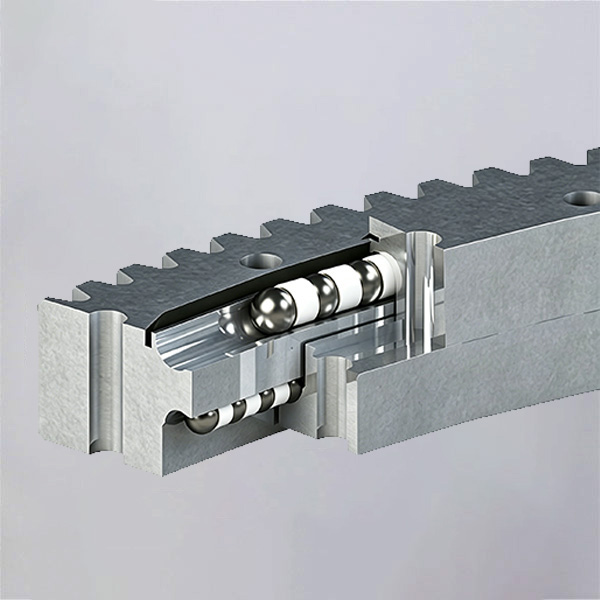
For robot joint designs, see our Bearings for Industrial Robotics page. For compact joints and tight envelopes, Precision Crossed Roller Bearings are the usual starting point.
Inventory and Lead Time as Cost Items
Long lead times turn into inventory cost. If a Tier-1 brand quotes 4 to 8 months, as the OEM buyers we speak with often report, you hold more spares to cover the gap. Those spares cost money to buy and store, and they sit idle if the design changes.
BY Bearings supports flexible MOQ and OEM customization for special dimensions and mounting holes. Our 13,500 m² intelligent factory, with a CNC workshop and automated heat treatment line, runs at 15,000 sets monthly capacity. Delivery time depends on the product and the order, so ask for a written lead time on your specific part rather than assuming a number. A shorter confirmed lead time lets you reduce the spare count in your formula.
Two real examples show where this matters. We supplied crossed roller bearings for semiconductor equipment in Germany, where low vibration and positioning stability drive the cost, not the piece price. For a customer in Mexico, we supplied P2 rotary table bearings for gear grinding, where precision grade was the requirement. These are individual projects, not a promise that every order performs identically, but they show the kind of applications the formula is built for. We also exported BBH crossed roller bearings in bulk to Germany, a volume order where holding cost matters.
Common Mistakes When Comparing Suppliers
Comparing quotes with different precision grades. A P5 bearing and a P4 bearing are not the same product. Compare like for like.
Leaving downtime at zero. This is the most frequent error. Ask finance for the hourly cost of the stopped line, even as a rough range.
Using the datasheet life as a promise. Catalog life assumes ideal conditions. Your preload, shaft fit and contamination will change it.
Ignoring the swap itself. Some positions need machine disassembly. A cheap bearing in a hard-to-reach joint is rarely cheap.
Treating warranty as a cost guarantee. A 12-month warranty from shipment covers defects under agreed conditions. It does not pay for your downtime.
Buyer's Checklist Before You Choose a Supplier
List every bearing position and mark which ones stop the line when they fail.
Get the stopped-hour cost from finance and the swap time from maintenance.
Request quotes with precision grade, runout limit and preload stated.
Ask for inspection records. At BY Bearings, our Quality Control process under an ISO 9001 system includes 100% inspection before shipment, and products carry CE and RoHS certification.
Confirm interchangeability with the part you use today, and whether custom dimensions are needed.
Get written lead time and MOQ, then set your spare count from that.
Run the five year formula for two or three suppliers and a sensitivity check: what if life is 30% shorter?
Order a sample or small batch and test torque and runout in your own assembly before volume commitment.
If your machine is a CNC table, our Rotary Table Bearings range covers high tilting stiffness under combined loads. The same method applies there: price the failure, not just the part.
Send us your drawing, load conditions and current bearing part number, and we will help you run this comparison for your application. You can get a quote from our engineering team, with a written lead time for your part.
 +8618939019135
 sales@bybearings.com
 +8618939019135