Bearings for Industrial Automation in Washdown Lines
Which seal should protect a bearing when a packaging or filling line is exposed to water, cleaning chemicals, residue, and repeated sanitation cycles? The answer is rarely “the most sealed option.” Equipment designers need to define what reaches the bearing, how often it happens, and whether the bearing location can be cleaned, inspected, and relubricated.
Bearings for Industrial Automation are often selected first for load, speed, and mounting space. In wet process equipment, seal selection deserves the same attention. A suitable rolling element bearing can still suffer early damage if liquid enters through the seal lip, cleaning fluid attacks lubricant, or trapped contamination dries into an abrasive deposit.
BY Bearings supports precision bearing design and OEM customization for machinery builders. Our product range includes crossed roller bearings, harmonic drive bearings, crossed tapered roller bearings, rotary table bearings, slew bearings, thin section bearings, spherical roller bearings, cylindrical roller bearings, and thrust bearings. For system level application context, review our Bearings for Automation Industry solutions.
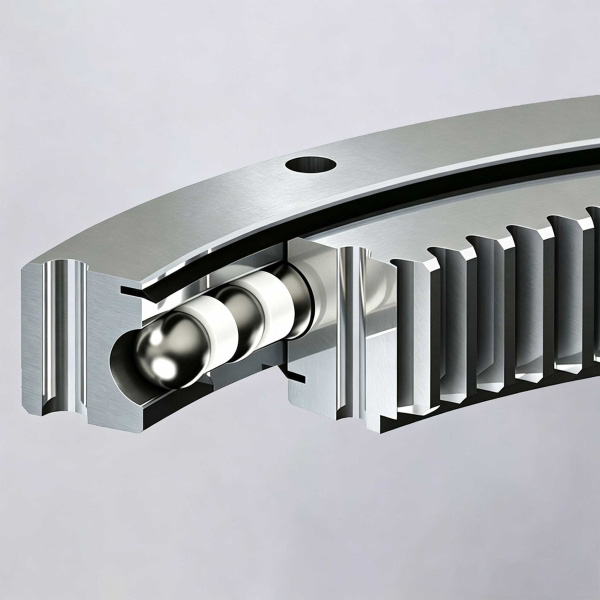
Start with the exposure map instead of the bearing catalog
The first useful decision is to separate bearing duty from exposure duty. A bearing beside a conveyor drive, a bearing inside a guarded rotary indexing unit, and a bearing near an open filling nozzle may carry similar loads but face very different contamination paths.
Conclusion: specify the washdown environment before selecting a seal style. Reason: seal performance depends on the direction, duration, chemistry, and frequency of exposure, not merely on the label “washdown.” Best fit: early design stages, supplier qualification, and redesigns after moisture related bearing failures. Limit: an exposure map does not replace bearing load and speed calculations.
Record these conditions for every bearing position
Water path: Identify whether water is airborne mist, runoff, direct spray, pooling liquid, or intermittent splashing.
Spray direction: Confirm whether the spray is aimed toward the shaft entry, seal face, housing split, or mounting bolt pattern.
Cleaning chemistry: List each detergent, sanitizer, rinse additive, and concentration used by the plant. The seal material and lubricant must be reviewed against the actual chemical list.
Cleaning cycle: State how frequently cleaning occurs and how long liquid remains before drying.
Contamination type: Separate fine powder, sugar dust, pulp, grease, metal particles, carton fibers, and process liquid. These contaminants enter and behave differently.
Access condition: Identify whether operators can inspect the seal, clear drainage paths, or replace a damaged unit without removing adjacent equipment.
For bearings for filling lines, the most relevant question is often not the nominal bearing load. It is whether overflowing product or cleaning runoff can collect around the rotating shaft. If liquid can stand at the seal interface, a conventional contact seal may be exposed for far longer than the designer expects.
A useful distinction is between observed operating facts and interpretation. The observed facts are spray direction, chemical list, residue, cleaning frequency, and bearing location. The interpretation is whether a particular seal can tolerate those conditions. That interpretation should be confirmed by the bearing supplier with the seal material, lubricant, enclosure, and shaft arrangement under review.
Boundary analysis for standard seals under chemicals pressure and contamination
Standard seals can work well in protected automation assemblies. They become less suitable when exposure exceeds the conditions they were intended to manage. The boundary is not one universal pressure value or cleaning interval. It is the point where the combined exposure creates a credible route for fluid or debris to bypass the seal, degrade lubricant, or damage the sealing lip.
| Exposure condition | What a standard seal may manage | Boundary where risk rises | Buyer response |
|---|---|---|---|
| Occasional splash | Short contact where spray is not directed at the shaft entry | Repeated liquid pooling around the seal or liquid retained behind guards | Improve drainage and specify the seal orientation with the housing design |
| Direct washdown spray | Indirect spray with a protective cover and controlled water path | Spray aimed at the seal lip, shaft interface, or housing joint | Add shielding, revise the mounting arrangement, and request seal suitability review |
| Cleaning chemicals | Known chemical exposure reviewed for seal and lubricant compatibility | Unspecified detergent changes, strong sanitizers, or residues left after cleaning | Provide the exact chemical data and confirm compatible materials before release |
| Fine dry contamination | Low volume dust outside the primary seal contact area | Powder or fibers accumulate at the seal and mix with moisture into paste | Use external exclusion features and define a cleaning method for deposits |
| Product residue | Contained process material separated from the bearing enclosure | Sticky residue reaches the shaft, hardens, or creates a liquid bridge | Review enclosure geometry, drainage, shaft finish, and cleaning access together |
Conclusion: a standard seal should not be treated as the complete washdown protection system. Reason: water and contamination often enter through the surrounding assembly rather than through the seal alone. Best fit: guarded mechanisms with controlled drainage and indirect exposure. Limit: this approach does not suit an exposed bearing position receiving direct spray or persistent chemical residue.
The phrase which bearing seal suits washdown equipment should therefore lead to a broader design question: can the housing, shaft, cover, and drainage route prevent concentrated exposure at the seal? If the answer is no, selecting a different seal without changing the surrounding geometry may only shift the failure point.
Match seal protection to the machine function and bearing arrangement
Packaging equipment contains several bearing environments. A conveyor roller, rotary table, robot wrist, labeler, and carton handling mechanism do not require the same architecture. Selection should start with the motion type, load direction, required accuracy, and exposure category.
| Machine area | Primary bearing concern | Protection focus | Selection limit |
|---|---|---|---|
| Conveyor and transfer modules | Frequent rotation and external residue | Prevent ingress at shaft ends and avoid trapped runoff | Do not assume a sealed unit corrects poor drainage |
| Rotary filling equipment | Combined radial axial and moment loads | Protect the bearing enclosure from product splash and cleaning liquid | Seal selection must be coordinated with table stiffness and runout needs |
| Robotic handling joints | Positioning accuracy and compact installation | Keep moisture away from joint interfaces and internal lubricant | External sealing cannot compensate for unsuitable preload or mounting accuracy |
| Indexing and inspection stations | Stable low speed movement and repeat positioning | Exclude dust, mist, and cleaning residue while retaining smooth rotation | Higher sealing contact may affect friction torque and drive sizing |
For a rotary filling or indexing station, BRTM Series Rotary Table Bearings can be assessed where the design calls for a rotary table bearing arrangement. The decision should include loading, required rotation accuracy, mounting surface quality, and the external protection design. Do not select a precision rotary bearing solely because it has a compact profile.
For compact robot axes or automated handling devices, Precision Crossed Roller Bearings may be considered where high rigidity and compact integration are required. In a washdown zone, however, the designer still needs an enclosure strategy. Precision motion capability and environmental sealing are connected, but they are not the same requirement.
Sealed bearings for packaging machines should be evaluated as an assembly decision. Ask for the bearing drawing, shaft details, housing details, cleaning media, temperature range, lubrication expectation, and required service interval. A supplier cannot responsibly judge seal suitability from bore diameter alone.

Specify food contact and hygiene requirements without assumptions
The term food grade bearing seals is frequently used in equipment discussions, but it should not be treated as a complete specification. Buyers need to clarify whether the requirement concerns seal material, lubricant, accidental contact risk, cleanability, product zone location, or customer documentation.
Conclusion: describe the hygiene requirement in operational terms rather than using a broad label alone. Reason: a material request, a lubricant request, and a cleanability request are separate engineering questions. Best fit: food and beverage equipment, pharmaceutical adjacent packaging, and equipment supplied across several customer sites. Limit: this does not establish regulatory approval; the machine builder remains responsible for confirming the applicable requirement for the final equipment and market.
Questions to include in the bearing specification
Is the bearing located inside, adjacent to, or outside the product zone?
Can cleaning fluid contact the bearing directly, indirectly, or only through runoff?
Does the customer require named seal material or lubricant documentation?
Will the bearing be exposed to acidic, alkaline, oxidizing, or unknown cleaning agents?
Must the assembly be opened for inspection, or is it intended to remain enclosed?
Could grease leakage, seal wear particles, or retained liquid affect the product area?
These questions also prevent an alternative explanation from being missed. If a bearing shows corrosion, noise, or rough running after washdown, the cause may be direct seal exposure. It may also be a damaged housing joint, a missing drain path, incorrect installation, unsuitable lubrication, shaft surface damage, or contamination introduced during maintenance. Inspection should examine the full assembly before assigning the cause to the seal.
Use a release checklist before approving washdown automation bearings
A short release process reduces late changes during machine commissioning. The checklist below is intended for early component specification and should be completed jointly by the equipment designer, sanitation team, maintenance lead, and bearing supplier.
Classify the bearing location. Mark it as dry, splash exposed, direct spray exposed, chemical exposed, or residue exposed. Select the highest realistic exposure condition.
Document the cleaning process. Supply cleaning chemical names, concentrations, application method, rinse method, and cycle frequency. Do not use “standard washdown” as the only description.
Review liquid escape routes. Check whether water can pool at the shaft, behind covers, around fasteners, or inside the bearing housing.
Confirm the motion requirement. Define radial load, axial load, moment load, rotational speed, accuracy need, and allowable friction torque.
Choose the bearing family. Match the mechanical duty to the bearing arrangement before choosing seal details. Rotary tables, thin section designs, and crossed roller designs have different mounting and load characteristics.
Review the seal and enclosure together. Confirm the seal material request, lubricant requirement, protective cover, shaft interface, and housing joint.
Set inspection evidence. Define what should be checked after cleaning cycles, including seal condition, lubricant appearance, corrosion signs, torque change, and contamination deposits.
Approve a sample or drawing. Use the actual machine arrangement wherever possible. A catalog image cannot show an adverse water path.
BY Bearings has more than 15 years of precision bearing manufacturing experience and supports OEM and ODM customization. Our ISO 9001 quality system includes 100% inspection before shipment. For precision bearing applications, grinding accuracy can reach P2 class and runout is controlled within 1.5 μm. These controls are relevant when washdown equipment also requires stable rotary accuracy, but they do not replace machine level validation of the seal arrangement.
As an example of where accuracy and application requirements must be considered together, BY Bearings supplied P2 rotary table bearings for gear grinding equipment in Mexico. That customer case concerns a precision machining application, not a washdown packaging line. It supports the company’s experience with precision rotary bearing requirements, while it should not be interpreted as evidence of washdown performance.
Know when the seal decision needs further evidence
Not every washdown decision can be finalized from drawings. Further evidence is needed when the chemical formula is unknown, the spray direction changes during sanitation, a bearing is close to an open product area, or the required maintenance interval is uncertain.
Conclusion: pause final approval when any exposure condition is assumed rather than documented. Reason: uncertainty about chemistry or water path can invalidate an otherwise reasonable seal selection. Best fit: new filling lines, export equipment, customized OEM machines, and installations with customer controlled sanitation processes. Limit: additional review adds engineering time, so it should focus on locations with direct exposure or costly access constraints.
Signals that justify revising the original selection include recurring moisture behind guards, visible deposits at seal interfaces, changes in cleaning chemicals, unexpected friction increase, corrosion around the shaft entry, or a maintenance team that cannot inspect the bearing location. These are evidence to investigate, not automatic proof that one bearing style is defective.
For broader machine arrangements involving turntables or combined loads, review our Bearings for Turn Mill Center application guidance and compare the required load path with the actual packaging machine design. The core rule remains simple: select the bearing for its mechanical task, then design the seal, housing, drainage, and maintenance plan around the real washdown boundary.
Send your bearing drawing, washdown process details, and required operating conditions to get a quote or request seal selection advice from BY Bearings.
 +8618939019135
 sales@bybearings.com
 +8618939019135