Crossed Roller Bearing Accuracy Grades: P5, P4, and P2 Explained
Selecting a crossed roller bearing for precision machinery involves more than checking dimensions and load capacity. Crossed roller bearing accuracy can influence rotational runout, positioning performance, assembly consistency, and the overall precision of the equipment.
Accuracy grades such as P5, P4, and P2 are used to define increasingly tighter bearing tolerances. However, a higher accuracy grade is not automatically the right choice for every application. The appropriate grade depends on the required machine accuracy, mounting structure, operating conditions, and application requirements.
This guide explains crossed roller bearing accuracy grades, the differences between P5, P4, and P2, the tolerances that affect bearing precision, and what engineers and purchasing teams should consider when selecting and ordering a precision crossed roller bearing.
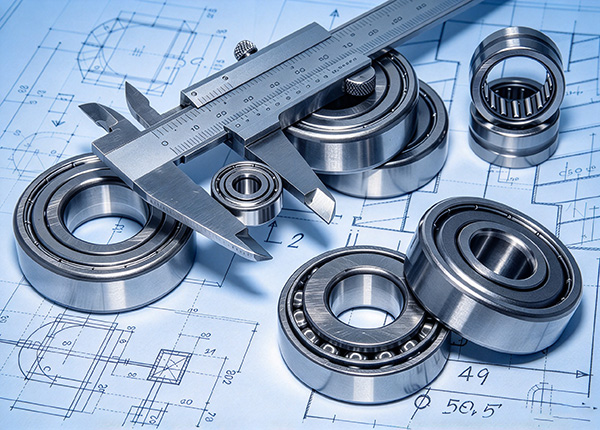
What Does Bearing Accuracy Grade Mean?
A bearing accuracy grade defines the level of dimensional and geometrical precision to which a bearing is manufactured.
Rolling bearings are manufactured within specified tolerances rather than to perfectly exact nominal dimensions. These tolerances control the allowable variation in important dimensions and geometrical characteristics.
For crossed roller bearings, accuracy can involve bore and outside diameter tolerances, ring geometry, width-related tolerances, and rotational runout.
These characteristics become particularly important when the bearing is used as part of a precision rotating or positioning system.
For example, a bearing used in general industrial equipment may allow more dimensional or rotational variation than one installed in a CNC rotary table, precision measuring system, or high-accuracy positioning mechanism.
Accuracy grade therefore provides engineers with a standardized way to communicate the required manufacturing precision.
However, accuracy grade should not be treated as a complete description of bearing performance. Preload, internal geometry, rigidity, lubrication, mounting accuracy, and operating conditions can also influence how the bearing performs after installation.
For this reason, bearing accuracy should always be evaluated as part of the complete mechanical system.
What Do P5, P4, and P2 Mean for Crossed Roller Bearings?
P5, P4, and P2 are commonly recognized bearing tolerance classes used to indicate progressively tighter manufacturing accuracy.
The basic relationship can be understood as follows:
| Accuracy Grade | Relative Precision | General Application Direction |
|---|---|---|
| P5 | High precision | Precision industrial equipment requiring controlled rotational accuracy |
| P4 | Higher precision | Machine tools, robotics, precision rotary systems, and demanding positioning equipment |
| P2 | Very high precision | Applications requiring extremely tight dimensional and rotational control |
From P5 to P4 and P2, the permissible deviations for relevant bearing characteristics generally become tighter.
This does not mean that P2 should automatically be selected whenever high precision is required.
Higher accuracy requires tighter control during machining, grinding, assembly, and inspection. The surrounding shaft, housing, mounting surfaces, and assembly process must also be capable of supporting the required level of precision.
For example, installing a P2 bearing on mounting surfaces with insufficient flatness or geometrical accuracy may prevent the complete assembly from achieving the expected rotational performance.
It is also important to understand that a P5, P4, or P2 designation should not be converted into one universal tolerance value for every crossed roller bearing.
The applicable tolerance values can depend on factors such as bearing dimensions, bearing design, the characteristic being measured, and the technical standard or manufacturer specification being applied.
Therefore, when a project requires a particular accuracy grade, the bearing drawing and specific dimensional or runout requirements should also be confirmed.
Which Bearing Tolerances Affect Crossed Roller Bearing Accuracy?
Crossed roller bearing accuracy is determined by multiple dimensional and geometrical characteristics rather than a single measurement.
Understanding these characteristics helps engineers communicate more precise technical requirements when selecting or ordering a bearing.
Dimensional Tolerances
Dimensional tolerances control allowable deviations in important bearing dimensions.
Depending on the bearing design and applicable specification, these may include:
• bore diameter;
• outside diameter;
• bearing width;
• ring width;
• other specified boundary dimensions.
These dimensions determine how the bearing interfaces with the shaft, housing, flange, and surrounding machine components.
For precision equipment, dimensional variation can influence fits and assembly conditions. This is one reason why matching only the nominal inner diameter, outer diameter, and width may not be sufficient when selecting a replacement bearing.
Radial Runout
Radial runout describes radial variation observed as a bearing ring rotates relative to a defined reference.
In high-precision rotating systems, excessive radial runout can contribute to unwanted movement of the supported component.
This can affect machining, inspection, positioning, and other operations where the rotational axis must remain stable.
The allowable radial runout should therefore be evaluated according to the accuracy requirements of the complete machine rather than considered only as an isolated bearing value.
Axial Runout
Axial runout describes variation in the axial direction during rotation.
For rotary tables and precision positioning equipment, axial runout can affect the stability and repeatability of the rotating surface.
Even when the bearing itself is manufactured to a high accuracy level, final system runout can also be influenced by mounting surfaces, shaft and housing accuracy, fastening methods, and assembly procedures.
Engineers working with high-accuracy rotary systems should therefore also consider runout and deflection in precision crossed roller bearings when evaluating the final positioning performance of the assembly.
Ring and Raceway Accuracy
Ring and raceway geometry are also important to precision bearing operation.
In a crossed roller bearing, cylindrical rollers are arranged alternately at approximately 90 degrees to each other. This configuration allows one bearing to support radial, axial, and moment loads within a compact structure.
Accurate raceway geometry helps maintain consistent roller contact and stable rotational behavior.
For a precision crossed roller bearing, machining, grinding, component matching, assembly, and inspection therefore all contribute to the accuracy of the finished bearing.
How Does Accuracy Grade Affect Crossed Roller Bearing Performance?
Bearing accuracy becomes increasingly important when small rotational deviations can influence machine performance.
One of the most direct effects is rotational accuracy.
If radial or axial runout occurs during rotation, that movement can be transferred to the component supported by the bearing. Depending on the application, this may affect machining accuracy, measurement results, positioning performance, or motion consistency.
Another consideration is positioning repeatability.
Industrial robots, indexing systems, machine tools, and precision automation equipment frequently move between controlled positions. Bearing-related rotational variation is only one contributor to total system error, but its importance increases as the required positioning accuracy becomes tighter.
Accuracy also affects assembly consistency.
Tighter dimensional control can help engineers maintain more predictable relationships between the bearing, shaft, housing, and mounting components. However, the surrounding components must also be manufactured and assembled to appropriate tolerances.
It is equally important to understand what accuracy grade does not determine by itself.
A higher accuracy grade does not automatically provide:
• greater load capacity;
• higher rigidity;
• higher preload;
• lower rotational torque;
• lower friction;
• longer bearing life.
These characteristics depend on other aspects of bearing design and operating conditions.
For example, bearing rigidity is influenced by internal geometry, roller contact, preload, mounting structure, and applied load. Rotational torque may be affected by preload, lubrication, sealing, internal design, and installation.
Accuracy grade should therefore be treated as one part of the overall bearing specification rather than as a universal measure of bearing performance.
How to Choose Between P5, P4, and P2 Crossed Roller Bearings
Choosing between P5, P4, and P2 should begin with the actual performance requirements of the machine.
The objective is not to select the highest possible grade, but to select an accuracy level that supports the required equipment performance.
Start with the Required Machine Accuracy
First determine what the complete machine must achieve.
Relevant requirements may include:
• rotational accuracy;
• radial runout;
• axial runout;
• positioning accuracy;
• repeatability;
• allowable displacement.
The bearing specification should support these system-level requirements.
If the equipment does not require extremely tight rotational accuracy, selecting a higher grade than necessary may increase manufacturing requirements and cost without producing a meaningful improvement in actual machine performance.
Consider the Application
Different applications place different demands on bearing accuracy.
A general automation mechanism may have different requirements from a CNC rotary table, industrial robot joint, optical positioning system, semiconductor machine, or precision measuring device.
However, the equipment category alone should not determine the accuracy grade.
Two machines within the same industry may have significantly different runout, positioning, or repeatability requirements.
Evaluate the Mounting Structure
A high-accuracy bearing cannot compensate for an inaccurate surrounding structure.
Shaft geometry, housing accuracy, mounting-face flatness, perpendicularity, fits, fastening methods, and structural rigidity can all influence installed performance.
This becomes especially important when using P4 or P2 bearings.
If the surrounding components cannot maintain comparable precision, the complete assembly may not achieve the performance expected from the bearing accuracy grade.
Consider Speed and Operating Conditions
The bearing's operating pattern should also be considered.
A crossed roller bearing may operate under:
• continuous rotation;
• intermittent indexing;
• oscillating motion;
• frequent starts and stops;
• repeated reversing motion.
Temperature variation, lubrication, preload, rotational torque, and duty cycle may also influence actual operating behavior.
Accuracy grade should therefore be selected together with these conditions rather than considered independently.
Balance Accuracy with Actual Requirements
Higher precision can be valuable when the machine requires it, but unnecessary accuracy can increase manufacturing complexity and procurement cost.
When the required grade is uncertain, engineers should provide the bearing manufacturer with actual machine requirements rather than simply requesting P2 or P4.
This allows the bearing specification to be evaluated according to the application.
Typical Applications for P5, P4, and P2 Crossed Roller Bearings
Crossed roller bearings are widely used in equipment requiring compact bearing arrangements, combined load capacity, high rigidity, and controlled rotational motion.
The appropriate accuracy grade depends on the actual performance requirements of each machine.
P5 Applications
P5 may be suitable for precision industrial equipment requiring controlled dimensional and rotational accuracy without the need for the tightest available tolerance level.
Potential applications include:
• industrial automation equipment;
• indexing mechanisms;
• precision assembly equipment;
• selected robotic systems;
• general precision rotating mechanisms.
The final selection should still be based on actual runout and positioning requirements.
P4 Applications
P4 is commonly considered for more demanding precision applications.
Depending on the machine design, these may include:
• CNC rotary tables;
• machine tool positioning systems;
• industrial robot joints;
• precision inspection equipment;
• high-accuracy automation systems;
• semiconductor manufacturing equipment.
In these applications, the bearing may contribute directly to rotational or positioning performance, making tighter control of dimensional and geometrical accuracy more important.
For CNC rotary tables and other high-accuracy rotating systems, rotary table bearings may also be considered when combined load capacity, rigidity, and rotational accuracy are key requirements.
P2 Applications
P2 represents a very high level of bearing accuracy and may be considered when extremely tight dimensional and rotational control is required.
Potential applications can include highly demanding measuring, machining, positioning, or specialized precision systems.
However, P2 should not be selected simply because it represents a tighter accuracy grade.
To benefit from a very high-accuracy bearing, the complete mechanical system—including the shaft, housing, mounting surfaces, drive system, structural components, and assembly process—must be capable of supporting the required precision.
The final bearing grade should therefore be based on measurable performance requirements rather than the application name alone.
What Should You Specify When Ordering a Precision Crossed Roller Bearing?
When ordering a high-precision crossed roller bearing, specifying only "P4" or "P2" may not provide enough information for reliable selection.
A technical RFQ should provide enough information for the manufacturer to understand both the bearing specification and the actual application.
Bearing Model or Drawing
For replacement projects, provide the complete existing bearing model and manufacturer information when available.
A technical drawing is even more useful because it allows the supplier to review dimensions, mounting features, hole patterns, and other design requirements.
For a new design, provide the required:
• inner diameter;
• outer diameter;
• bearing width;
• mounting dimensions;
• available installation space.
Required Accuracy Grade
Specify P5, P4, P2, or another required accuracy class if it has already been defined by the machine design.
If the required grade is unknown, provide the actual machine accuracy requirements instead.
This gives the bearing manufacturer a stronger technical basis for evaluating the required bearing precision.
Runout Requirements
If radial or axial runout is critical, specify the allowable values in the drawing or RFQ.
This is particularly important when rotational accuracy directly affects machine performance.
Do not assume that an accuracy grade alone communicates every application-specific inspection requirement.
Applied Loads
Provide the expected radial, axial, and moment loads.
Where possible, distinguish between normal operating loads, maximum loads, static loads, peak loads, and shock loads.
Although accuracy grade does not determine load capacity by itself, load conditions remain essential for selecting the correct bearing size and design.
Preload or Internal Clearance
Accuracy grade and preload are different specifications.
A P4 or P2 bearing does not automatically define the preload required by the machine.
If the design requires a specific preload or internal clearance condition, include it separately in the RFQ.
If the requirement is unknown, provide the required rigidity, operating torque, load conditions, speed, and application information.
Speed and Motion Pattern
Specify normal and maximum rotational speeds together with the actual motion pattern.
For example:
• continuous rotation;
• indexing;
• oscillation;
• repeated reversing;
• intermittent operation.
A maximum speed value alone may not fully describe the bearing's operating conditions.
Mounting and Operating Conditions
Where possible, provide information about:
• shaft and housing design;
• mounting surfaces;
• fits;
• fastening arrangement;
• operating temperature;
• lubrication;
• duty cycle;
• environmental conditions.
These factors can influence the final installed performance of a high-precision bearing.
Application and Required Quantity
Identify the machine or equipment in which the bearing will be installed.
The expected order quantity or annual demand can also help the manufacturer evaluate whether an existing standard bearing is appropriate or whether a customized solution should be considered.
A practical RFQ for a precision crossed roller bearing may therefore include:
bearing model or drawing + dimensions + accuracy grade + radial/axial runout requirements + radial/axial/moment loads + preload or clearance + speed + motion pattern + mounting information + operating conditions + application + required quantity.
Common Mistakes When Selecting a Crossed Roller Bearing Accuracy Grade
One common mistake is assuming that P2 is always better than P4 or P5.
P2 represents tighter precision requirements, but that additional precision only provides value when the machine requires it and the surrounding structure can support it.
Another mistake is confusing accuracy grade with preload or rigidity.
These specifications can all affect the performance of a precision bearing system, but they describe different characteristics. A high-accuracy bearing still requires appropriate preload, mounting conditions, and structural support.
Engineers should also avoid focusing on bearing accuracy while ignoring mounting accuracy.
An inaccurate shaft, housing, flange, or mounting surface can affect the final rotational performance even when the bearing itself meets a demanding accuracy specification.
Another common problem occurs during bearing replacement.
Two bearings may have the same or similar nominal dimensions but differ in accuracy, preload, internal design, mounting configuration, or other technical requirements.
For this reason, replacement projects should not rely only on the inner diameter, outer diameter, and width.
Finally, avoid selecting an accuracy grade without defining the actual performance requirement.
If radial runout, axial runout, positioning repeatability, or another characteristic is critical, include that requirement directly in the technical documentation.
This gives the manufacturer a clearer basis for evaluating whether P5, P4, P2, or another specification is appropriate.
How BY Bearings Supports High-Precision Crossed Roller Bearing Requirements
BY Bearings (Luoyang Boying Bearing Co., Ltd.) manufactures precision bearing solutions for industrial applications.
Its product range includes crossed roller bearings, crossed tapered roller bearings, rotary table bearings, slewing bearings, and other precision bearing products.
For crossed roller bearing projects, BY Bearings can support P5, P4, and P2 precision requirements depending on the bearing design and application requirements.
High-precision bearing manufacturing requires control throughout multiple production stages rather than relying only on final inspection. Machining, heat treatment, grinding, component matching, assembly, and measurement can all influence the dimensional and rotational characteristics of the finished bearing.
For new equipment projects, customers can provide bearing dimensions, technical drawings, load conditions, required accuracy grade, runout requirements, preload requirements, speed, mounting information, and application details.
For replacement projects, providing the original bearing model and drawing together with actual operating requirements can help identify technical differences that may not be visible from nominal dimensions alone.
When an existing standard bearing does not meet the equipment design, dimensions and other technical characteristics can also be evaluated as part of a customized bearing solution.
Most importantly, bearing accuracy should be matched to the complete mechanical system.
A P5, P4, or P2 designation provides useful information about manufacturing precision, but engineers should also consider runout, preload, rigidity, mounting accuracy, load conditions, rotational torque, speed, and operating environment before finalizing the bearing specification.
Need a precision crossed roller bearing for a new design or replacement project?
Send BY Bearings your bearing model or drawing, dimensions, required accuracy grade, runout requirements, load conditions, preload requirements, mounting information, and application details.
Our team can review your technical requirements and help identify a suitable crossed roller bearing solution.
Contact BY Bearings to discuss your application or request a quote.
Conclusion
Crossed roller bearing accuracy is an important consideration in machinery where rotational precision, positioning stability, and controlled runout affect overall equipment performance.
P5, P4, and P2 provide useful accuracy classifications with progressively tighter precision requirements. However, the highest accuracy grade is not automatically the most appropriate choice for every application.
The correct grade depends on the required rotational accuracy, radial and axial runout, positioning performance, mounting structure, operating conditions, and overall machine design.
Bearing accuracy is also only one part of a precision bearing system. Preload, rigidity, internal geometry, mounting accuracy, lubrication, load conditions, and assembly quality can all influence final installed performance.
For purchasing teams, specifying only bearing dimensions and an accuracy grade may therefore be insufficient. A more complete RFQ should include the bearing model or drawing, required accuracy, runout requirements, loads, preload or clearance, speed, mounting conditions, operating environment, and application.
By matching the required crossed roller bearing accuracy to actual machine requirements rather than simply selecting the highest available grade, engineers and purchasing teams can establish clearer technical specifications and make more appropriate bearing selections.
 +8618939019135
 sales@bybearings.com
 +8618939019135