Crossed Roller Bearing Friction Torque: Causes, Measurement, and Selection Considerations
Crossed roller bearings are widely used in precision motion systems where compact dimensions, high rigidity, and accurate rotational movement are essential. From industrial robot joints to precision rotary stages and automated inspection equipment, these bearings must support combined loads while allowing controlled rotation.
However, bearing accuracy and load capacity are not the only factors that determine motion performance. Friction torque also deserves careful attention, particularly in applications involving low-speed movement, frequent starts and stops, small angular displacements, or sensitive servo control.
Excessive friction torque can increase the demand on a drive system, contribute to heat generation, and interfere with smooth motion. Irregular torque can be equally problematic, especially when an application requires consistent movement across a limited angular range.
Understanding crossed roller bearing friction torque helps engineers evaluate bearing behavior, identify possible installation problems, and communicate appropriate performance requirements to suppliers.
In this guide, BY Bearings explains what crossed roller bearing friction torque means, which factors influence it, how it can be measured, and what engineers should specify when selecting precision crossed roller bearings.
What Is Friction Torque in a Crossed Roller Bearing?
Friction torque is the resisting moment that must be overcome to rotate a bearing under defined operating conditions. It arises from several sources, including contact between rolling elements and raceways, internal sliding, lubricant resistance, and friction associated with seals or other bearing components.
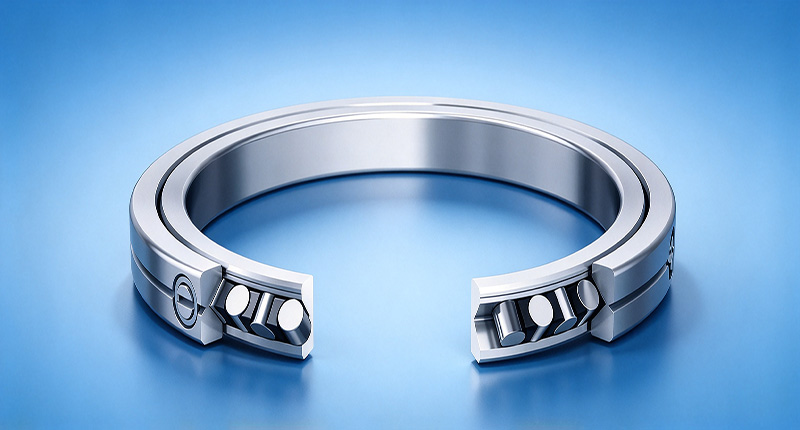
In crossed roller bearings, cylindrical rollers are arranged alternately at right angles to one another. This arrangement enables a single bearing to support radial loads, axial loads, and overturning moments. Its compact structure is particularly useful where installation space is limited and rotational rigidity is important.
Although the rolling elements reduce friction compared with sliding contact arrangements, crossed roller bearings are not friction-free. The resistance to rotation depends on the bearing design and its operating environment.
Friction torque should also be distinguished from the total torque required by a machine's drive system. Motor torque may need to overcome bearing friction as well as external loads, acceleration, transmission losses, and other mechanical resistance.
For this reason, a motor torque measurement alone does not necessarily reveal the friction torque generated by the bearing.
Engineers should evaluate friction torque under clearly defined conditions rather than treating it as a single, universally applicable value.
Why Does Friction Torque Matter in Precision Motion Systems?
Friction torque affects the relationship between the driving force applied to a rotating assembly and the motion that the assembly produces.
In a precision positioning system, relatively small changes in resistance may influence how smoothly the axis starts, moves, reverses direction, or settles at its target position.
Several performance considerations make friction torque particularly relevant.
Servo motor sizing and control: The drive must provide sufficient torque to overcome bearing resistance in addition to the application's working loads. Unexpected friction can reduce the torque margin available for acceleration or disturbance rejection.
Low-speed motion: Precision rotary stages often operate at very low speeds. Variations in resisting torque can contribute to uneven movement, especially when combined with other sources of mechanical friction or control-system limitations.
Positioning repeatability: Friction characteristics may affect reversal behavior and the response of a positioning axis. However, bearing friction alone does not determine positioning accuracy or repeatability.
Temperature control: Friction produces heat during rotation. The resulting temperature rise depends on rotational speed, torque, heat dissipation, and the surrounding assembly.
Energy efficiency: In continuously operating equipment, unnecessary mechanical resistance increases the power required to maintain movement.
These considerations are especially important in robotics, precision machine tools, inspection equipment, and automated production systems.
Nevertheless, the lowest possible friction torque is not always the best design objective. Engineers must also consider rigidity, load support, positioning stability, and the bearing's intended operating conditions.
What Factors Affect Crossed Roller Bearing Friction Torque?
Crossed roller bearing friction torque is influenced by a combination of internal bearing characteristics and external operating conditions. Evaluating these factors together is more useful than examining any single parameter in isolation.
Bearing Preload
Preload is an intentional internal loading condition used in many precision bearing arrangements to control clearance and support rigidity.
Increasing preload generally increases contact forces within the bearing, which can increase friction torque. Excessive preload may produce unnecessary rotational resistance and heat.
However, insufficient preload can also be undesirable where the application requires high rigidity or stable rotational behavior.
Engineers should therefore evaluate crossed roller bearing preload together with friction torque, rigidity, and the intended operating conditions rather than selecting preload solely to minimize resistance.
Applied Loads
Radial loads, axial loads, and overturning moments influence how forces are distributed among the rolling elements.
A change in loading conditions may alter contact forces and friction torque. The relationship is not necessarily linear because bearing geometry, internal load distribution, and mounting conditions also influence the result.
When comparing torque values, engineers should confirm whether the measurements were taken without an external load or under a representative operating load.
Lubrication
Lubrication affects both friction and the protection of rolling contacts.
Grease type, base oil viscosity, consistency, fill quantity, and operating temperature can influence rotational resistance. Excessive grease fill may increase churning resistance, while inadequate lubrication can create conditions that accelerate wear.
Oil lubrication introduces its own considerations, including viscosity, supply method, and operating speed.
A lubricant suitable for a high-speed industrial bearing may not automatically provide the desired behavior in a low-speed precision positioning axis.
Seals and Bearing Construction
Contact seals can contribute additional resisting torque. Their effect may be particularly noticeable in small or low-torque assemblies.
Sealed and open bearing configurations should therefore not be assumed to have identical friction characteristics.
The bearing's internal construction, roller arrangement, and component geometry may also influence torque behavior.
Speed and Temperature
Friction torque can change with rotational speed and temperature because lubrication behavior and internal contact conditions are not constant.
For grease-lubricated bearings, cold-start resistance may differ significantly from resistance after the assembly has reached a stable operating temperature.
A torque specification should therefore identify the relevant speed and temperature conditions.
Mounting Accuracy and Fits
Even a correctly manufactured bearing may exhibit undesirable friction characteristics after installation if the surrounding components distort its rings.
Housing roundness, shaft geometry, mounting-face flatness, fits, and tightening procedures can all influence the installed bearing condition.
This is particularly important for precision crossed roller bearings, where the surrounding structure forms part of the overall rotational system.
Starting Torque vs. Running Torque: What Is the Difference?
Starting torque and running torque describe different aspects of rotational resistance.
Starting torque refers to the torque required to initiate movement from rest under specified conditions. It may be influenced by lubricant behavior, contact conditions, seals, and the duration of the preceding stationary period.
Running torque refers to the resistance encountered while the bearing is already rotating at a defined speed and operating condition.
The two values should not be treated as interchangeable.
For example, a precision rotary axis that remains stationary for extended periods may require more torque to begin moving than it does to continue rotating at a low, steady speed.
Likewise, an assembly that operates smoothly in continuous rotation may behave differently during repeated reversals or small-angle oscillation.
Engineers may also need to distinguish average running torque from peak torque and torque variation throughout a complete revolution.
These differences matter in applications such as robotic joints, optical positioning stages, measuring instruments, and precision indexing systems.
A useful friction torque requirement should therefore specify the operating state being evaluated.
Simply requesting a "low-torque bearing" leaves too much room for interpretation.
How Is Crossed Roller Bearing Friction Torque Measured?
Friction torque can be evaluated using a controlled test arrangement that rotates the bearing or its mounted assembly while measuring the resisting moment.
The appropriate method depends on the bearing size, expected torque range, rotational speed, and required measurement accuracy.
A typical test arrangement may include a controlled drive, a torque sensor, suitable mounting fixtures, and a data acquisition system.
The objective is to measure rotational resistance while minimizing or accounting for contributions from the test equipment.
Define the Test Conditions
Before testing, engineers should establish the conditions under which torque will be measured.
Important parameters include rotational speed, direction of rotation, temperature, lubrication condition, applied load, mounting configuration, and any required running-in procedure.
If these parameters differ, the measured results may not be directly comparable.
For example, the torque of a grease-lubricated bearing measured immediately after a cold start may differ from its torque after repeated rotation.
Measure Starting and Running Torque Separately
Starting torque should be recorded under a defined starting procedure.
Running torque should be measured at the specified rotational speed, with the test procedure identifying whether results are recorded during initial operation or after a stabilization period.
Where the application involves bidirectional motion, testing in both directions may provide useful information.
Evaluate Torque Variation
A single average value may conceal local increases in resistance.
Recording torque against angular position can help identify periodic variation, localized interference, or other irregular behavior.
For applications requiring exceptionally smooth movement, peak torque and torque fluctuation may be as important as average torque.
Interpret the Results Carefully
Measured torque may include resistance from seals, fixtures, couplings, and other parts of the test assembly.
The test method must establish whether the reported value represents the bearing alone or the complete mounted system.
There is no single friction torque limit that applies universally to every crossed roller bearing. Acceptable values depend on the bearing model, operating conditions, and the application's performance requirements.
When purchasing a precision bearing, engineers should request confirmation of the applicable measurement method rather than assuming that torque values from different suppliers were obtained under identical conditions.
What Causes Excessive or Uneven Friction Torque?
Unexpectedly high or irregular friction torque does not automatically mean that the bearing itself is defective.
In many precision assemblies, the source of the problem must be identified by examining the bearing, its mounting structure, and the operating conditions together.
Excessive Preload
An internal preload condition that is too high for the intended application can increase rolling-contact forces and rotational resistance.
Preload may also be affected by mounting fits or ring deformation after installation.
If friction torque rises significantly after assembly, engineers should check whether the installed condition differs from the intended bearing configuration.
Mounting Surface Errors
Poor flatness, insufficient perpendicularity, or distortion of the bearing seat can affect the geometry of the installed rings.
These conditions may produce uneven load distribution and localized resistance during rotation.
Following appropriate installation guidelines for precision crossed roller bearings can help reduce assembly-related problems.
Uneven Bolt Tightening
Incorrect or uneven tightening can introduce deformation into the mounted bearing arrangement.
The correct tightening sequence and torque values depend on the bearing construction and the manufacturer's installation requirements.
Engineers should not assume that applying greater bolt torque will improve bearing rigidity or rotational accuracy.
Lubrication Problems
Unsuitable lubricant, excessive grease quantity, insufficient lubrication, or contamination may contribute to abnormal torque behavior.
A change in friction torque after maintenance should prompt a review of the lubricant type, quantity, and application method.
Contamination or Mechanical Interference
Particles, damaged components, or contact between rotating and stationary parts can create localized torque peaks.
When investigating irregular rotation, engineers should check adjacent mechanical components as well as the bearing.
How to Control Friction Torque
A practical troubleshooting approach begins by comparing the measured condition with the specified operating and test conditions.
Engineers should verify mounting geometry, tightening procedures, lubrication, external loading, and the presence of interference.
Where practical, comparing measurements before and after installation can help determine whether the surrounding assembly contributes to the problem.
Any corrective action should follow the bearing manufacturer's instructions. Changes to preload, fits, or internal components should not be made without evaluating their effects on bearing performance.
How to Specify Friction Torque Requirements When Ordering Crossed Roller Bearings
For equipment manufacturers and technical purchasing teams, friction torque requirements should be communicated as part of the complete bearing specification.
A request for high accuracy or low friction alone may not provide enough information for a supplier to recommend an appropriate bearing.
The following table summarizes the key information engineers should prepare when discussing friction torque requirements with a bearing supplier.
Crossed Roller Bearing Friction Torque Specification Checklist
| Specification Item | Information to Provide | Why It Matters |
|---|---|---|
| Bearing dimensions | Bore diameter, outside diameter, width, bearing series | Establishes the required bearing configuration |
| Load conditions | Radial load, axial load, overturning moment | Helps evaluate operating contact conditions |
| Motion profile | Speed range, rotation direction, continuous or intermittent movement | Defines the relevant torque behavior |
| Preload and rigidity | Required preload condition and rigidity requirements | Helps balance rotational resistance and structural performance |
| Lubrication | Grease or oil type, lubrication method, operating temperature | Influences friction and measurement results |
| Friction torque requirements | Starting torque, running torque, peak torque, or torque variation | Clarifies which performance parameter is critical |
| Test conditions | Speed, temperature, load, mounting arrangement, test procedure | Allows meaningful interpretation of measured torque |
| Inspection documentation | Required test records or agreed acceptance information | Clarifies verification expectations before ordering |
Define Torque Limits Under Realistic Conditions
If friction torque is a critical acceptance parameter, the purchasing specification should identify whether the requirement applies to starting torque, running torque, peak torque, or torque variation.
The measurement speed, temperature, lubrication state, loading condition, and mounting arrangement should also be defined.
If a numerical torque limit is required, it should be established through application analysis, relevant product data, and agreement with the supplier.
For equipment involving frequent starts and stops, engineers should pay particular attention to starting torque and reversal behavior. For continuously rotating equipment, running torque and temperature-related changes may be more relevant.
Discussing Requirements With BY Bearings
BY Bearings manufactures precision bearing products for industrial applications, including crossed roller bearing series used in compact, high-rigidity rotating assemblies.
Engineers evaluating friction torque requirements can review the company's precision bearing solutions and provide detailed operating conditions when requesting product information.
Sharing load conditions, motion profiles, dimensional constraints, and any required torque acceptance criteria helps make technical discussions more specific and productive.
The availability of particular test procedures, torque limits, or customized specifications should be confirmed for the selected product rather than assumed across all bearing series.
Conclusion
Crossed roller bearing friction torque is an important consideration in precision motion systems, particularly where smooth low-speed rotation, frequent starting and stopping, or controlled positioning is required.
Friction torque is influenced by bearing preload, applied loads, lubrication, seals, speed, temperature, and mounting conditions. These factors interact, so torque performance should be evaluated in the context of the complete application.
Engineers should also distinguish starting torque from running torque and ensure that measurements are compared under equivalent test conditions.
When abnormal torque occurs, the investigation should include mounting accuracy, tightening procedures, lubrication, and surrounding mechanical components rather than focusing only on the bearing itself.
For purchasing decisions, the most useful approach is to define the required operating conditions and agree on any critical friction torque acceptance criteria before ordering.
By combining clear specifications with appropriate bearing selection and installation practices, equipment manufacturers can better manage rotational resistance while maintaining the rigidity and precision their applications demand.
Need Help Selecting a Crossed Roller Bearing for Your Application? Friction torque requirements can vary depending on preload, operating speed, lubrication, and mounting conditions. If you are evaluating crossed roller bearings for a precision motion system, contact BY Bearings with your application details. Our team can discuss your bearing requirements and help you identify suitable product options.
 +8618939019135
 sales@bybearings.com
 +8618939019135