Crossed Roller Bearing Preload: What to Specify When Ordering a Precision Bearing
Selecting a crossed roller bearing involves more than matching dimensions and load ratings. Preload is an important specification that can influence bearing rigidity, rotational accuracy, operating torque, and overall performance.
However, the appropriate preload cannot be determined from bearing dimensions alone. It depends on the actual load conditions, accuracy requirements, speed, mounting structure, and operating environment.
This guide explains crossed roller bearing preload and what engineers and purchasing teams should specify when ordering a precision bearing.
What Are Crossed Roller Bearings?
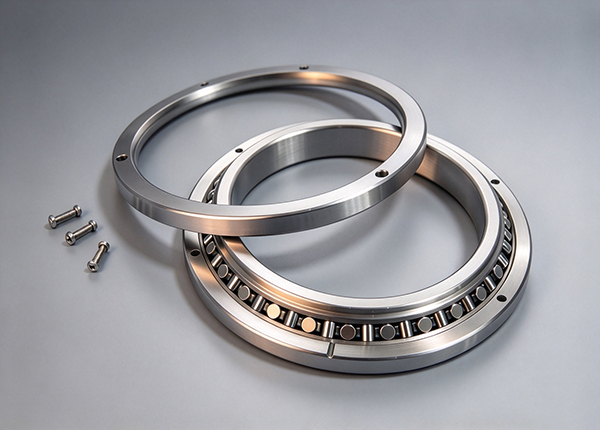
Crossed roller bearings are precision bearings in which cylindrical rollers are arranged alternately at right angles to each other between the inner and outer rings. This crossed arrangement allows a single bearing to support radial loads, axial loads, and moment loads simultaneously.
Because the rollers provide line contact with the raceways, crossed roller bearings can offer high rigidity and load-carrying capability within a compact cross section. Their design is particularly suitable for applications where installation space is limited but precise and stable rotational motion is required.
Typical applications include industrial robots, machine tool rotary tables, precision positioning systems, measuring equipment, semiconductor equipment, and other machinery requiring high rigidity and rotational accuracy.
In these precision applications, internal clearance and preload become important considerations because they can directly influence the installed bearing's rigidity, rotational behavior, and positioning performance.
What Is Preload in a Crossed Roller Bearing?
Preload refers to a controlled internal load applied between the rolling elements and raceways before the bearing carries its external operating load.
Depending on the bearing design and application requirements, the internal condition of a crossed roller bearing may involve positive clearance, near-zero clearance, or preload.
With positive internal clearance, a small amount of relative movement exists between the bearing components before an external load is applied.
With near-zero clearance, internal play is minimized while avoiding excessive initial contact force.
With preload, the rollers maintain controlled contact with the raceways before the external operating load is applied.
Preload is commonly considered when an application requires greater rigidity, reduced internal movement, or improved positioning stability. However, this does not mean that a higher preload is always better.
As preload increases, the internal contact forces between the rollers and raceways also increase. This may increase rotational resistance, friction, and heat generation.
The objective is therefore not to specify the maximum possible preload, but to establish an internal condition that matches the mechanical and operating requirements of the application.
Why Preload Matters When Ordering a Crossed Roller Bearing
Two crossed roller bearings with similar dimensions may operate under very different conditions.
For example, one bearing may be installed in a robotic joint where rigidity and positioning repeatability are critical. Another may be used in precision measuring equipment where smooth motion and low rotational resistance are more important.
The appropriate preload condition may therefore differ even when the bearing dimensions are similar.
Preload can influence several important operating characteristics, including:
• bearing rigidity;
• internal displacement;
• rotational accuracy;
• positioning repeatability;
• rotational torque;
• friction and heat generation;
• vibration behavior;
• load distribution;
• operating life.
An appropriate preload can help reduce unwanted internal movement and improve resistance to deformation under load. This is particularly important when the bearing directly contributes to the positioning accuracy of the machine.
However, excessive preload can increase internal contact forces. The bearing may require more drive torque, generate additional heat, and become more sensitive to mounting errors or thermal expansion. Excessive internal stress may also contribute to accelerated wear under unsuitable operating conditions.
Insufficient preload can create a different problem. If the application requires high rigidity but the bearing has excessive internal movement, the system may experience reduced positioning stability or unwanted displacement as the load changes.
For this reason, simply requesting a "high-preload crossed roller bearing" does not provide enough information for proper bearing selection.
The manufacturer needs to understand the actual application requirements before evaluating an appropriate preload condition.
What Determines the Right Preload for Your Application?
There is no universal preload specification suitable for every crossed roller bearing application.
The appropriate preload depends on the complete mechanical system. Load, rigidity, accuracy, speed, torque, temperature, mounting conditions, and operating cycles should be considered together.
Load Conditions
The magnitude and direction of the applied loads are fundamental factors in bearing selection.
Crossed roller bearings can support combinations of:
• radial load;
• axial load;
• moment load.
The actual combination of these loads affects the contact forces between the rollers and raceways.
Engineers should consider not only normal static loads but also dynamic loads, peak loads, shock loads, load reversals, and changes in load direction during operation.
Providing realistic load data allows the bearing manufacturer to evaluate preload within the context of the actual application rather than based only on the bearing size. For applications involving higher combined loads and demanding moment-load conditions, crossed tapered roller bearings may also be evaluated depending on the required rigidity, accuracy, and machine structure.
Required Rigidity and Accuracy
High rigidity is one of the main reasons crossed roller bearings are selected for precision machinery.
When external forces act on a bearing, elastic deformation occurs within both the bearing and its surrounding structure. In precision positioning systems, even small amounts of displacement can affect machine accuracy.
An appropriate preload can help reduce internal movement and improve rigidity.
However, the required level depends on the machine. A precision measuring instrument may have different requirements from a robotic joint, indexing table, or machine tool rotary table. For CNC rotary tables and other high-accuracy rotating systems, rotary table bearings may also be considered when axial-radial load capacity and positioning rigidity are key requirements.
Where possible, engineers should provide information about required rotational accuracy, positioning repeatability, allowable deflection, and bearing precision.
Rotational Speed and Motion
Crossed roller bearings are commonly used in precision applications with low to moderate rotational speeds, but operating patterns can vary considerably.
The bearing may perform:
• continuous rotation;
• intermittent indexing;
• oscillating motion;
• frequent starts and stops;
• repeated reversing motion.
These different motion patterns affect lubrication, friction, temperature, and internal contact conditions.
A preload condition suitable for a slowly indexing rotary table may not necessarily be suitable for a bearing operating continuously for extended periods.
Operating Torque
Rotational torque is particularly important in precision motion systems.
Increasing preload generally increases the internal contact force between the rollers and raceways. As a result, the torque required to rotate the bearing may also increase.
This can be important in applications using compact servo motors, direct-drive systems, sensitive positioning mechanisms, or other equipment requiring smooth, low-resistance motion.
If the drive system has a specific torque limitation, this requirement should be communicated during bearing selection.
Operating Temperature
Temperature can affect the effective internal condition of a crossed roller bearing.
The bearing rings, rolling elements, shaft, housing, and surrounding components may expand differently as operating temperatures change.
If a bearing already operates with preload, thermal expansion may alter internal contact forces.
For applications with significant temperature variation, the expected operating temperature range should therefore be included in the technical information provided to the bearing manufacturer.
Mounting Conditions
A precision bearing does not operate independently of its surrounding structure.
Housing rigidity, shaft geometry, mounting surface accuracy, fits, fastening methods, and assembly procedures can all influence the final installed condition of the bearing.
For example, deformation of a relatively thin bearing ring during mounting may alter internal contact conditions and affect the effective preload.
The bearing preload should therefore be considered together with the mounting design rather than as an isolated specification. For related applications, understanding rotary table bearing structure and installation can also help engineers evaluate how bearing design and mounting conditions affect system performance.
Duty Cycle
Operating duration and frequency should also be considered.
A bearing used for occasional positioning can experience very different conditions from one that operates continuously throughout a production shift.
When discussing preload requirements, specify whether the equipment operates continuously, intermittently, or in repeated short cycles.
Together, load, rigidity, accuracy, speed, torque, temperature, mounting conditions, and duty cycle provide a much stronger basis for preload selection than bearing dimensions alone.
What Should You Specify When Ordering a Crossed Roller Bearing?
When requesting a precision crossed roller bearing, providing complete technical information helps the manufacturer evaluate the application and determine whether a standard bearing specification is appropriate.
The exact information required varies by project, but the following details are particularly useful.
Bearing Dimensions or Existing Model
For a new design, provide the required:
• inner diameter;
• outer diameter;
• bearing width;
• mounting dimensions;
• available installation space.
For a replacement project, provide the complete existing bearing model whenever possible.
A technical drawing or datasheet is even more useful because bearings with similar dimensions or model designations from different manufacturers may not have identical internal specifications.
Applied Loads
Provide the expected radial, axial, and moment loads.
Where possible, indicate whether these values represent normal operating loads, maximum loads, static loads, or peak loads.
Shock loads, frequent load reversals, or other unusual loading conditions should also be specified.
Preload or Internal Clearance Requirement
If the machine design already specifies a preload class, internal clearance, or related requirement, include this information in the RFQ.
If the required preload is unknown, avoid choosing an arbitrary value.
Instead, provide the bearing manufacturer with the application conditions and required performance so that the internal specification can be evaluated accordingly.
Accuracy Requirements
For precision applications, specify the relevant accuracy requirements whenever available.
These may include:
• rotational accuracy;
• runout requirements;
• positioning accuracy;
• repeatability;
• required bearing precision grade.
Accuracy requirements can affect both bearing selection and manufacturing specifications.
Rigidity Requirements
If the bearing is part of a precision positioning or structural system, provide any known rigidity or allowable deformation requirements.
This information can be particularly useful for machine tools, robotics, inspection systems, and precision positioning equipment.
Speed and Motion Pattern
Specify both normal and maximum rotational speeds and explain how the bearing moves during operation.
For example:
• continuous rotation;
• indexing;
• oscillation;
• repeated reversing;
• intermittent operation.
A maximum speed value alone may not fully describe the actual operating conditions.
Rotational Torque Requirements
If the drive system has a torque limitation or the equipment requires smooth, low-resistance rotation, include the required operating torque information when available.
This can be particularly important when selecting preload for servo-driven and precision motion systems.
Operating Environment
Relevant operating conditions may include:
• operating temperature;
• contamination exposure;
• humidity;
• cleanroom requirements;
• lubrication conditions;
• other unusual environmental factors.
These conditions may influence bearing design, lubrication, sealing, and overall operating performance.
Mounting Information
Where possible, provide information about the shaft, housing, mounting surfaces, fits, and fastening arrangement.
For custom or high-precision applications, an assembly drawing can help the bearing manufacturer understand how the bearing interacts with the surrounding components.
Application and Required Quantity
Identify the machine or equipment in which the bearing will be installed.
Knowing whether the bearing is intended for a robot joint, machine tool rotary table, measuring system, semiconductor machine, or automation platform provides important context that dimensions alone cannot provide.
The expected order quantity or annual demand can also be useful when discussing standard versus customized bearing solutions.
A practical crossed roller bearing RFQ may therefore include:
bearing model or drawing + dimensions + radial/axial/moment loads + preload or clearance requirement + accuracy requirement + rigidity requirement + rotational speed + motion pattern + torque requirement + mounting information + operating temperature + application + required quantity.
Providing this information at the beginning of the project can improve technical communication and help determine whether a standard crossed roller bearing is suitable or whether a customized solution should be considered.
Common Preload Specification Mistakes to Avoid
Many crossed roller bearing selection problems result from incomplete specifications rather than the basic bearing type itself.
One common mistake is ordering only by dimensions.
Matching the inner diameter, outer diameter, and width does not automatically mean that two bearings have the same accuracy, internal clearance, preload, rigidity, or rotational characteristics.
Another mistake is assuming that more preload always means better precision.
Higher preload may improve rigidity under certain conditions, but it can also increase rotational torque, friction, and heat generation. The appropriate preload should match the application rather than simply being maximized.
A third mistake is ignoring the surrounding mounting structure.
Even a precision crossed roller bearing can be affected by inaccurate mounting surfaces, insufficient housing rigidity, improper fits, or deformation during installation. Bearing specifications and mounting design should therefore be evaluated as part of the same mechanical system.
Another common problem occurs during bearing replacement.
Providing only the old bearing model may not always be sufficient, especially when the original bearing has been discontinued, modified, or sourced from another manufacturer.
Where possible, replacement projects should include the original drawing, dimensions, precision requirements, preload or clearance specification, application information, and actual operating conditions.
Engineers and purchasing teams should also avoid focusing only on static load capacity.
Crossed roller bearings used in precision machinery are often selected not only for load-carrying capability but also for rigidity, rotational accuracy, torque, and positioning performance.
Finally, preload should not be specified without considering speed, temperature, lubrication, mounting conditions, and duty cycle.
A bearing specification that performs well under one operating condition may behave differently when these conditions change.
How BY Bearings Supports Crossed Roller Bearing Selection and Customization
Selecting the correct crossed roller bearing involves more than finding a bearing that fits the available installation space. Load conditions, precision requirements, rigidity, rotational behavior, mounting design, and preload should be considered together.
BY Bearings (Luoyang Boying Bearing Co., Ltd.) specializes in precision bearing solutions for industrial applications. With 16 years of manufacturing experience and a 13,500 m² intelligent factory, BY Bearings manufactures crossed roller bearings, crossed tapered roller bearings, rotary table bearings, slewing bearings, and other precision bearing products.
Our manufacturing capabilities include advanced CNC machining, heat-treatment processes, and comprehensive inspection equipment. Under an ISO 9001 quality control system, critical bearing characteristics are controlled throughout the manufacturing process, with 100% inspection performed before shipment.
BY Bearings supports precision bearing requirements covering P5, P4, and P2 grades, serving applications where dimensional accuracy, rotational performance, rigidity, and bearing consistency are important.
For crossed roller bearing projects, customers can provide an existing bearing model, technical drawing, dimensions, load conditions, accuracy requirements, preload requirements, mounting information, and other relevant application data.
Our team can review these requirements to help determine whether an existing bearing solution is appropriate or whether a customized bearing should be considered.
For replacement projects, providing the original bearing information together with actual operating conditions can also help identify important differences in dimensions, precision, internal clearance, preload, or application requirements before a replacement is selected.
BY Bearings supplies bearing solutions to customers in more than 100 countries and supports global OEMs, equipment manufacturers, distributors, and industrial users with standard and customized precision bearing solutions.
Need a crossed roller bearing for a new design or replacement project?
Send BY Bearings your bearing drawing, existing model number, dimensions, load conditions, preload requirements, accuracy requirements, mounting information, and application details. Our team can review your technical requirements and help you identify a suitable crossed roller bearing solution.
Contact BY Bearings to discuss your application or request a quote.
Conclusion
Preload is an important specification when ordering a precision crossed roller bearing, but it should not be considered independently from the complete bearing system.
The appropriate preload depends on actual application requirements, including load direction and magnitude, rigidity, rotational accuracy, speed, operating torque, temperature, mounting conditions, and duty cycle.
For this reason, selecting a crossed roller bearing only by model number or dimensions may overlook important differences in internal specifications and operating performance.
A more reliable approach is to provide the bearing manufacturer with complete application information and clearly identify the performance requirements that matter to the machine.
For engineers and purchasing teams, a well-prepared RFQ containing the bearing model or drawing, dimensions, loads, preload requirements, accuracy requirements, speed, torque, mounting information, operating conditions, and application details can make the selection process more efficient.
By treating preload as part of the complete bearing and machine system rather than as an isolated specification, equipment designers and purchasing teams can make better-informed bearing selections and achieve more consistent precision bearing performance.
 +8618939019135
 sales@bybearings.com
 +8618939019135