DD Motor Bearings: Thermal Growth Limits
How Much Rotor Heat Can a Direct Drive Bearing Absorb Before Preload Goes Wrong?
That is the question behind most thermal reviews we see at prototype stage. A direct drive axis runs with no gearbox to buffer the load, and the rotor sits close to the bearing. Copper loss, eddy current heating and sustained speed all push heat into the same few millimetres of steel and aluminium. DD Motor Bearings are usually specified with a defined preload or near-zero clearance so the axis stays stiff and repeatable. The same preload is what makes them sensitive to temperature.
This article sets out where the limit sits. It does not claim a single universal temperature rise is safe. It shows how to estimate when thermal growth consumes the preload window, what else can mimic the same symptom, and which checks to run before you release a design.
What This Analysis Covers, and What It Does Not
This is an evergreen engineering analysis, not a market report. It rests on three things: basic thermal expansion physics, the way crossed roller and rotary table bearings are built, and the customer applications we support at BY Bearings. It does not rest on a measured industry-wide trend, and a list of target markets or a single project does not prove one.
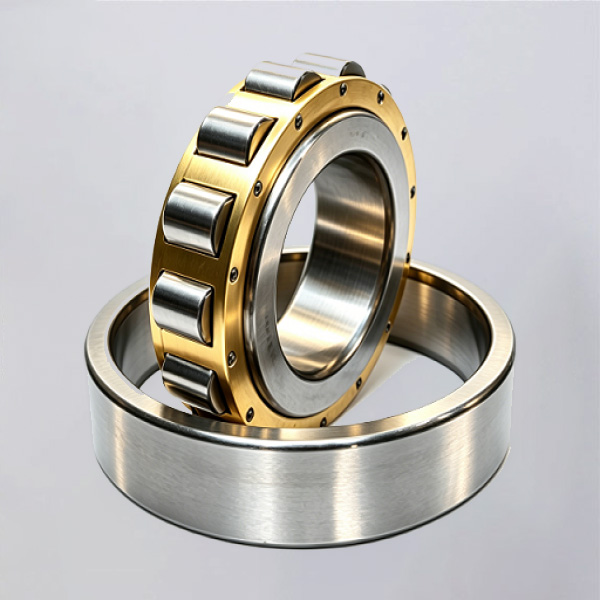
Product scope: single-row crossed roller bearings and integrated rotary table bearings used as the main support in direct drive turntables and rotary axes.
Observed: in customer reviews, a torque rise after warm-up is usually reported before any measurable loss of positioning accuracy.
Interpreted: preload shift from differential growth is one plausible cause, but not the only one (see the alternatives section below).
Not covered: large slewing rings above direct drive motor sizes, and grease-life modelling, which depends on the lubricant supplier's data.
Our own application experience includes Precision Crossed Roller Bearings supplied for semiconductor equipment in Germany, and P2 rotary table bearings for gear grinding in Mexico. Both are precision rotary uses where heat and runout matter. They illustrate the type of duty we are discussing. They are not evidence that any specific thermal limit has been proven across all designs.
Boundary Analysis: When Rotor Thermal Expansion Pushes Preload Past Torque Limits
Preload changes when the inner ring, outer ring, rotor hub and housing grow by different amounts. Steel expands by roughly 11.5 µm per metre per kelvin. Aluminium expands at about twice that rate. Any temperature gap between parts, or any material mismatch, becomes a change in interference at the raceways.
Worked example (first-order screening figures)
Case A, steel on steel: inner ring 10 K hotter than the outer ring, race diameter 150 mm. Diametral difference ≈ 150 mm × 11.5×10⁻⁶ × 10 K ≈ 0.017 mm, or about 17 µm.
Case B, aluminium rotor hub on a steel inner ring: 20 K rise, 150 mm fit diameter. Extra growth of the hub over the ring ≈ 150 mm × 11.5×10⁻⁶ × 20 K ≈ 0.035 mm, or about 35 µm. Whether this loosens or tightens the fit depends on which part is the outer member.
Compare those figures with the preload window on your bearing drawing. If the window is only a few microns wide, even Case A is decisive. If the window is wider, or the bearing is mounted with a controlled clearance, the same growth may be harmless. This is a screening method, not a substitute for FEA or a measured test.
| Zone | Thermal growth vs. preload window | Typical effect | Action |
|---|---|---|---|
| Inside the window | Growth uses a small share of the available preload range | Friction torque rises slightly and stabilises after warm-up | Confirm with a warm-up torque log |
| Consuming margin | Growth uses a large share of the range | Torque drifts with duty cycle; the cold start differs from the hot state | Re-check fits, lubricant and housing material; consider a lower-preload option |
| Beyond the window | Growth exceeds the range, or the fit loses clearance entirely | Torque climbs with temperature, which adds more heat; runout and noise may follow | Redesign the thermal path or the fit before prototype release |
| Loss of preload | The fit opens up as the hub or housing grows away from the ring | Backlash, tilt play, reduced stiffness | Change the mating material or the fit tolerance |
Two limits to keep in mind. First, the table only holds if the temperature gap is measured at the bearing, not at the motor housing; thermocouples on the outside of a casing can understate the rotor-side value. Second, a stiff, thin housing or a tight bolt pattern can change the result in either direction, so treat these zones as a starting point.
Other Causes of Torque Rise That Look Like Thermal Growth
Before blaming preload, rule out the alternatives. Several of them produce the same warm-up torque curve.
Lubricant viscosity and fill: too much grease raises churning losses at speed; a different grade changes the cold-start torque.
Mounting distortion: uneven bolt tightening or a housing face that is not flat deforms the ring and raises torque regardless of temperature.
Seal drag: contact seals add friction that rises as the seal lip heats and swells.
Motor cogging and magnetic pull: an off-centre rotor can load the bearing radially and look like a bearing problem.
Measurement method: torque measured with and without the motor engaged can differ by more than the bearing's own contribution.
The practical consequence: strip the system into stages. Measure the bearing alone with the housing fitted, then with the rotor, then under power. The step where torque jumps tells you which explanation fits.
What This Changes in Your Bearing Specification and Sourcing
Thermal limits turn into purchasing requirements only when they are written down. These are the questions we suggest asking, and the decision each one affects.
What is the preload or clearance class at operating temperature, not just at 20 °C? This decides whether you need a lighter preload grade.
What are the housing and hub materials? A steel bearing in an aluminium seat needs a different fit strategy from an all-steel stack.
What runout and torque is verified before shipment? We hold runout within 1.5 μm and inspect 100% of bearings before shipment, and our Quality Control record lets you compare incoming data with your own warm-up log.
Is a low-friction build available? For direct drive duty we can customise crossed roller bearings with precision-matched rolling elements and suitable lubricants, which helps keep low-speed rotation smooth and thermal behaviour stable.
Does the axis need an integrated unit? BRTM Series Rotary Table Bearings suit axes that carry combined axial, radial and moment loads, and our P4/P2 grinding keeps accuracy where the machine demands it.
The right option depends on load and installation space. In compact joints, thin section bearings may be the better route, while stiff turntables often favour crossed roller or rotary table types.
A Step-by-Step Thermal Check Before Prototype Release
Record the target duty cycle: speed, dwell time and ambient temperature.
Place a sensor on or near the bearing ring on the rotor side, not only on the motor case.
Run a cold torque measurement with the housing fitted and the motor disengaged.
Run the duty cycle until temperature stabilises, logging torque every few minutes.
Compare cold and hot torque. A shift that stabilises suggests margin remains; a shift that keeps climbing points to a closed preload window.
Repeat after a fresh grease fill and re-torqued bolts to separate lubricant and mounting effects.
Check runout when hot against the cold figure.
Some uncertainty will remain. A single prototype cannot show how a production batch with fit tolerance scatter behaves, and a short test cannot show grease ageing. If hot torque is close to your drive's torque limit, treat that as a signal to revisit the fit or preload grade, not a reason to extend the test.
If you are comparing bearing options for a direct drive axis, send us your housing drawing, operating temperature and torque limit. Our engineers will review the preload and fit with you, and you can get a quote or ask for selection advice at BY Bearings.
 +8618939019135
 sales@bybearings.com
 +8618939019135