How Robot Bearings Impact Positioning Repeatability
When an industrial robot's end-effector fails to return to the same programmed point with micron-level consistency, engineers often investigate the drive, the controller, or the structural components. However, a primary source of this positioning error is frequently found within the joints themselves: the bearings. The subtle imperfections in a bearing's rotation are magnified along the length of a robot's arm, directly degrading its repeatability. Understanding how these bearing characteristics contribute to error is the first step in designing a truly precise system. High-performance Bearings for Industrial Automation are not just about load capacity; they are about minimizing rotational error.
For engineers specifying components for robotic systems, the bearing datasheet provides critical clues. Key parameters like radial runout, axial runout, and friction torque variation are not just quality metrics—they are direct inputs into the final accuracy of your machine. At BY Bearings, our work with clients on Bearings for Industrial Robotics has shown that a clear understanding of these factors is essential for meeting demanding positioning targets.
The Three Sources of Bearing Error: Runout, Preload, and Torque Variation
Every bearing introduces some level of rotational error. The goal in precision applications is to minimize these errors by selecting a bearing designed to control them. Three main factors contribute to the loss of repeatability in robot joints: radial runout, axial runout, and torque variation. While related, they cause distinct types of positioning deviation.
Misunderstanding these factors can lead to over-specifying in one area while neglecting another, resulting in a system that is both expensive and inaccurate. For example, focusing solely on a bearing's ABEC/ISO class without considering its frictional characteristics can lead to motion control issues, even if the runout is low.
Here is a breakdown of how each error source manifests and its specific impact on a robot's end-effector:
| Error Source | Physical Manifestation in Bearing | Effect on Robot End-Effector | Best Mitigated By |
|---|---|---|---|
| Radial Runout | Eccentric rotation where the bearing's axis of rotation shifts or "wobbles" as it turns. | Causes a lateral deviation from the programmed path. The end-effector traces a small, unintended arc instead of a straight line or precise point. | High-precision grinding to P4/P2 class, and 100% runout inspection before shipment. |
| Axial Runout | Face wobble or a "camming" effect, where the face of the bearing is not perfectly perpendicular to the axis of rotation. | Induces a tilting or "nodding" deviation. This can alter the end-effector's angle of approach or its height (Z-axis position). | Strict parallelism control on ring faces and precision-matched rolling elements. |
| Torque Variation | Inconsistent rotational resistance (stick-slip or cogging) as the bearing moves. | Leads to positional overshoot and undershoot as the motor control system struggles to compensate. It can also introduce micro-vibrations. | Optimized internal geometry, high-grade lubricants, and precise robot axis bearing preload. |
How Bearing Runout Affects Repeatability: A Deeper Look
Runout is perhaps the most intuitive source of error. It is the total variation in a bearing's desired position as it rotates 360 degrees. Even a microscopic runout of a few microns at a robot's joint can translate into a significant positioning error at the end of the arm.
Imagine a robotic arm bearings system where the main shoulder joint has a radial runout of just 5 micrometers (0.005 mm). If the arm has a reach of 1 meter, this small wobble at the base is magnified. The error at the end-effector becomes a function of the arm's length, meaning longer arms are more sensitive to runout. This is why high-reach collaborative robots and large articulated arms require bearings with exceptional accuracy.
At BY Bearings, our manufacturing processes are designed to address this challenge directly. Our quality control systems, fully compliant with ISO 9001:2015, enable us to achieve grinding accuracy up to P2 class. Critically, we control maximum runout to within 1.5 μm and perform 100% inspection before shipment. This ensures that the industrial robot bearing accuracy specified on paper is the accuracy delivered to your assembly line. For applications demanding high rigidity and minimal runout, our Precision Crossed Roller Bearings provide an effective solution by handling moment loads without deflection.

The Critical Role of Preload in Joint Stiffness and Accuracy
Preload is the internal loading applied to a bearing to eliminate clearance or "play" between the rolling elements and raceways. A correctly preloaded joint is stiff and responsive, with zero backlash. However, managing preload is a delicate balance.
Too Little Preload: The joint will have clearance, causing "slop" or backlash. When the robot changes direction, this clearance must be taken up before movement occurs, making precise positioning impossible.
Too Much Preload: This increases friction, generating excess heat and dramatically shortening the bearing's life. It also leads to higher and more variable running torque, which can cause the drive motor to struggle for control.
For robotics customers facing issues with joint backlash and vibration, we often recommend solutions with optimized negative clearance (preload) built-in. Our ultra-thin, high-rigidity crossed roller bearings are designed specifically for these scenarios, delivering the micro-radian positioning stability needed for smooth, repeatable motion. Applying the correct preload is not just an assembly step; it is a fundamental design consideration for achieving high performance.
Common Mistakes in Bearing Preload for Robotic Joints
Achieving the ideal preload requires careful attention to detail. Here are some common errors that can compromise joint performance:
Ignoring Thermal Expansion: As a joint heats up during operation, the shaft and housing can expand at different rates, altering the preload. This must be calculated and accounted for in the initial design.
Using Standard Clearance Bearings: Bearings with standard radial clearance (like C0) are unsuitable for precision robot joints. A preloaded or specific clearance class is necessary.
Uneven Torquing of Mounting Bolts: For bearings mounted with bolts, an uneven torque sequence can distort the bearing rings, leading to tight spots and inconsistent preload.
Mismatched Housing and Shaft Tolerances: If the shaft is oversized or the housing is undersized, simply installing the bearing can induce an excessive and uncontrolled amount of preload.
Selecting the Right Bearing for Your Automation Application
The ideal bearing solution depends entirely on the specific joint's requirements, including the loads, speed, size constraints, and required accuracy. There is no single "best" bearing for all automation tasks. For example, the bearing needed for a high-speed SCARA robot's wrist is very different from the one required for a heavy-duty rotary table.
We work with OEM clients to solve a range of application-specific challenges. A German customer uses our crossed roller bearings for sensitive semiconductor equipment where low vibration and clean operation are essential. In another case, we provided P2 precision Rotary Table Bearings to a client in Mexico for gear grinding machines, where extreme accuracy under heavy load is the primary goal.
This table outlines common scenarios and recommended bearing types:
| Application Scenario | Primary Challenge | Recommended Bearing Type | Why It Works |
|---|---|---|---|
| Compact 6-Axis Robot Joints | High rigidity, moment load capacity, and a compact footprint. | Thin Section Bearings or Crossed Roller Bearings | Both offer high load capacity in a minimal cross-section, handling combined radial, axial, and moment loads effectively. |
| Harmonic Drive Reducer Output | Extreme torsional stiffness, zero backlash, and high positioning accuracy. | Harmonic Drive Bearings | These are specialized crossed roller bearings integrated with flanges, preloaded for maximum stiffness required by precision gear reducers. |
| CNC Rotary Tables & Turn-Mill Centers | Heavy overturning moments and dynamic multi-axis cutting forces. | BRT/YRT Series Rotary Table Bearings | Designed with high axial and radial roller counts and preload for exceptional tilting stiffness and P4/P2 runout control. |
| Semiconductor Wafer Handlers | Ultra-low vibration, smooth rotation, and cleanroom compatibility. | Custom Low-Friction Crossed Roller Bearings | Precision-matched rollers, special lubricants, and 100% torque inspection ensure quiet, stable performance. |
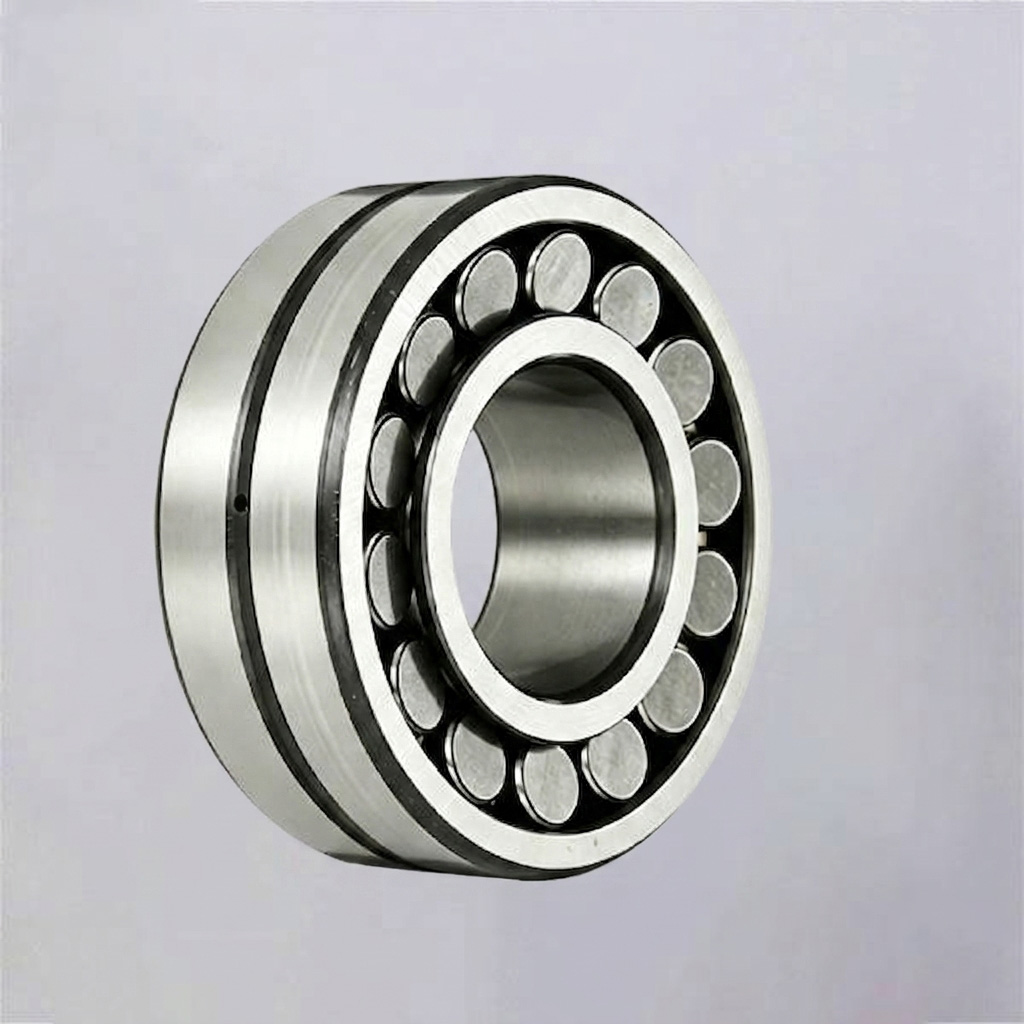
Manufacturing Excellence That Guarantees Performance
The specifications on a datasheet are only meaningful if they are backed by rigorous manufacturing and quality control. The difference between a standard bearing and a precision bearing lies in the process. It starts with the raw materials and continues through every stage of production.
We build reliability into our products from the very beginning. We utilize premium GCr15 (SAE 52100) bearing steel, which is verified through spectrographic analysis to ensure its chemical purity and integrity. After our automated heat treatment process, we conduct metallographic examinations. This step confirms the steel has achieved the optimal hardness (HRC 60-64) and a stable martensitic microstructure, which are essential for long-term durability and load-carrying capacity.
Ultimately, these process controls enable us to produce bearings that solve real-world problems for our OEM clients, who often face bottlenecks with 4–8 month lead times from other brands. Our ability to offer full dimensional interchangeability, support OEM customization, and provide rapid turnaround makes us a reliable partner in demanding supply chains.
Selecting the right robot joint bearings is a critical engineering decision that directly influences the performance and reliability of your automation system. By focusing on the key metrics of runout, preload, and torque consistency, you can effectively mitigate positioning errors at their source.
If you are designing a robotic system and need to ensure maximum repeatability, our engineers can help you select or customize the right bearing for your application. Submit your drawings or get a quote to discuss your requirements with our team.
 +8618939019135
 sales@bybearings.com
 +8618939019135