How to Choose a Bearing Supplier for Automation Equipment
Selecting the wrong bearing supplier can lead to catastrophic failures in your automation systems. A bearing that fails prematurely causes line-down situations, missed production targets, and costly emergency repairs. The sourcing decision goes far beyond a price comparison on a datasheet. It's about finding a partner whose manufacturing precision, quality systems, and supply chain reliability match the demands of your equipment. Choosing an unqualified or inconsistent provider introduces unacceptable risk to your operations and reputation. This guide outlines the critical factors to evaluate when choosing a bearing supplier for automation equipment, ensuring your choice supports performance and reliability, rather than undermining it.
Beyond the Datasheet: Key Technical Capabilities to Verify
A bearing's performance is determined long before it's installed. The supplier's control over materials, heat treatment, and precision grinding directly impacts the final product's rigidity, accuracy, and service life. When you evaluate a potential partner, look for evidence of deep manufacturing expertise.
Material Purity and Composition: High-performance bearings start with clean, high-grade steel. We insist on using premium GCr15 (SAE 52100) bearing steel for our products. A serious supplier must be able to prove material integrity. Ask for spectrographic analysis reports that verify the chemical composition and purity of their raw materials. This step prevents contaminants that can lead to premature wear and fatigue failure.
Heat Treatment and Microstructure: The heat treatment process is arguably the most important factor in a bearing's load capacity and durability. After treatment, a metallographic examination is essential to confirm the steel has achieved an optimal, stable martensitic structure. The target hardness should be within a tight range, such as HRC 60-64, to balance toughness with wear resistance.
Precision Grinding and Runout Control: In automation, accuracy is everything. The supplier's grinding capabilities determine the bearing's precision grade (P5, P4, P2). For demanding applications like CNC spindles or semiconductor wafer handlers, runout must be minimized. At BY Bearings, we implement 100% pre-shipment inspection to ensure runout is controlled within an exacting 1.5 μm, a specification that guarantees superior rotational accuracy.
Verified Quality Management Systems: A supplier's claims of quality are meaningless without independent verification. Look for full compliance with internationally recognized standards. Our facilities operate under a strict ISO 9001:2015 certified quality system, providing a framework for every process from raw material intake to final inspection and packaging.
Common Mistakes When Sourcing Industrial Automation Bearings
Experienced procurement managers and engineers learn to avoid common pitfalls that can derail a project. Sourcing bearings is not just about finding a part that fits; it's about securing a reliable component for the design life of your machine. Here are frequent errors to avoid.
Focusing Solely on Unit Price: The lowest-priced bearing is often the most expensive in the long run. A component that fails early forces unscheduled downtime, requires replacement labor, and can damage more expensive parts of the machine. The total cost of ownership (TCO) should be the primary financial metric, not the initial purchase price.
Ignoring Application Engineering Support: A supplier who simply sells parts is not a partner. A true automation bearing supplier should have an engineering team that understands your application's unique loads—whether it's the combined radial, axial, and moment loads on a turn-mill center or the need for negative clearance in a robotic joint. Without this support, you risk mis-specifying a bearing that is not optimized for your system's dynamics.
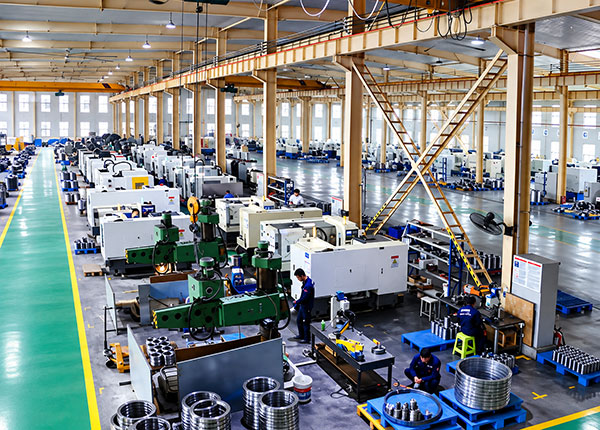
Overlooking Lead Time and MOQ Flexibility: Supply chain disruptions are a major threat. Many Tier-1 brands like THK or IKO quote lead times of 4 to 8 months, creating significant production bottlenecks. A flexible supplier can offer a critical advantage. We have structured our 13,500 m² intelligent factory to provide full dimensional and functional interchangeability with major brands, but with a rapid 3-6 week turnaround and no MOQ, helping our OEM clients avoid costly delays.
Neglecting Material and Production Traceability: If a batch of bearings shows a defect, how do you contain the problem? Without full traceability, it's impossible. A qualified supplier must be able to trace any single bearing back to its specific batch of GCr15 steel, its heat treatment cycle, and its final grinding and inspection reports. This is a non-negotiable part of a professional Quality Control system.
How to Vet a Bearing Supplier: A Sourcing Checklist
Before issuing a purchase order, use this checklist to conduct a thorough evaluation. The goal is to understand not just what the supplier makes, but how they support their products and customers. This is how to vet a bearing supplier for a long-term partnership.
| Evaluation Criteria | Why It Matters & What to Ask |
|---|---|
| Application Engineering Expertise | Why: A supplier's engineers should act as an extension of your design team. Their input can prevent costly design flaws and improve machine performance. Ask: "Can your team review our drawings and recommend the optimal preload for our robotic joint application to minimize backlash?" or "What lubrication is best for our low-speed, high-load rotary table?" |
| Quality System & Traceability | Why: This is your assurance of consistency and your recourse if a problem arises. It separates professional manufacturers from traders or assemblers. Ask: "Please provide your current ISO 9001 certificate. Can you explain your lot tracking process from raw material to finished product?" |
| Production Capacity & Lead Time | Why: You need a partner who can meet your production schedules, both for initial builds and for spare parts. Unreliable delivery cripples your ability to serve your customers. Ask: "What is your monthly production capacity for this bearing series? What are your standard and expedited lead times for an order of 500 units?" (For reference, our capacity is 15,000 sets monthly). |
| Proven Track Record & References | Why: Past performance is the best indicator of future reliability. A supplier should be proud to share their successes, particularly in demanding markets. Ask: "Can you provide a case study or reference for a customer in the semiconductor (or medical/CNC) industry, preferably in Germany or North America?" We have documented cases supplying P2 precision Rotary Table Bearings for gear grinders in Mexico and high-precision bearings for semiconductor equipment in Germany. |
| Customization (OEM/ODM) | Why: Standard off-the-shelf products do not fit every design. The ability to customize mounting holes, dimensions, materials, or seals is essential for creating innovative machinery. Ask: "We require a non-standard bolt pattern on this crossed roller bearing. What is your process and lead time for such a modification?" |
Application-Specific Solutions from a Specialized Supplier
Different automation tasks impose very different demands on bearings. A knowledgeable supplier will not offer a one-size-fits-all solution but will instead guide you to a component optimized for the specific application environment. When you're searching for where to source bearings for automation, ensure their catalog and expertise cover your specific needs.

Robotics and Automation Joints
Industrial robot arms require bearings with exceptional rigidity and minimal cross-section to save weight and space. Backlash or wobble at the joint directly translates to poor repeat positioning accuracy at the end-effector. Ultra-thin, high-rigidity Precision Crossed Roller Bearings are the ideal solution, providing micro-radian positioning accuracy and handling complex loads in a compact package.
CNC Rotary Tables and Turn-Mill Centers
These applications involve heavy cutting forces that generate a combination of radial, axial, and strong overturning moment loads. This can cause spindle chatter and poor surface finishes. High-stiffness YRT rotary table bearings and crossed tapered roller bearings with P4 or P2 precision are designed specifically to provide high tilting stiffness and maintain rotational accuracy under these dynamic, multi-axis loads.
Direct Drive (DD) Motors
The primary challenges in DD motors are high friction torque and heat buildup, which limit dynamic response and efficiency. The solution is a customized low-friction torque bearing. This is achieved through precision-matched rolling elements, optimized internal geometry, and the use of high-grade, low-viscosity lubricants that ensure smooth rotation and stable thermal performance, even at low speeds.
Medical Imaging and Semiconductor Equipment
In these sensitive environments, micro-vibrations and acoustic noise from bearings can compromise diagnostic results or wafer handling precision. These applications demand clean, low-vibration bearings. Suppliers must demonstrate their ability to control these factors through 100% runout and torque inspection before shipment, ensuring ultra-quiet operation and long-term stability.
If your automation project requires precise motion control and a reliable supply chain, submit your technical drawings to our engineering team for a feasibility review and get a quote.
 +8618939019135
 sales@bybearings.com
 +8618939019135