Prevent False Brinelling in Crossed Roller Bearings
Why a New Bearing Can Feel Rough Before It Has Run
A bearing arrives in clean condition and passes visual inspection. Yet the first hand rotation feels notchy, or a faint ticking repeats as the ring turns. Is that a manufacturing defect, or did something happen between the packing bench and the machine?
For precision crossed roller bearings, one often-overlooked cause is false brinelling. It develops while the bearing is not rotating, so there is no running history to point at. BY Bearings ships these units with runout controlled within 1.5 μm and 100% inspection before shipment. That means the factory-side condition is documented, and the checks below help you find where a change occurred.
Keep two things separate from the start:
Observed symptom: periodic notchiness, ticking, uneven turning torque, or red-brown dust near the raceway.
Suspected cause: fretting from vibration while stationary. This remains a hypothesis until the evidence in the later sections supports it.
Stop condition: if you feel repeating roughness, do not keep turning the bearing under load to "wear it in". Running through damaged contact zones spreads debris and can turn a local mark into a spalling site.
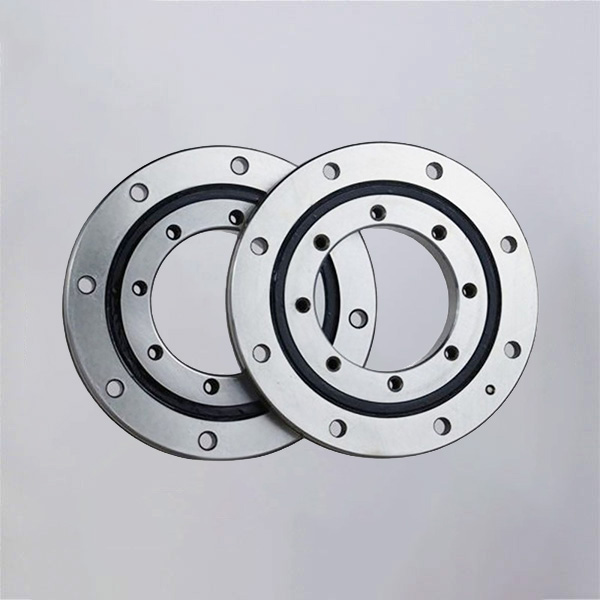
How Vibration in Storage, Transport and Idle Periods Creates False Brinelling
False brinelling is wear, not dents. In crossed roller bearings, the cylindrical rollers sit at alternating 90° angles between the rings. When the bearing is stationary and exposed to small repeated movements, each roller rocks by a few micrometres on the same patch of raceway. The lubricant film is squeezed out of that patch. Metal contacts metal, fine particles are removed, and they oxidize into red-brown debris. This is fretting corrosion. The result is a shallow, dull or polished mark at each roller position, repeating at the roller spacing.
No rotation is needed. A pallet on a truck, a container on a ship, or a machine beside a press can all supply the motion. This is the core of crossed roller bearing vibration damage during non-running periods.
| Exposure period | How the motion arises | Prevention action | Limit of the action |
|---|---|---|---|
| Storage | Floor vibration from presses, compressors, forklift traffic; racks near doors or docks | Keep bearings in original sealed packaging on a stable, low-vibration shelf, lying flat. Do not stack heavy loads on top. | Cannot remove vibration entirely. Long storage near a heavy source still needs a different location. |
| Transport | Continuous low-amplitude vibration over road, rail or sea, plus shocks when lifting | Use rigid inner packing so the bearing cannot rock. Keep rust-preventive protection intact. Avoid loose loading in cartons that can shift. | Good packing reduces risk, but cannot compensate for rough handling or open-top exposure. |
| Installed but idle | Machine sits for weeks or months while nearby equipment runs, or a transport lock is missing during relocation | Fit the transport lock or axis clamp. Rotate the bearing periodically through enough angle to move every roller well past its previous contact position. | Rotation helps only if the bearing is lubricated and unloaded enough to turn freely. It will not reverse marks that already exist. |
How to Store Crossed Roller Bearings Before Installation
Leave the bearing in its original packaging until installation day.
Store it horizontally in a dry, temperature-stable area, away from machinery and traffic lanes.
Check the rust-preventive film and packaging at receipt and at regular intervals, then record the dates.
Do not "test spin" repeatedly in dusty areas. Each unnecessary opening exposes the raceway to contamination.
For finished machines such as industrial robot joints, treat the whole assembly as the packaged unit. Lock the joint before shipping so the bearing cannot oscillate against its own preload.
Diagnosis Order: What to Check First and What It Means
Work from the cheapest, least invasive checks to the most involved. Stop whenever a check clearly explains the symptom.
Review the record. Note the route, the transport mode, storage location, idle time, and any machine relocation. If vibration exposure or a missing transport lock is documented, false brinelling becomes a stronger candidate.
Inspect the outside. Look for torn packaging, displaced inner protection, or red-brown dust around the ring gap or seals. Dust suggests fretting debris. Water stains suggest a moisture path instead.
Check mounting first. Confirm the housing and shaft seats are flat and clean, the bolts are tightened evenly in the specified sequence, and the ring is not distorted. Roughness that changes when bolts are loosened points to mounting distortion, not raceway damage.
Turn by hand, unloaded. Feel the pattern. Repeating notches at regular angular intervals point to localized raceway marks. Constant gritty roughness suggests contamination. One tight sector points toward housing flatness or preload distribution.
Listen and compare. Compare against an unused bearing of the same series if one is available. A difference you can feel is stronger evidence than an absolute impression.
Escalate before opening. Do not disassemble an integral bearing in the field. Photograph, record, and contact the supplier. Raceway inspection needs controlled conditions and, ideally, magnification.
| Observation | Possible meaning | Next step |
|---|---|---|
| Notches repeat at roller-pitch intervals; red-brown dust present | Fretting / false brinelling | Stop use. Send photos and the shipping and storage record. |
| Roughness disappears when mounting bolts are released | Mounting distortion | Re-check flatness, seat cleanliness, bolt torque sequence. |
| Uniform grit or scratching sound | Contamination | Review the sealing and assembly environment. Escalate before flushing. |
| Random pitting and staining | Moisture or corrosion | Check storage humidity and packaging integrity. |
| Distinct dents following an impact event | True brinelling from shock or overload | Review handling or load history. Do not reuse. |
Telling False Brinelling From Other Raceway Marks
A mark alone rarely settles the cause. Combine its appearance with the history.
False brinelling: shallow wear patches, often dull or polished, spaced like the rollers, with reddish debris nearby. Edges are usually not raised. The cause is micro-movement without rotation.
True brinelling: plastic deformation with displaced material at the edges. It follows shock, overload, or a dropped unit.
Moisture corrosion: irregular staining or pits that do not follow roller spacing.
Normal running wear: follows the load zone and appears only after operation, not in a never-run bearing.
If a bearing has been run and the marks are inside the load zone, do not label it false brinelling just because the pattern looks regular. Equally, a mark that looks like both types is possible. In that case, treat the cause as unconfirmed and give the supplier the full record. Our application team can review images against the production inspection data.
Cause, Corrective Action and Result Check
Raceway marks cannot be repaired in service. Corrective action follows the evidence.
Marks confirmed or strongly suspected: replace the bearing. Then correct the exposure that caused it: add a transport lock, change the pallet restraint, move the storage location, or add an idle-rotation routine.
Mounting distortion found: correct the seat or torque, then re-test turning feel before assuming the bearing is damaged.
Contamination found: clean the surroundings and review how the bearing is handled. Escalate if debris appears inside the raceway.
Result check: after correction, repeat the unloaded hand rotation and compare to the earlier pattern. Notches that vanish after a mounting correction point to distortion. Notches that persist at the same angular spacing point back to the raceway. Where the application calls for it, verify runout and turning torque against the specification on your drawing.
Application context affects the tolerance for damage. In semiconductor and medical equipment, micro-vibration and acoustic noise are the first signs customers notice. We supply crossed roller bearings for semiconductor equipment in Germany, and low-vibration performance is part of that brief. At the P2 level, such as the rotary table bearings we supplied for gear grinding in Mexico, even slight raceway marks would be visible in positioning. Bulk shipments, such as the BBH Series Crossed Roller Bearings we have exported to Germany, multiply the number of units exposed to pallet handling. The same packing and storage rules apply whatever the order size.
Prevention Checklist and When to Escalate
Common Mistakes
Storing bearings on a shelf attached to a vibrating machine frame.
Leaving a rotary table or robot joint unlocked during relocation.
Opening packaging early "to check" and leaving the raceway exposed.
Assuming a bearing is fine because it looks clean externally.
Running a rough-feeling bearing to see whether it improves.
Buyer and Maintenance Checklist
Document the transport mode, route, and the date received.
Photograph the packaging on arrival, especially if it shows damage.
Record the storage location and its distance from vibrating equipment.
For idle machines, schedule rotation and keep a log of dates.
Choose lubrication with the supplier's guidance, particularly for oscillating or low-speed duty.
Rotate by hand and note the feel before installation, then again after mounting.
For bearings in long-idle machines such as BRTM Series Rotary Table Bearings in rotary tables, the same idle-period routine applies. Rotation alone does not replace correct lubrication or a stable mounting.
Support Boundary and Information to Send
Escalate when notchiness is repeatable, when debris is visible, or when you cannot separate mounting effects from raceway effects. Our products carry a 12-month warranty from the date of shipment, and our Quality Control records let us compare your report to the inspection data for that batch. Warranty assessment depends on the evidence, so please send:
Series, size, and batch or order number
Photos of the packaging, the bearing, and any debris
Transport, storage, and idle-period history
How the bearing was mounted, including bolt torque and housing condition
A description of the feel when rotating: periodic, uniform, or localized
If you are reviewing storage rules or investigating a suspect unit, send your drawings and logistics details to Daniel Wei's team and get a quote or selection advice for your crossed roller bearings.
 +8618939019135
 sales@bybearings.com
 +8618939019135