
RB vs RBV Bearings: When to Choose Full-Roller Load Capacity
As a precision bearing specialist with over 15 years in manufacturing, one of the most frequent technical questions I address involves choosing between a standard caged bearing and its full-complement counterpart. For engineers working with applications requiring high rigidity and compact design, RB series crossed roller bearings are a common solution. The decision often narrows down to two variants: the standard RB series (with a cage or separators) and the RBV series (a full-complement or "full-roller" design). While they may look similar externally, their internal differences create significant performance trade-offs.
Choosing the wrong type can lead to issues like excessive friction torque, overheating at high speeds, or insufficient load-bearing capacity. This guide provides a direct comparison to help you determine when the higher load rating of a full-roller design is a genuine advantage, and when the balanced performance of a caged bearing is the more reliable choice.
Understanding the Core Design: Cages vs. Full Complement
The defining difference between RB and RBV bearings lies in how the cylindrical rollers are managed within the bearing raceways. This single design choice dictates the bearing's ideal operating conditions, affecting everything from speed limits to rotational torque.
Standard RB Series: The Role of the Cage
A standard RB series bearing incorporates a cage or individual separators between each cylindrical roller. This physical barrier serves several important functions:
Prevents Roller-to-Roller Contact: By keeping the rollers separated, the cage eliminates the friction, heat, and wear that would occur if they rubbed against each other at high speeds.
Ensures Proper Spacing: The cage maintains uniform spacing between rollers, which contributes to more stable load distribution and smoother rotation.
Retains Lubricant: The structure of the cage helps to hold and distribute grease or oil evenly across the rolling elements, improving lubrication effectiveness and service life.
This design makes standard RB bearings the preferred choice for applications where rotational speed and low, stable friction torque are primary considerations.
RBV Series: The Full-Complement Advantage
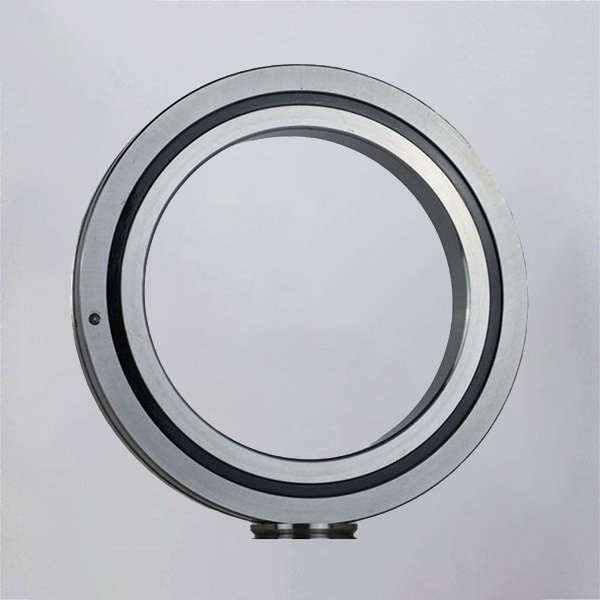
The RBV series, also known as a full-complement or full-roller bearing, omits the cage entirely. Instead, the internal space is filled with the maximum possible number of cylindrical rollers. This design is built for one primary purpose: maximizing load capacity.
By filling the raceway with rollers, the contact area available to support applied loads is significantly increased. This makes RBV bearings capable of handling much heavier radial, axial, and moment loads within the same dimensional envelope as their caged counterparts. However, this comes at the cost of direct roller-to-roller contact, which inherently increases friction and limits the permissible rotational speed.
RB vs. RBV: A Direct Performance Comparison
Selecting the right bearing requires a clear understanding of the trade-offs. The decision between a caged (RB) and full-complement (RBV) design is a classic engineering balance of load, speed, and rotational stability. At BY Bearings, we guide customers through this decision daily, drawing on performance data from our 13,500 m² intelligent factory and ISO 9001 certified quality system.
The following table breaks down the key performance differences:
| Performance Characteristic | RB Series (with Cage/Separators) | RBV Series (Full Complement) |
|---|---|---|
| Load Capacity | Good | Excellent. The higher number of rollers provides a significantly greater load rating. |
| Maximum Rotational Speed | Higher. The cage prevents roller-to-roller friction, allowing for much higher RPMs without excessive heat generation. | Lower. Direct contact between rollers creates friction and heat, limiting safe operating speeds. |
| Friction Torque | Lower and more stable. Ideal for applications requiring smooth, low-resistance motion. | Higher and less stable, especially at lower speeds, due to inter-roller sliding friction. |
| Rigidity | High | Very High. The densely packed rollers create a stiffer assembly, minimizing deflection under load. |
| Noise & Vibration | Lower. The cage promotes smoother rolling, making it suitable for noise-sensitive equipment. | Higher, due to the interactions between adjacent rollers. |
| Ideal Applications | Robotic joints, medical imaging (CT/MRI), high-speed rotary tables, semiconductor equipment. | Heavy-duty indexing tables, turn-mill centers, construction machinery swivels, low-speed/high-load pivots. |
The takeaway is clear: the RBV's strength in load capacity and rigidity comes at the expense of speed and rotational smoothness. Conversely, the RB series excels in dynamic applications where speed and low torque are more important than absolute maximum load.
Application Scenarios: Where Each Bearing Type Excels
Theory is useful, but practical examples clarify the choice. Let's examine specific applications where one type is clearly superior to the other.
When to Specify the Standard RB Series (Caged)
Choose the caged RB series for dynamic applications where smooth motion and speed are priorities.
Robotics & Automation Joints: The joints in an industrial robot arm must move quickly and smoothly with minimal resistance to ensure repeat positioning accuracy. The low, stable friction torque of an RB bearing is essential for this. Our work with customers on Bearings for Industrial Robotics confirms that caged designs are almost always the correct choice here.
Medical Imaging Gantries (CT/MRI): These systems require ultra-quiet, low-vibration rotation to produce clear diagnostic images. The smooth operation of a caged bearing is non-negotiable. For a German customer developing semiconductor equipment with similar low-vibration needs, we supplied specialized crossed roller bearings to meet their exacting standards.
High-Speed CNC Rotary Tables: For rotary tables used in finishing or light machining operations, high rotational speed is necessary for productivity. An RBV bearing would quickly overheat and fail in this scenario.
When Full-Roller RBV Bearings Pay Off
Specify the full-complement RBV series when the primary challenge is managing immense static or low-speed loads.
Turn-Mill Centers: These machines subject the main spindle and rotary table to heavy combined loads during complex cutting operations. The exceptional rigidity and moment load capacity of an RBV bearing prevent chatter and ensure machining accuracy under heavy force. These are common applications for our Bearings for Turn Mill Center solutions.
Heavy-Duty Indexing Tables: For tables that position very heavy workpieces or fixtures, the primary need is for rigidity and the ability to withstand high static loads and moments without deflection. Rotational speed is very low or intermittent, making the RBV a perfect fit.
Construction & Mining Equipment: The pivot points on cranes, excavators, and boring machines experience massive loads at very low rotational speeds. The raw load capacity of an RBV bearing ensures durability and safety in these harsh environments.

Common Selection Mistakes to Avoid
Making the right choice goes beyond reading a spec sheet. It involves understanding the application's true demands. Here are some common missteps I've seen engineers make when choosing between RB and RBV bearings.
Mistake 1: Over-specifying for Load. The most common error is choosing an RBV bearing "just in case" because of its higher load rating. If the application's maximum load is well within the capacity of a standard RB bearing, selecting the RBV needlessly introduces higher friction, consumes more energy, and limits the machine's speed.
Mistake 2: Ignoring the Speed (dn) Limit. Engineers sometimes focus solely on load and overlook the speed rating (expressed as the dn value). Pushing an RBV bearing beyond its recommended speed limit will cause rapid heat buildup from roller-to-roller friction, leading to lubricant breakdown and catastrophic failure.
Mistake 3: Underestimating Friction's Impact. The higher friction torque of an RBV bearing isn't just an efficiency issue; it can require a larger, more powerful drive motor to achieve the desired motion, increasing both cost and system footprint.
Mistake 4: Not Verifying Manufacturing Precision. Whether you choose RB or RBV, the bearing's performance is ultimately defined by its manufacturing quality. Insist on suppliers who can verify material purity (we use premium GCr15 bearing steel), heat treatment processes, and geometric accuracy. At BY Bearings, we perform 100% pre-shipment inspection to control runout to within 1.5 μm, ensuring that the design's potential is realized in the final product. Our strict Quality Control is foundational to the performance of all our precision bearing solutions.
The choice between RB and RBV bearings is not about which is "better," but which is better suited to your specific combination of load, speed, and precision requirements. The RB series offers balanced, high-speed performance, while the RBV series provides maximum load capacity and rigidity for low-speed applications. By carefully analyzing your operating conditions and avoiding common pitfalls, you can select a bearing that delivers optimal performance and reliability.
If you are evaluating options for your design and need help analyzing the trade-offs, please send your technical specifications to our engineering team. We can provide a detailed recommendation based on your application's unique demands.
 +8618939019135
 sales@bybearings.com
 +8618939019135
