RE Series Crossed Roller Bearings: Design Limits Guide
Engineers often ask when an RE series crossed roller bearing is not the right choice for their design. While its split inner ring and solid outer ring offer simplified mounting and preload adjustment, this design carries specific trade-offs. Understanding these limitations is essential for ensuring the long-term accuracy and reliability of high-performance machinery, from industrial robot joints to CNC rotary tables.
At BY Bearings, with over 15 years of manufacturing experience in Precision Crossed Roller Bearings, we guide our customers through these critical selection decisions. The RE series is an excellent general-purpose bearing, but for applications demanding the highest levels of rigidity under shock loads or complex mounting conditions, its inherent design boundaries must be respected. This article clarifies those boundaries to help you specify the correct bearing from the start, avoiding costly redesigns and performance issues down the line.

The Core Design of an RE Bearing: The Split Inner Ring
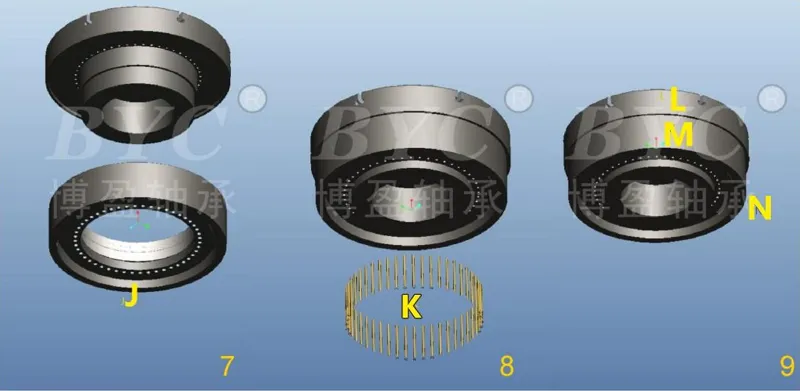
The defining feature of the RE series is its inner ring, which is split into two separate halves. The outer ring remains a single, solid piece. This construction is functionally similar to the RB series, but with the split part on the inner ring instead of the outer.
This design was developed for a specific purpose: to simplify installation and preload management. The two halves of the inner ring are clamped together against the shaft by a housing, flange, or pressure plate. By controlling the clamping force, an engineer can fine-tune the bearing's internal clearance, often setting a specific preload to increase stiffness and reduce deflection. This adjustability can be an advantage in applications where thermal expansion or minor assembly variations need to be compensated for.
However, this split creates a structural discontinuity. Unlike a solid, single-piece ring, the interface between the two halves can become a point of weakness or instability if the bearing is pushed beyond its intended operational limits. The integrity of the entire assembly relies on the clamping mechanism's ability to hold these two halves together as if they were one solid piece—a condition that is not always achievable in demanding real-world scenarios.
When to Reconsider an RE Series Bearing: Key Application Limits
The split-inner-ring design, while convenient, introduces performance boundaries. In certain high-demand situations, this design can compromise the very precision you are trying to achieve. Our ISO 9001 certified quality system ensures every bearing meets spec, but choosing the right type for the application is paramount. The following table outlines scenarios where the limitations of an RE series bearing may warrant considering an alternative with an integrated, solid-ring construction (like the RU or RB series).
| Application Challenge | RE Series (Split Ring) Behavior & Risk | Recommended Alternative & Rationale |
|---|---|---|
| High Shock Loads or Heavy Vibration | Under sudden impact or intense vibration, the clamping force on the split inner ring may be insufficient to prevent micro-movements. This can lead to a loss of preload, increased runout, and accelerated wear at the split interface. The risk is a sudden drop in rotational accuracy. | RU/RB Series (Integrated Rings): The solid, one-piece inner and outer ring construction provides superior structural integrity. It distributes impact forces evenly around the raceway without the risk of ring separation, maintaining consistent preload and stiffness. |
| Maximum Rotational & Tilting Stiffness Required | The split in the inner ring acts as a structural joint, introducing a point of lower rigidity compared to a solid ring. Even when perfectly clamped, this interface can permit minute deflection under heavy overturning moments, slightly reducing the overall stiffness of the assembly. | Rotary Table Bearings (BRT Series): These bearings are designed with a single-piece structure and a higher degree of roller conformity specifically for the combined axial, radial, and moment loads found in CNC indexing tables and turn-mill centers. |
| Potential for Housing or Shaft Misalignment | If the shaft or housing has even minor geometric errors (out-of-roundness or taper), the clamping mechanism may apply uneven pressure to the split ring. This concentrates stress on one area, leading to localized wear, high friction torque, and a significant reduction in bearing life. | RU/RB Series with Precision Mounting: An integrated bearing is more forgiving of minor imperfections, but the true solution is ensuring the mounting surfaces are machined to tight tolerances. Our P4/P2 precision bearings require equally precise mating components to perform correctly. |
| Inconsistent or Unreliable Clamping Mechanism | The performance of an RE bearing is entirely dependent on the quality of the external clamping. If the flange is not sufficiently rigid, bolts are torqued unevenly, or the mounting surface is not perfectly flat, the inner ring halves can shift, immediately compromising the bearing's accuracy. | RU/RB Series with Integrated Mounting Holes: These models eliminate the need for external clamping rings. The bearing is bolted directly to the housing and shaft, providing a direct, secure load path and removing clamping-related variables from the assembly process. This is common in Bearings for Industrial Robotics. |
Common Mistakes in Mounting RE Series Bearings
Even when an RE series bearing is suitable for the application, incorrect mounting is a frequent cause of premature failure. Achieving the specified performance, including our guaranteed runout control within 1.5 μm, depends on a precise installation procedure. Here are common mistakes to avoid:
- Uneven Bolt Torquing: Failing to use a torque wrench and a star-pattern tightening sequence on the clamping flange is the most common error. This leads to uneven pressure on the split inner ring, causing distortion and high spots that generate noise, vibration, and wear.
- Ignoring Surface Finish and Flatness: Mounting an RE bearing onto a surface that is not perfectly flat or has a rough finish will prevent the clamping flange from applying uniform pressure. This creates gaps and pressure points, negating the bearing’s precision.
- Contamination During Assembly: Even small particles of dirt, metal shavings, or debris trapped between the inner ring halves or under the clamping flange can prevent proper seating. This can cause a loss of preload and introduce runout into the system. Our bearings are manufactured and inspected in a clean environment; the assembly environment should match this standard.
- Using a Non-Rigid Clamping Flange: A thin or poorly designed clamping flange can flex under bolt tension. This flexing results in pressure being concentrated near the bolts, while the areas between the bolts are insufficiently clamped, leading to ring instability.
- Improper Preload Setting: Either over-tightening or under-tightening the clamping mechanism can be detrimental. Excessive preload increases friction, heat, and wear. Insufficient preload results in clearance, allowing for chatter and reduced stiffness. The ideal preload is a fine balance that should be verified by measuring starting torque.
Alternative Bearing Solutions for High-Demand Applications
When your analysis shows that an RE series bearing's limitations pose a risk to your design, BY Bearings offers several high-stiffness alternatives. Our ability to provide OEM and ODM solutions means we can help you integrate the ideal bearing for your specific load case and mounting configuration.
For applications demanding maximum rigidity, consider these options:
- RU and RB Series Bearings: These are the most direct upgrade. Their one-piece inner and outer ring construction (RB has a split outer ring, RU has integrated rings) provides the highest possible stiffness and rotational accuracy in a crossed roller bearing design. They are ideal for applications like the semiconductor equipment we supply to customers in Germany, where positional stability is non-negotiable.
- BRT Series Rotary Table Bearings: Specifically designed for the spindles of CNC machining centers and rotary tables, these bearings handle heavy combined loads and high overturning moments. Their internal geometry is optimized for tilting stiffness, making them a superior choice for demanding cutting operations. A gear grinding machine builder in Mexico uses our P2 precision BRT bearings to achieve exceptional workpiece accuracy.
- Crossed Tapered Roller Bearings: For the most extreme moment load requirements, crossed tapered roller bearings offer an even higher level of stiffness. The tapered geometry and line contact of the rollers create a wider effective spread, providing exceptional resistance to tilting.
The choice is not just about the bearing, but about the entire mechanical system. Factors like machining tolerances, material selection (we use high-purity GCr15 / SAE 52100 bearing steel), and assembly procedures all contribute to the final performance.
If you are evaluating the trade-offs between different bearing series for your application, submit your design parameters. Our engineering team can provide a detailed analysis and recommendation to ensure you achieve your performance goals. Please contact us to get a quote and discuss your project.
 +8618939019135
 sales@bybearings.com
 +8618939019135