RFQ Guide for a Crossed Roller Bearing Manufacturer
Submitting a Request for Quote (RFQ) with incomplete data is the most common reason for project delays and budget overruns. When sourcing precision components, an ambiguous RFQ sent to a crossed roller bearing manufacturer leads to a cycle of questions, revised quotes, and the risk of receiving a bearing that fails under load. The difference between specifying a part number and detailing the functional requirements can mean the difference between rapid prototyping and a costly production halt.
At BY Bearings, we have over 15 years of experience manufacturing high-precision bearings for clients in over 65 countries. We've seen firsthand how a well-prepared RFQ accelerates the entire procurement process. This guide outlines the exact technical and commercial data our engineering team needs to provide you with a precise, actionable quote for your application, ensuring you get the right component on time.
Key Technical Data Your RFQ Must Include
To quote accurately, we need to understand the complete operating environment of the bearing. Generic requests force us to make assumptions, which rarely align with specific application demands. A detailed RFQ should be a technical snapshot of your project. Use the following checklist to gather the essential data before contacting a supplier.
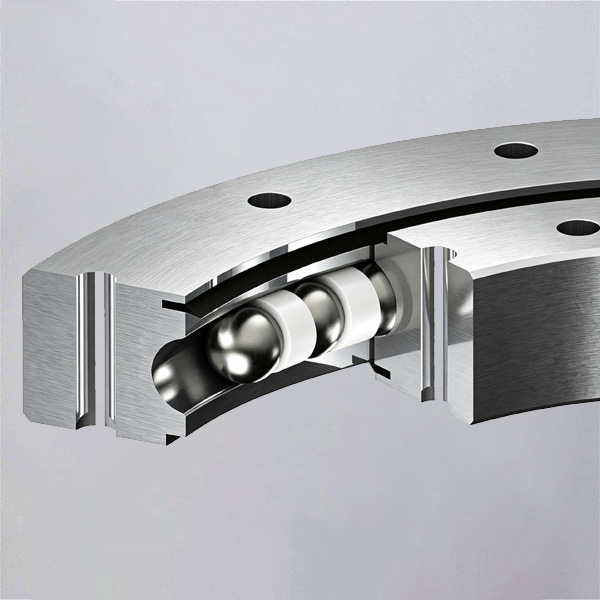
Loads & Operating Conditions
- Axial Load (Fa): The maximum thrust load the bearing will experience.
- Radial Load (Fr): The maximum load perpendicular to the axis of rotation.
- Moment Load (M): The maximum overturning or tilting load. This is often the most critical parameter for crossed roller bearings and dictates the required rigidity.
- Operating Speed: Specify the typical and maximum rotational speed in RPM. High speeds may require special lubrication or cage materials.
- Duty Cycle & Environment: Is the operation continuous or intermittent? What is the operating temperature range? Will the bearing be exposed to contaminants like dust, moisture, or cutting fluid?
Accuracy & Performance Requirements
- Required Accuracy Grade: Specify the required precision class (e.g., P5, P4, P2). As a high precision bearing supplier, we can achieve grinding accuracy up to P2 class, but specifying a higher grade than necessary increases cost. For example, our work with German clients on semiconductor equipment often requires P2, while other industrial automation might be satisfied with P4.
- Rotational Runout: Define the maximum allowable axial and radial runout. Our standard process includes 100% pre-shipment inspection to ensure runout is controlled within 1.5 μm, but your specific tolerance is a key quoting factor.
- Preload Specification: Do you require negative clearance (preload) for high rigidity, or do you need positive clearance for low friction torque? Applications like Bearings for Industrial Robotics often need a specific preload to eliminate joint wobble, whereas DD motors require minimal friction.
Physical & Mounting Specifications
- Dimensions: Provide the required inner diameter (ID), outer diameter (OD), and width. Attaching a 2D or 3D drawing is always best.
- Mounting Holes: Are standard mounting holes acceptable, or do you require a custom bolt pattern? We support full OEM and ODM customization.
- Sealing: Does the bearing require integrated seals (e.g., UU type) for protection against contaminants?
Common RFQ Mistakes That Lead to Delays and Inaccurate Quotes
Providing the right data is half the battle. Avoiding common pitfalls is the other. Over the years, we've identified several recurring mistakes in RFQs that can hinder the sourcing process. Here are the most frequent issues and how to prevent them.
- Specifying Only a Competitor's Part Number: Sending an RFQ asking for a quote on "Brand X, part number 12345" is a start, but it's incomplete. Another brand's part number doesn't tell us the specific preload, accuracy class, or lubrication you received. To ensure true dimensional and functional interchangeability, provide the performance data from the list above. This allows us to match the bearing's function, not just its form.
- Underestimating Moment Loads: Many RFQs detail axial and radial loads but omit the overturning moment. Precision Crossed Roller Bearings are specifically designed to handle high moment loads in a compact space. Without this data, a manufacturer might quote a bearing that lacks the necessary tilting stiffness, leading to chatter, vibration, and premature failure in applications like CNC rotary tables.
- Using Vague Accuracy Terms: Statements like "high accuracy needed" are subjective. For one application, P5 is sufficient; for another, only P2 will do. Quantify your needs by specifying the ISO or DIN accuracy grade. This directly impacts manufacturing processes, inspection time, and final cost. For example, a gear grinding machine we supplied bearings for in Mexico required P2 precision to meet workpiece finish requirements.
- Ignoring Material & Treatment Certifications: Not all bearing steel is created equal. Simply stating "GCr15 steel" is not enough. A reliable manufacturer should be able to provide material certifications. At BY Bearings, we use spectrographic analysis to verify the chemical purity of our GCr15 (SAE 52100) steel. After our automated heat treatment process, we conduct metallographic examinations to confirm optimal hardness (HRC 60-64) and a stable martensitic structure. If you require this level of traceability, specify it in your RFQ.
Evaluating a Manufacturer's Capability Beyond the Quote
The price on a quote is only one part of the equation. A lower price from an unverified supplier can lead to higher costs from production downtime and product failure. A true manufacturing partner offers transparent processes, reliable capacity, and engineering expertise.

Quality Systems & Production Capacity
Look for a manufacturer that operates under a certified quality management system. Our entire process, from raw material sourcing to final inspection, is compliant with the ISO 9001:2015 standard. This isn't just a certificate; it's an integrated system of process controls and traceability. Furthermore, our 13,500 square meter intelligent factory has a monthly capacity of 15,000 bearing sets, allowing us to offer flexible MOQs and rapid turnaround times of just 3-6 weeks, a significant advantage over the 4-8 month lead times common with other large brands.
Engineering Support & Customization
Your supplier should be more than just a component vendor. They should be an engineering resource. We provide full OEM and ODM support, from creating custom mounting hole patterns to developing entirely new Precision Bearing Solutions for unique applications. Whether you are designing for medical imaging systems or heavy-duty turn-mill centers, our team can help optimize the bearing selection for performance and cost.
A Buyer's Decision Checklist
Before issuing a purchase order, use this final checklist to vet your potential manufacturing partner:
- [ ] Does the manufacturer hold current ISO 9001:2015 certification? Can they provide it?
- [ ] Do they perform 100% runout and torque inspection before shipment?
- [ ] Can they provide material and heat treatment certifications upon request?
- [ ] What is their stated lead time for prototype and production quantities?
- [ ] Do they have documented experience in your industry (e.g., robotics, CNC, medical)?
- [ ] Can they offer functional equivalents to other major brands with clear technical justification?
Answering these questions ensures you are partnering with a qualified manufacturer committed to quality and transparency.
Real-World RFQ Example: Bearings for a CNC Rotary Table
Let's compare an ineffective RFQ with a detailed one for a common application: a CNC 4th-axis rotary table. This application demands high rigidity and precision to resist cutting forces and produce accurate parts.
An Ineffective RFQ: "Please quote 20 pcs of your BRT series rotary table bearings. Need it fast."
This request lacks the detail needed for an accurate quote. We would have to reply with multiple questions about size, accuracy, and loads, causing delays.
An Effective RFQ: This RFQ would include a drawing and a table with specific parameters.
| Parameter | Specification | Notes |
|---|---|---|
| Application | CNC 4th Axis Rotary Table | For intermittent steel milling |
| Loads | Fa: 8kN, Fr: 5kN, M: 2.5 kNm | Dynamic cutting forces |
| Speed | Max 60 rpm | Low-speed, high-torque |
| Accuracy Grade | P4 or better | Critical for workpiece finish |
| Required Runout | Axial/Radial < 4 μm | |
| Preload | Light preload (-2 to -4 μm) | To maximize tilting stiffness |
| Dimensions | Per attached drawing CNC-RT-002 | Custom mounting holes |
| Quantity | 20 pcs prototype, 300/yr est. |
This detailed RFQ allows our engineers to immediately select the correct Rotary Table Bearings, confirm that our P4 capabilities meet the runout requirements, and provide a firm quote and lead time without any back-and-forth. This is the foundation of a successful partnership.
If you are preparing an RFQ for a precision application, our engineers can review your specifications to ensure all critical data is included. Contact us to get a quote or submit your drawings for a technical review.
 +8618939019135
 sales@bybearings.com
 +8618939019135