Slewing Bearing vs. Standard Bearings: Why Precision Engineering Matters
In the landscape of modern mechanical design, the ability to control motion with precision and reliability is the cornerstone of inustrial success. As machines become larger, more specialized, and capable of handling increasingly complex tasks, the components that facilitate their rotation must evolve in kind. Among these critical components, the slewing bearing stands out as a sophisticated marvel of engineering. Unlike standard bearings, which are often designed for high-speed, light-duty applications, the slewing bearing is built to handle the heavy-duty, multi-directional stresses inherent in today's most advanced machinery.
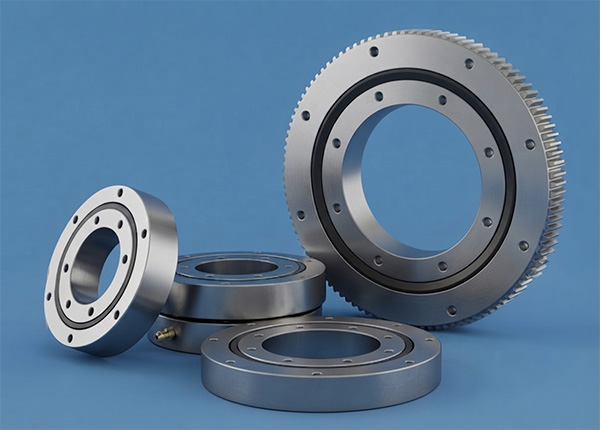
This article explores the fundamental differences between slewing bearings and standard rolling bearings, examines why precision engineering in these components is non-negotiable, and highlights how specialized manufacturers like Luoyang Boying Bearing are setting the standard for performance in the global market.
What is a Slewing Bearing?
At its most basic level, a slewing bearing is a large-scale rotational device designed to support high axial, radial, and moment loads simultaneously. Often referred to as a "turntable bearing," it acts as the vital link between a static base and a rotating platform.
Unlike a standard ball bearing that might only handle rotation on a single axis, a slewing bearing is a structural member of the equipment it serves. It is designed to sustain not only the vertical weight of a structure (axial load) but also the side-to-side forces (radial load) and the tilting forces (moment load) that occur during heavy-duty operation. By integrating the housing, the raceway, and often the gear teeth into a single unit, the slewing bearing enables compact, efficient, and robust rotational motion.
Core Structure of a Slewing Bearing
The engineering prowess behind a slewing bearing lies in its robust yet refined construction. A typical slewing bearing consists of several core components that must work in perfect harmony:
The Raceways: These are the circular paths on which the rolling elements travel. In high-precision applications, these raceways undergo specialized heat treatment and precision grinding to ensure a perfectly smooth surface, minimizing friction and maximizing longevity.
Rolling Elements: Depending on the specific load requirements, these may be steel balls or cylindrical rollers. The choice between balls and rollers—and their arrangement—dictates the bearing's capacity for load distribution.
Spacers and Cages: These components keep the rolling elements separated, preventing them from colliding and reducing heat build-up caused by friction.
Internal or External Gearing: One of the defining features of many slewing bearings is the integrated gear system. By machining teeth directly onto the inner or outer ring, the bearing itself becomes part of the transmission system, allowing it to be driven by a pinion gear to rotate the entire assembly.
Sealing Systems: Given that these bearings often operate in harsh environments—such as mines or outdoor construction sites—robust sealing is essential to protect the internal components from dust, moisture, and debris.
Key Differences: Slewing Bearings vs. Standard Rolling Bearings
While standard rolling bearings (such as deep groove ball bearings or cylindrical roller bearings) are ubiquitous in the mechanical world, they are distinct from slewing bearings in both design intent and capability.
Load Capacity and Directionality
Standard bearings are typically optimized for high-speed rotation with a primary focus on radial loads. While some are designed for axial loads, few are engineered to withstand the massive moment loads (tilting forces) that a slewing bearing manages as a matter of routine. A slewing bearing is specifically designed to handle "combined loads"—loads coming from multiple angles at once—which is critical for equipment like cranes, excavators, and radar antennas.
Structural Integration
A standard bearing is usually an "off-the-shelf" component that requires a precisely machined housing to function correctly. In contrast, a slewing bearing is often a structural component itself. Because it comes with pre-drilled mounting holes, it is designed to be bolted directly to the equipment's frame. This integration simplifies assembly and reduces the total number of parts required to build a rotating system.
Speed and Performance
Standard bearings are generally better suited for high-RPM (revolutions per minute) applications where cooling and low friction are the primary concerns. Slewing bearings, however, are geared toward lower-speed, high-torque applications. They are built for strength, stability, and endurance under stress rather than for reaching extreme rotational speeds.
Why Slewing Bearings Are Critical for Engineering?
Precision engineering is not merely about making parts smaller or faster; it is about ensuring that a machine performs exactly as intended, under any condition. Slewing bearings are the "joints" of heavy industry. When a massive wind turbine or a robotic assembly arm moves, the precision of that movement is entirely dependent on the bearing.
If a bearing lacks the necessary precision, the resulting "play" (or backlash) in the system can lead to vibrations, reduced accuracy, and eventually, catastrophic failure. By ensuring that the tolerances are maintained to a microscopic level, engineers ensure that the load is distributed evenly across the raceway. This distribution is what allows a machine weighing several tons to rotate with the smoothness of a high-end watch. Precision in slewing bearings is, therefore, the primary factor in the longevity and safety of large-scale mechanical systems.
Advantages of Slewing Bearings in Precision Applications
The shift toward using high-performance slewing bearings offers several distinct advantages in precision-critical industries:
Space Efficiency
By consolidating the support and transmission functions into a single unit, manufacturers can significantly reduce the footprint of their machinery. This allows for more compact and efficient designs.
Extreme Rigidity
In applications such as precision CNC rotary tables or medical imaging equipment, any deflection is unacceptable. Slewing bearings provide the necessary structural rigidity to maintain alignment under varying loads.
Environmental Resilience
Because they are often custom-designed for the end-use environment, they can be engineered with specific materials and coatings that resist corrosion, extreme temperature fluctuations, and high-impact conditions.
Customization Potential
Unlike standard bearings, which are often mass-produced to rigid specifications, slewing bearings can be tailored in diameter, gear ratio, and seal type to fit the exact geometry of a unique engineering project.
Variety Applications of a Slewing Bearing
The versatility of the slewing bearing has allowed it to revolutionize several key industrial sectors:
Mining and Construction
From the massive rotating superstructures of excavators to the precision slewing of tower cranes, these bearings handle the extreme weight and shock loads found in the world's toughest work environments.
Medical Imaging (PET/CT Scans)
These devices require incredibly smooth and constant rotation. A high-precision slewing bearing ensures that the imaging array rotates without vibration, which is critical for obtaining clear, diagnostic-quality images.
Agricultural Irrigation
Large-scale center-pivot irrigation systems rely on the durability of these bearings to rotate massive pipes over vast fields for years without maintenance.
Astronomical Telescopes
For the study of the stars, the movement must be near-perfect. Slewing bearings enable these massive instruments to track objects across the sky with exquisite precision and minimal backlash.
Industrial Automation
In robotic assembly lines, high-rigidity slewing bearings are used to ensure that arms and grippers reach their targets with repeatable accuracy, hour after hour.
How to Choose the Right Slewing Bearings for Your Project?
Selecting the correct slewing bearing is a process that demands technical rigor. It is not just about choosing a size; it is about matching the bearing's performance profile to the specific dynamic requirements of the equipment.
Analyze the Load Profile
You must define the maximum axial load, radial load, and moment load the bearing will encounter during operation. Peak loads during emergency stops or heavy lifting are particularly important.
Define the Operational Environment
Does the machine operate in a clean, temperature-controlled factory, or in a dusty, wet outdoor environment? This will dictate the required sealing and lubrication systems.
Evaluate Rotational Requirements
Determine if the machine needs continuous rotation or intermittent, precise indexing. High-precision indexing requires lower clearance, whereas continuous rotation might prioritize thermal management.
Consult with Engineering Experts
Because slewing bearings are often customized, it is rarely advisable to rely solely on a standard catalog. Engaging with an experienced manufacturer early in the design phase ensures that the bearing's specifications align perfectly with your machine's architecture.
Luoyang Boying Bearing: Leading Slewing Bearing Manufacturer in China
At the forefront of this industry is Luoyang Boying Bearing Co., Ltd. Based in China, a global hub for high-precision manufacturing, we have dedicated ourselves to the mastery of bearing technology. We understand that in the world of high-rigidity rotary systems, there is no room for compromise.
Our expertise spans a wide range of high-precision solutions, including:
• Slewing Bearings: Designed for large-scale rotation and heavy load-bearing.
• Crossed Roller Bearings: Renowned for their ability to handle combined loads while maintaining extreme compact precision.
• Crossed Tapered Roller Bearings: Ideal for applications requiring high stiffness and accuracy.
• Rotary Table Bearings: Engineered to provide the smooth, vibration-free rotation required in CNC machine tools and advanced automation.
Our products are widely utilized in CNC machine tools, industrial robots, automation equipment, and various high-rigidity rotary systems where both precision and load-bearing performance are paramount. We do not just supply parts; we provide the foundation upon which your machine's performance is built.
With years of experience in the manufacturing sector, we combine advanced engineering capabilities with a commitment to quality that ensures our bearings perform under the most demanding conditions. We recognize that every project is unique, and our team is always ready to work alongside your engineers to design a solution that exceeds your expectations.
If you have any questions regarding slewing bearings or any other precision bearing solutions, feel free to contact us now!
 +8618939019135
 sales@bybearings.com
 +8618939019135