What are BRE Series Crossed Rollers?
What a BRE Bearing Is and What It Is Built to Do
If you are sizing a compact rotary axis, the first question is usually simple: can one thin bearing carry radial, axial and tilting loads at the same time, and which ring should turn? The BRE Series Crossed Roller Bearings are designed for that job when the outer ring rotates and the inner ring stays fixed.
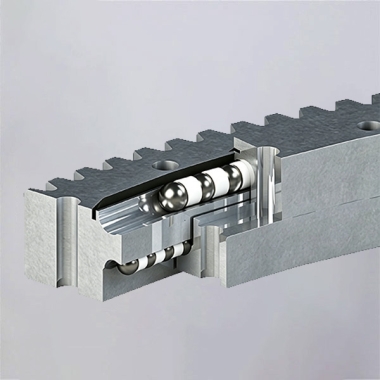
Inside, cylindrical rollers sit in a 90° V-groove raceway. Each roller is set perpendicular to its neighbor, so every second roller takes load in one axial direction and the others take it in the opposite direction. Radial load is shared across all of them. The result is a single slim bearing that replaces a pair of angular contact or tapered bearings in many compact axes.
What sets BRE apart is its ring split. The inner ring is separable (two halves) and the outer ring is one solid piece. That layout is what makes it suit outer-ring-rotating designs. The next section explains why.
Typical use: rotary tables, indexing heads, measuring stages, robot wrist or joint modules where the housing turns around a fixed shaft or hub.
Not the first choice for: designs where the shaft turns and the housing is fixed. A bearing with a separable outer ring usually fits that layout better.
Related families: for larger tilting moments, look at Crossed Tapered Roller Bearings, and for large-diameter table axes, our Rotary Table Bearings.
Structure Deep-Dive: Separable Inner Ring and Outer Ring Rotation
The ring that rotates should be the one-piece ring. A split ring is clamped together by the housing or end plates. Its joint line and clamp-up are fine for a stationary part, but they introduce small geometric variation on a part that spins. A solid rotating ring keeps the raceway continuous for every roller pass, and that supports high rotational accuracy.
| Feature | BRE (separable inner ring) | Outer-ring-separable type |
|---|---|---|
| One-piece ring | Outer ring | Inner ring |
| Split ring | Inner ring, two halves | Outer ring, two halves |
| Best rotation layout | Outer ring rotates, inner ring fixed | Inner ring rotates, outer ring fixed |
| Preload set by | Clamping the inner ring halves | Clamping the outer ring halves |
| Typical axis | Turntable with rotating housing, hollow fixed hub | Rotating shaft in a fixed housing |
| Limit | Poor fit for rotating-shaft layouts | Poor fit for rotating-housing layouts |
Why the load direction matters
| Load | How BRE carries it | Design note |
|---|---|---|
| Radial | Shared by all rollers through the V-groove | Capacity is lower than a same-size full-complement radial bearing |
| Axial (both directions) | Alternate rollers take each direction | No second bearing needed to resist thrust reversal |
| Overturning moment | Roller rows act on a wide contact span | Moment arm is short on thin sections, so check moment capacity separately |
| Combined load | Rollers share it at the same time | Verify the equivalent load, not each load alone |
A BRE bearing performs best when the rotating mass sits on the outer ring and the loads arrive as a mix of thrust and tilting moment. That is the common case on CNC turntable bearings and compact positioning stages.
FAQ: How Do Fit and Preload Change Radial, Axial and Moment Behavior?
Catalog load ratings assume a correctly mounted bearing. In practice, fit and preload decide whether you reach them. These are the questions design engineers ask most often before they commit a drawing.
Does one BRE bearing really replace a bearing pair?
Often, yes. Because roller direction alternates, a single bearing resists radial load, thrust in both directions and tilting moment. This saves axial space and part count. The limit is moment capacity on very short sections or very large overhangs. In those cases a wider cross-section, or a crossed tapered design, gives a longer effective moment span.
How tight should the fit be on the split inner ring?
The inner ring halves are stationary and sit on a fixed hub. A light or transition fit is the usual direction, and the clamping plate then sets the axial clamp-up. Too tight a fit squeezes the raceway and removes the running clearance. The bearing feels stiff, runs warm and shows higher friction torque. Too loose a fit lets the ring halves shift and the moment rigidity drops. The right tolerance depends on the bore size and the series, so confirm it against the size table rather than a general rule.
Does more preload always improve rigidity?
No. A slightly negative clearance (preload) removes play and raises stiffness, which helps positioning repeatability. Beyond that, extra preload raises friction torque, heat and wear. A direct drive axis with limited motor torque, or a slow measuring axis, may gain more from lighter preload. A heavy-cut milling table may need more. State the speed, duty cycle and torque budget when you ask for a recommendation.
What happens if I use BRE with a rotating shaft?
It can work at low speed or in oscillating motion, but the split inner ring is now the rotating part. You may see higher runout and a more demanding clamping requirement. If your layout is shaft-rotating, ask for an outer-ring-separable design instead.
Mistakes That Change the Result, and What to Check Before CAD
Common mistakes
Choosing by bore size alone. Two bearings with the same bore can differ in section height, roller size and rated load. Compare dynamic and static ratings and the allowable moment.
Ignoring housing and hub flatness. The bearing takes the shape of its seat. A distorted housing shows up as uneven torque and runout, whatever the bearing grade.
Treating a higher precision class as automatically better. P2 suits a gear grinding or measuring axis. A material-handling indexer rarely needs it, and the added cost brings no benefit there.
Comparing runout figures from different measurement conditions. Check whether the value is for the bearing alone or after mounting.
Leaving out the lubricant requirement. Low-friction or clean-environment axes need a specified grease, not a default.
What to request from a supplier
The dimension and tolerance table for the exact BRE size.
The recommended shaft and housing fits and the clamping method for the split ring.
Runout and friction torque inspection records for your batch.
Preload or clearance options and the grease on offer.
Whether special mounting holes, seals or dimensions are possible for a custom crossed roller bearing.
Our standard process includes 100% inspection before shipment, with runout controlled within 1.5 μm. You can read more on our Quality Control page. Precision classes of P5, P4 and P2 are offered across our precision bearing range. Confirm the class available for the BRE size you need.
Where BRE Fits: Application Scenarios and Next Steps
Consider a compact indexing table. The table top turns, the base and center hub are fixed, and the axis sees thrust from clamping forces plus a tilting moment from off-center workpieces. A BRE bearing carries this load path in one slim section. The turning outer ring has a continuous raceway, and the fixed inner ring halves are clamped through the hub. This is why we recommend BRE for outer-ring-rotating tables, measuring stages and the rotating housing of compact automation modules. For wider machine tool axes, see our guide to Bearings for Machine Tools.
The same selection logic applies across our crossed roller work. We have supplied crossed roller bearings for semiconductor equipment in Germany, and we ship BBH Series Crossed Roller Bearings to German customers in bulk. In Mexico, our P2 rotary table bearings serve gear grinding. Each application has different loads and tolerances, so the fit and preload were chosen per axis rather than copied from another design.
Decision checklist before requesting samples
Which ring rotates: housing (BRE) or shaft?
Axial load, radial load and tilting moment, with the moment arm length.
Rotation speed, oscillation angle and duty cycle.
Required runout and the accuracy class it implies.
Hub and housing material, flatness and the available clamping space.
Torque budget, if the axis is direct driven.
For other compact options, compare against Precision Crossed Roller Bearings in other ring configurations. Our team has more than 15 years of experience with precision crossed roller and rotary table bearings, and samples are available without a minimum order quantity.
If you have a drawing or load data ready, send it over and we will check the series, fit and preload with you. You can get a quote or ask for the BRE size table at any stage of your design.
 +8618939019135
 sales@bybearings.com
 +8618939019135