When Do Crossed Roller Bearings Beat Angular Contacts?
Understanding the Core Trade-Off: Space, Stiffness, and Simplicity
For design engineers, selecting the right bearing is a defining choice that impacts machine performance, size, and assembly cost. A common decision point is choosing between a single crossed roller bearing and a back-to-back pair of angular contact bearings. While both can manage combined loads, they offer fundamentally different approaches to achieving rigidity and precision.
The choice is not about which bearing type is "better" overall, but which is optimal for a specific set of constraints. An angular contact pair is a traditional, proven solution. However, a single Precision Crossed Roller Bearings can replace that pair, offering a more integrated and compact design. This article directly compares these two solutions to clarify when the consolidated design of a crossed roller arrangement provides a distinct engineering advantage, particularly in applications where space is limited and high moment stiffness is required.
Direct Comparison: Crossed Roller Bearings vs. Angular Contact Pairs
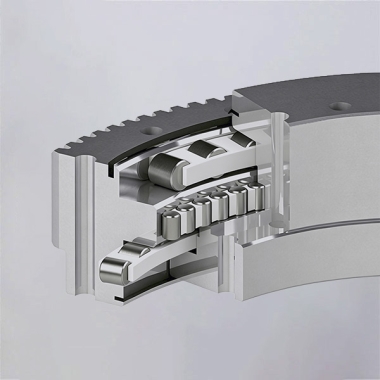
The primary distinction lies in how each solution handles complex loads within a given physical space. A crossed roller bearing uses a single row of cylindrical rollers arranged orthogonally in a 90° V-groove. This geometry allows one bearing to manage forces from all directions. In contrast, an angular contact arrangement requires two separate bearings, typically mounted in a back-to-back or face-to-face configuration, to achieve similar multi-directional load support and moment rigidity.
Here is a direct comparison of key performance and design characteristics:
| Characteristic | Crossed Roller Bearing | Paired Angular Contact Bearings |
|---|---|---|
| Load Handling | A single bearing handles radial, axial (both directions), and moment loads simultaneously. | Requires a pair of bearings to handle bidirectional axial loads and moment loads effectively. |
| Stiffness & Rigidity | Extremely high rotational and moment stiffness due to the line contact of rollers and factory-set negative clearance (preload). | High stiffness, but highly dependent on the "span" or distance between the two bearings and the precision of the preload applied during assembly. |
| Space Requirement (Envelope) | Highly compact. The single-bearing design significantly reduces axial height and housing complexity. Ideal for space-constrained applications. | Requires significantly more axial space to accommodate two bearings, and potentially a larger housing diameter depending on the mounting configuration. |
| Mounting & Assembly | Simpler installation. As a single unit, it requires fewer components and alignment steps. Preload is built-in, removing a difficult assembly variable. | More complex. Requires precise alignment of two separate bearings and the critical step of setting the correct preload, which demands skilled technicians and specialized tools. |
| Friction Torque | Can be customized for low friction. The line contact of rollers can result in slightly higher friction than ball bearings, but this is manageable with proper lubrication and geometry. | Generally lower friction due to the point contact of balls, but total friction is the sum of two bearings and is influenced heavily by the applied preload. |
| Total System Cost | Higher initial component cost but often leads to lower total cost by simplifying housing design, reducing component count, and shortening assembly time. | Lower cost per individual bearing, but the total cost can be higher when factoring in the second bearing, more complex machining for the housing, and longer assembly labor. |
When to Specify Crossed Roller Bearings: Key Application Scenarios
The theoretical benefits of a compact, high-rigidity bearing become clear in demanding, real-world applications. The decision to use a crossed roller design is often driven by a need to solve specific performance problems that conventional bearing pairs struggle with.

1. Robotics & Automation Joints
Problem: Industrial robot arms suffer from joint backlash and deflection under load, which degrades repeat positioning accuracy. The weight and size of the joints also limit the robot's speed and payload capacity.
Solution: Bearings for Industrial Robotics, such as our RA, RB, and RU series, provide exceptional moment stiffness in a very low-profile package. The integrated design eliminates the "play" between components that can cause backlash in other assemblies. By providing a rigid, compact joint, these bearings allow for smaller, lighter, and more accurate robotic systems. This is a key reason clients in high-tech fields, such as a German customer using our bearings for semiconductor handling equipment, specify these components.
2. CNC Rotary Tables and Turn-Mill Centers
Problem: The main spindle of a rotary table or 5-axis machine experiences a combination of heavy radial, axial, and strong overturning moment loads during aggressive cutting operations. Insufficient bearing stiffness leads to spindle chatter, poor surface finish on the workpiece, and premature bearing failure.
Solution: High-precision (P4/P2) Rotary Table Bearings, like our BRT series, are designed for this exact scenario. Their high tilting stiffness resists deflection under dynamic, multi-axis loads. At BY Bearings, we enforce strict runout control, keeping it within 1.5 μm through 100% pre-shipment inspection. This level of precision is essential for customers like one in Mexico who uses our P2 grade rotary table bearings to achieve superior accuracy in gear grinding machines.
3. Direct Drive (DD) Motors
Problem: High-performance direct drive motors require bearings that offer smooth rotation with low, consistent friction torque. High or fluctuating friction can cause cogging, limit dynamic response, and generate excess heat, reducing motor efficiency and accuracy.
Solution: A customized low-friction crossed roller bearing provides the necessary rigidity to support the motor's rotor while ensuring smooth motion. By using precision-matched rollers and high-grade lubricants, we can minimize friction torque, enabling stable low-speed rotation and excellent thermal performance required for Bearings for DD Motors.
Common Mistakes in Bearing Selection and How to Avoid Them
Choosing between these two bearing systems involves more than just comparing datasheets. Engineers can fall into common traps that lead to suboptimal performance or increased system cost. Here are four mistakes to avoid.
- Mistake 1: Focusing on Radial/Axial Capacity Alone. Many applications, especially those with offset loads or cantilevered structures, are governed by moment stiffness, not just direct radial or axial forces. A paired angular contact setup may have sufficient radial capacity, but if the bearings are spaced closely together, their moment rigidity can be insufficient, leading to excessive tilting and vibration.
How to avoid: Always calculate the expected moment load and evaluate the bearing's moment stiffness rating. If high moment rigidity is required in a small space, a crossed roller bearing is often the superior technical choice. - Mistake 2: Underestimating Assembly Costs and Complexity. A pair of angular contact bearings may appear cheaper on a bill of materials. However, this ignores the cost of skilled labor and time required to properly install them, and especially to set the correct preload. Incorrect preloading can destroy a bearing quickly or negate its performance benefits.
How to avoid: Factor in total cost of ownership, including assembly time and the risk of installation error. The factory-set preload and single-unit design of a crossed roller bearing de-risks the assembly process. - Mistake 3: Ignoring Housing and Shaft Machining Tolerances. The performance of a paired angular contact system is heavily dependent on the precision of the housing and shaft. Any misalignment between the two bearing seats can introduce uneven loading and premature failure.
How to avoid: A single crossed roller bearing, fitting into a single housing bore, is more forgiving of minor misalignments compared to a two-bearing setup. It simplifies the required machining and reduces the number of critical tolerance stack-ups. - Mistake 4: Using a Standard Bearing for a Custom Application. When an application has unique constraints—such as special mounting holes, non-standard dimensions, or specific friction requirements—forcing a standard bearing can compromise the entire design.
How to avoid: Engage with a manufacturer that supports customization. At BY Bearings, we offer OEM and ODM services, providing full dimensional and functional interchangeability with major brands but with the flexibility to adapt designs for your specific needs, often with lead times of just 3–6 weeks.
Verifying Performance and Ensuring Quality
Whether you choose a crossed roller bearing or an angular contact pair, the specified performance is only achievable if the component is manufactured to high quality standards. For precision machinery, this is non-negotiable.
Our quality control process, which is fully compliant with ISO 9001:2015, begins with raw material verification. We use premium GCr15 (SAE 52100) bearing steel, confirming its chemical purity with spectrographic analysis. After heat treatment, metallographic examinations ensure the material achieves optimal hardness (HRC 60-64) and a stable martensitic microstructure for durability and load-bearing capacity.
Ultimately, performance is proven by final inspection. Our commitment to achieving grinding accuracy up to P2 class and controlling runout to within 1.5 μm ensures that every bearing we ship meets the stringent demands of modern robotics, CNC machining, and medical equipment. This meticulous approach to Quality Control is how we deliver reliable, high-performance Precision Bearing Solutions to over 500 B2B customers in more than 65 countries.
If you are evaluating bearing options for a high-precision application and need to balance performance, space, and system cost, our engineering team can help. Submit your design parameters to get a quote and a technical consultation.
 +8618939019135
 sales@bybearings.com
 +8618939019135