A Guide to Clearance and Preload in Rotary Table Bearings
In precision motion systems, the difference between flawless accuracy and costly failure often comes down to micrometers. For engineers designing CNC machine tools, robotic joints, or indexing equipment, one of the most fundamental decisions is the internal fit of the core rotational component: the bearing. Specifically, should the assembly have positive internal clearance or be set with a specific preload? This choice directly impacts system rigidity, rotational accuracy, thermal stability, and operational life. Getting it wrong can lead to vibration, poor surface finishes, and premature wear.
This article provides a practical engineering guide to making the right decision. We will explore the functional differences between clearance and preload in Rotary Table Bearings, outline the specific application conditions that demand one over the other, and identify common mistakes to avoid during specification and mounting.

Understanding the Fundamentals: Clearance vs. Preload
At its core, the choice between clearance and preload is a decision about managing the space available for the rolling elements (rollers or balls) between the inner and outer raceways. This "room to move" dictates how the bearing will behave under operational loads and temperatures.
Bearing Internal Clearance is the total distance one bearing ring can be moved relative to the other in either the radial or axial direction. Think of it as a small, engineered amount of "play" or looseness within the bearing before it is installed. This space is necessary to accommodate factors like press fits during mounting and thermal expansion during operation.
Bearing Preload is the opposite. It is the application of a sustained axial thrust load to the bearing assembly, effectively removing the internal clearance and creating a state of "negative clearance." This process seats the rolling elements firmly against the raceways, which significantly increases the bearing's stiffness and rotational accuracy.
Our manufacturing processes, compliant with the ISO 9001:2015 quality system, allow us to control these internal states with extreme precision, ensuring that the bearing you specify delivers the exact performance characteristics your application requires.
Key Differences at a Glance
The decision to use clearance or preload involves a series of engineering trade-offs. This table summarizes the primary performance implications of each.
| Feature | Positive Clearance | Negative Clearance (Preload) |
|---|---|---|
| Primary Goal | Accommodate thermal expansion, high speeds, and potential misalignment. | Maximize stiffness, eliminate backlash, and improve positioning accuracy. |
| System Stiffness | Lower. The bearing only becomes stiff after external loads overcome the clearance. | Higher. The system is rigid from the start, resisting deflection immediately. |
| Vibration & Noise | Can be higher, especially under reversing loads or light load conditions. | Significantly reduced or eliminated, leading to quieter and smoother operation. |
| Friction & Heat | Lower starting and running friction torque, generating less heat. | Higher friction torque and heat generation due to the constant internal load. |
| Typical Applications | High-speed electric motor spindles, gearboxes with thermal gradients. | Bearings for Machine Tools, robotic arm joints, semiconductor inspection stages. |
FAQ: When to Specify Preload vs. Clearance
Choosing the correct internal fit is application-dependent. Here are direct answers to the most common questions engineers face when specifying these critical parameters.
What exactly is bearing internal clearance?
Internal clearance is the total displacement possible between the inner and outer rings before mounting. It is categorized into two types:
Radial Internal Clearance (RIC): The "up-and-down" play. It is the total distance that one ring can be displaced relative to the other in a direction perpendicular to the bearing axis.
Axial Internal Clearance (AIC): The "side-to-side" play. It is the total distance one ring can be displaced along the bearing axis relative to the other.
The final "operating" clearance is what truly matters, which is the initial clearance minus the reduction caused by interference fits and thermal expansion.
Why is preload used in precision bearings?
Preload is an engineered internal load applied to a bearing to establish a desired stiffness and eliminate free play. Its primary purposes are to:
Increase System Rigidity: A preloaded bearing deflects much less under external operating loads. This is essential for applications like CNC milling where cutting forces can cause tool chatter and poor surface finish.
Improve Rotational Accuracy: By removing clearance, preload ensures the axis of rotation remains stable and repeatable, minimizing runout. We control runout to within 1.5 μm on our high-precision bearings.
Reduce Non-Repetitive Runout (NRRO): Preload keeps all rolling elements in constant contact with the raceways, preventing the micro-slips and skids that cause positioning errors.
Control Ball or Roller Motion: It prevents skidding of rolling elements when they enter and exit the load zone, especially under rapid acceleration and deceleration.
When is positive clearance the correct choice?
Despite the benefits of preload, there are specific scenarios where positive clearance is necessary.
High Rotational Speeds: Speed generates heat. Centrifugal forces and internal friction cause the inner ring and rolling elements to heat up and expand more than the outer ring and housing. Positive clearance provides the necessary space to accommodate this thermal growth without creating excessive internal stress that could lead to rapid failure.
Significant Temperature Differentials: If the shaft is expected to run much hotter than the housing, a larger initial clearance is required to prevent the bearing from seizing once it reaches operating temperature.
Accommodation of Misalignment: In some less rigid structures, a small amount of internal clearance can help the bearing tolerate minor shaft deflection or housing misalignment without concentrating stress on the edges of the raceways.
When should I always specify a preloaded bearing?
For high-performance applications, preload is often the default choice.
High Positioning Accuracy: Any application requiring micro-radian positioning, such as a CNC rotary table, robotic joint, or direct-drive motor, must be preloaded. This eliminates backlash for precise and repeatable movement. Our customers in Germany successfully use our Precision Crossed Roller Bearings in sensitive semiconductor equipment where positioning is paramount.
High Stiffness is Required: When an assembly must resist deflection from heavy or complex external loads (radial, axial, and moment), preload is mandatory. It ensures the structural integrity needed for heavy cutting operations on turn-mill centers or for stable support in medical imaging gantries.
External Vibration or Reversing Loads: Preload prevents rolling elements from rattling or losing contact with the raceway under external vibration or when loads rapidly change direction. This leads to smoother, quieter operation and longer life.
Common Mistakes in Specification and Mounting
A bearing's performance depends on the entire system. Even a perfectly manufactured bearing can fail if the surrounding components and installation procedures are incorrect. Here are common errors we see.
Ignoring the Effect of Fits: Specifying a C3 (larger) clearance bearing but then using a heavy interference fit on both the shaft and in the housing. The press fits can consume all the internal clearance, inadvertently creating a heavy, uncontrolled preload that leads to overheating and failure.
Applying Excessive Preload: Assuming that more preload is always better. Over-preloading dramatically increases friction, heat generation, and stress on the rolling elements, which can reduce bearing life by 90% or more. The optimal preload provides the required stiffness with the minimum possible friction.
Not Accounting for Thermal Gradients: Failing to calculate the effects of thermal expansion. A bearing set with a light preload at room temperature can become excessively preloaded once the machine is running and heat soaks into the shaft.
Poor Mounting Practices: Using a hammer or arbor press to force a bearing onto a shaft can cause brinelling (denting) of the raceways. These microscopic dents become stress concentration points that lead to noise, vibration, and early failure. Always use proper bearing heaters or precision presses with correct tooling.
Our commitment to Precision Bearings Quality Control includes 100% pre-shipment inspection of runout and torque to ensure the product you receive meets its exact specifications, providing a reliable foundation for your assembly.
How BY Bearings Delivers Precision-Controlled Preload
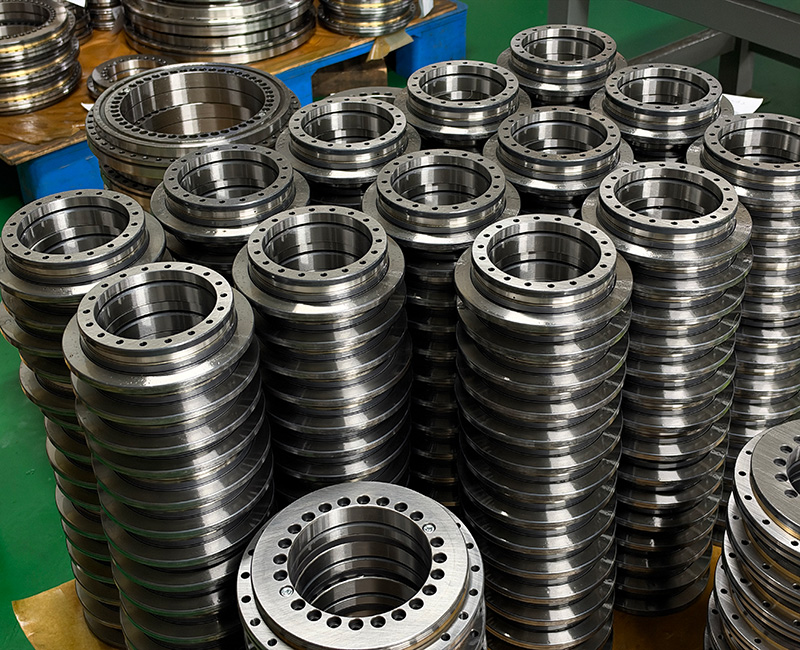
Achieving a consistent and accurate preload is not an accident; it is the result of a disciplined manufacturing and quality control process. With over 15 years of experience and a 13,500 m² intelligent factory, we have refined our methods for producing bearings with predictable, reliable performance.
1. Material Purity and Stability: We begin with high-grade GCr15 (SAE 52100) bearing steel. The chemical composition is verified by spectrographic analysis. After a controlled heat treatment process in our automated line, we conduct metallographic analysis to ensure a stable martensitic microstructure with optimal hardness (HRC 60-64). This material stability is the bedrock of predictable performance under preload.
2. Sub-Micron Grinding Accuracy: The final preload value is a direct function of the dimensional accuracy of the rings and rollers. Our CNC grinding workshops can achieve P5, P4, and even P2 precision grades. This allows us to manufacture components with tolerances measured in single micrometers, enabling us to set precise preload values for products like our YRT Rotary Table Bearings.
3. Advanced Metrology and Matched Sets: For our highest precision series, we don't just manufacture to a tolerance range. We measure each individual component and then create matched sets of inner rings, outer rings, and rolling elements. This meticulous matching process allows us to achieve a very narrow preload range for an entire production batch, ensuring consistent performance from one assembly to the next. This is how we support demanding B2B customers, like a client in Mexico requiring P2 rotary table bearings for high-precision gear grinding machines.
The choice between clearance and preload is a critical design decision. It involves a careful balance of stiffness, speed, thermal behavior, and accuracy requirements. Understanding these trade-offs is key to designing a reliable and high-performance machine.
If you are balancing these factors for your next design, our engineering team can help you specify the ideal bearing, preload, and mounting fit for your application. Contact us to discuss your requirements or to get a quote for a standard or custom bearing solution.
 +8618939019135
 sales@bybearings.com
 +8618939019135