Automation Bearing Suppliers: RFQ Questions to Ask
Most bearing sourcing problems start with an RFQ that left out one detail. Maybe nobody mentioned the moment load, or nobody asked for a material report, or the delivery date was only a verbal promise. Then the parts arrive, the robot joint shows backlash, and the production line waits. If you are looking for a Bearing Supplier for Automation Equipment, the questions you put in the RFQ decide how much of that risk you carry. This guide lists those questions, explains why each matters, and marks where a supplier's answer has limits.
What a Weak RFQ Costs You Later
A short RFQ such as "crossed roller bearing, 100 mm bore, 50 pcs" invites a short, unverified answer. The supplier quotes the cheapest matching catalog item. You find out about the mismatch after installation.
These are the mistakes we see most often in a typical bearing supplier RFQ:
Sending only dimensions. Bore, outer diameter and width do not tell a supplier whether the bearing will carry your overturning moment or hold your positioning accuracy.
Leaving out the accuracy class. P5, P4 and P2 are priced differently. If you do not state one, you may get the wrong class or no way to compare quotes.
Treating a certificate as proof of everything. An ISO 9001 certificate describes the factory's quality system. It does not replace a batch material report.
Accepting "fast delivery" without a date. A promise with no date in writing cannot be enforced.
Over-specifying everything. Light conveyor pivots rarely need P4 or P2 grades. Paying for precision the machine cannot use is a cost mistake too.
Build the RFQ Package in Seven Steps
A complete package takes an engineer about an hour to assemble. It saves several rounds of email. Here is the order we recommend:
Describe the application. Robot joint, harmonic drive output, CNC rotary table, DD motor turntable, conveyor, or medical or semiconductor equipment.
State the bearing type or series. If you are unsure, say so and let the supplier propose options. Interchange with an existing THK, IKO or INA part number is a valid starting point.
Give the accuracy requirement. Name the class (P5, P4 or P2) and any runout or torque target.
Supply loads and speed. Radial, axial, overturning moment, rotation speed, and whether motion is continuous or oscillating.
Note the environment. Temperature range, cleanroom use, washdown, dust.
Add quantity and schedule. Include trial lots and the ramp to series volume.
List the documents you require. Material report, inspection report, packing and labeling, warranty terms.
Match the Bearing Type to the Machine
Sending an RFQ for the wrong bearing family wastes the whole exercise. The table below summarizes how the main automation applications usually map to bearing types. It is a starting point, not a substitute for a load check.
| Application | Typical bearing | Why it fits | Where it falls short |
|---|---|---|---|
| Robot joints, harmonic drive output | Precision Crossed Roller Bearings, harmonic drive bearings | Compact, handles radial, axial and moment loads in one ring set, preload reduces wobble | Over-preloading raises friction torque and heat |
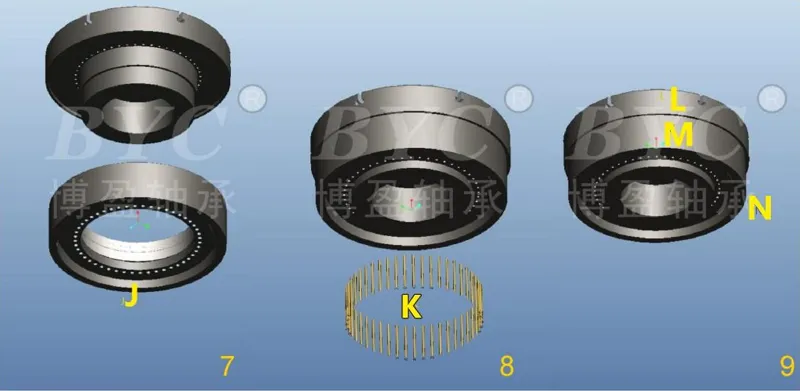
| CNC rotary tables, turn-mill centers | BRT Rotary Table Bearings, crossed tapered roller bearings | High tilting stiffness under combined loads, P4/P2 available | Heavier and costlier than a crossed roller bearing at the same bore |
| DD motors, direct drive turntables | Low friction torque crossed roller bearings | Smooth low speed rotation, stable thermal behavior | Needs lubricant and clearance matched to the duty |
| Medical imaging, semiconductor tools | Low vibration, high precision crossed roller bearings | Quiet operation and positioning stability | Requires torque and runout inspection records to verify |
| Conveyors, light pivots | Thin Section Bearings or standard series | Lower cost where positioning precision is not the goal | Not suited to heavy moment loads |
If your machine is a robot arm, our page on Bearings for Industrial Robotics shows the series commonly used in joints.
RFQ Answers on Load Calculations, Material Certificates, Lubrication and Delivery
These four topics cause most disputes after an order is placed. Below is what to ask a bearing supplier, when to insist on it, and where the supplier's answer reaches its limit.
When should the RFQ require a load calculation?
Require it when the bearing carries overturning moment, runs at high speed, or sits in a safety or precision critical joint. Also require it when you are replacing a branded part with an interchangeable one and your loads are higher than the original design assumed.
Limit: a calculation is only as good as your inputs. If you cannot provide radial, axial and moment loads plus speed and duty cycle, an honest supplier will say the result is an estimate. A calculation also does not replace a trial run on your machine.
When do you need a material certificate?
Require it when your customer audits your supply chain, when the bearing is used in medical or semiconductor equipment, or when you buy in bulk and want traceability per batch. On our side, bearing steel is GCr15 (SAE 52100) verified through spectrographic analysis, and after heat treatment we run metallographic examination to confirm hardness of HRC 60-64 and a stable martensitic structure.
Limit: bearing material certification confirms what the steel is. It says nothing about grinding accuracy or runout. Ask for the inspection report as a separate document. Also confirm what each certificate covers. ISO 9001:2015 describes the quality system, while CE, RoHS and TUV relate to the product or compliance scope.
Do you need lubrication advice in the quote?
Require it when the bearing runs at low speed with tight torque limits (DD motors, turntables), in a cleanroom, or at elevated temperature. Lubricant choice changes friction torque and thermal drift, so the quote should name the grease or state that you will supply your own.
Limit: a supplier can recommend a lubricant from your speed, temperature and load data. Nobody can guarantee a relubrication interval without knowing your real operating conditions. Treat any interval as a starting point and verify it in service.
What should a delivery guarantee look like?
Require it when a production ramp or customer launch depends on the parts. Ask for a dated delivery commitment per order, written into the quote or purchase order, and ask whether partial shipments are possible.
Limit: lead time depends on the item, quantity and whether special dimensions or mounting holes are involved. No supplier can honestly promise one number for every order. Also ask for warranty terms in writing. Ours run 12 months from the date of shipment.
| RFQ topic | Ask for | Good answer looks like | Warning sign |
|---|---|---|---|
| Load calculation | Check against your radial, axial and moment loads | States assumptions and what inputs are missing | "It will be fine" with no numbers |
| Material certificate | Steel grade and hardness records per batch | Names GCr15 (SAE 52100) and test method | Only a factory certificate, no batch data |
| Lubrication | Grease type and fill, or your own spec accepted | Explains effect on torque and temperature | No mention of lubricant at all |
| Delivery | Dated commitment and warranty terms | Date per order, conditions stated | "As soon as possible" |
Evidence to Request Before You Place the Order
Paper answers are the minimum. A credible automation bearing manufacturer should also show how it checks the parts it ships. Here is what we can point to, and what you can ask any supplier to match:
Inspection before shipment. We inspect 100% of bearings before shipment, with maximum runout controlled within 1.5 μm. Our Quality Control page describes the process.
Accuracy range. Grinding up to P2 class, with P5, P4 and P2 available.
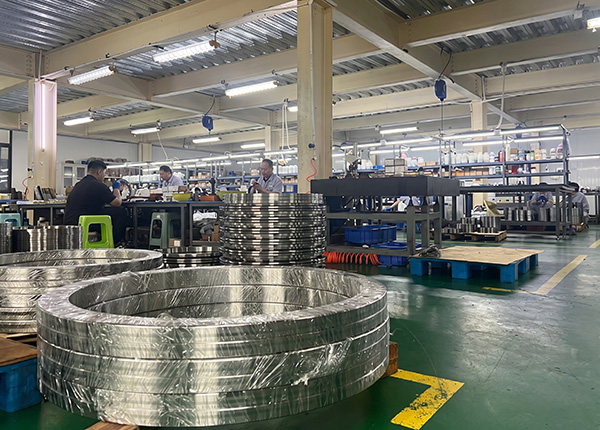
Capacity and facility. A 13,500 m² intelligent factory with a CNC workshop and automated heat treatment line, and monthly capacity of 15,000 sets.
Compliance. ISO 9001 quality system, plus CE, RoHS and TUV certification.
Order flexibility. No MOQ, plus OEM and ODM support for special dimensions or mounting holes.
Track record matters too, as long as it is specific. We have supplied P2 rotary table bearings for gear grinding in Mexico, crossed roller bearings for semiconductor equipment in Germany, and BBH Series Crossed Roller Bearings in bulk export to Germany. Those cases show the type of work we do. They do not mean every order follows the same timeline or specification, so we still confirm each RFQ on its own data.
When you compare quotes from any Bearing Supplier for Automation Equipment, put the answers side by side. A cheaper quote that skips the inspection report or the material record is usually not cheaper once rework is counted.
Buyer's Checklist Before You Send the RFQ
Drawing or part number, plus any interchange reference.
Accuracy class and runout or torque target.
Radial, axial and moment loads, speed and duty cycle.
Operating temperature and cleanliness requirements.
Lubricant: supplier recommendation or your own specification.
Required documents: material report, inspection report, certificates.
Quantity, trial lot size and target delivery date.
Warranty terms and who handles claims.
If you are still deciding between a crossed roller design and a larger rotary table bearing, review our Bearings for Automation Industry page first, then list both options in the RFQ so quotes are comparable.
Send your drawings, load data and delivery target, and our team will review them and reply with a quote and selection notes. You can get a quote through our contact page.
 +8618939019135
 sales@bybearings.com
 +8618939019135