BRT Rotary Table Bearings and Usable Torque Limits
Why does an axis built on BRT Rotary Table Bearings sometimes chatter, heat up or drift at a torque well below what the catalog row suggests? The short answer is that a catalog rating describes a bearing under clean, centered, rigidly supported conditions. A machine rarely offers those conditions. This article separates what can be observed on a rotary axis from what can only be inferred, then shows which design checks protect usable torque capacity before the architecture is frozen.
Catalog torque versus usable torque: what the gap means for design teams
"Torque capacity" is used loosely in rotary axis discussions, so we define it here. Usable torque capacity is the cutting, holding or drive torque an axis can handle while the bearing keeps its positioning accuracy, its runout and a friction torque the motor can still overcome. A catalog gives load ratings and stiffness figures. It does not give the torque at which your axis, with your fixture and your duty cycle, stops meeting its accuracy target.
Scope of this analysis. We do not cite a dated market survey or an industry-wide trend. This is an evergreen engineering issue drawn from application patterns in CNC rotary tables, turn-mill centers, direct drive turntables and handling axes. The BY Bearings case examples below illustrate how the issue shows up. They do not prove how the wider industry behaves.
Observation: axes with the same bearing size and the same nominal rating can behave very differently once a workpiece sits off center or the housing is thin.
Interpretation: the rating is being consumed by conditions the catalog does not include, not by a weaker bearing.
Buyer implication: compare operating limits at your real load offset and support condition, not only at the nameplate figure.
For OEM teams working on bearings for machine tools, this distinction decides whether one bearing size is enough or whether the axis needs a larger section, a different series or a stiffer housing.
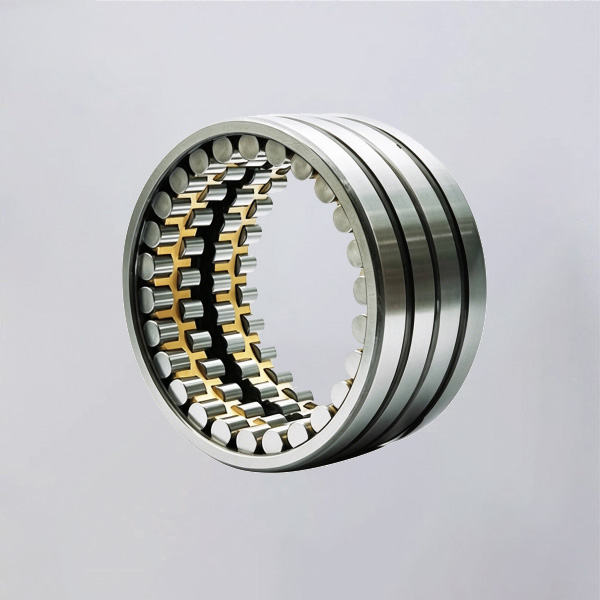
Load offset, support stiffness, contamination and lubricant condition: where usable torque drops
These four conditions are the ones we check first when a customer reports that an axis falls short. Each one reduces the torque the axis can sustain, and each is easy to miss in a drawing review. The table shows how they work and what to ask for.
| Condition | What happens inside the bearing | Effect on usable torque | Check at design review |
|---|---|---|---|
| Load offset | The workpiece or fixture center of mass sits away from the axis, adding tilting moment to axial load. Rolling elements on one side carry far more than the average. | The bearing reaches its moment limit sooner. Stiffness falls and positioning error grows before any visible damage. | Calculate combined axial load and tilting moment at the worst fixture, not the average part. |
| Poor support stiffness | A thin housing, a flexible base or too few bolts lets the rings deform. Contact stress concentrates and preload becomes uneven around the circumference. | Friction torque rises locally and runout worsens, even with a precision bearing grade. | Review flatness, wall thickness and bolt pattern on both mounting faces. |
| Contamination | Coolant mist, chips or fine dust reach the raceways. Rolling surfaces wear unevenly and lubricant degrades. | Friction torque becomes unstable. Rotation turns rough and accuracy drifts over time. | Define the sealing path, the coolant exposure and the cleaning routine for the axis. |
| Lubricant condition | Grease that is wrong for the speed, aged, or over- or under-filled changes film thickness and heat generation. | Heat builds under sustained duty. Thermal growth then changes preload and shrinks usable torque. | State grease type, fill quantity and relubrication interval on the drawing. |
Reasoning. These conditions rarely act alone. Load offset raises the moment, a soft housing makes the moment spread unevenly, and heat from poor lubrication then shifts preload. A bearing that handles each effect separately may still fall short when all three arrive together.
When this does not apply. If the load is nearly centered, the housing is thick and the axis is sealed and relubricated on a schedule, the catalog rating is a reasonable first estimate. A slow, intermittent positioning axis also tolerates more than a continuous high-speed one. When the combined moment is small, you do not need to oversize the bearing for these effects.
Other explanations to rule out before blaming the bearing
It is tempting to read a torque shortfall as a bearing problem and to answer it with a bigger bearing. That can be the wrong fix. Several other causes produce the same symptoms, and the evidence needed to separate them is usually available from the test bench.
Drive or gearing limits. Motor torque, gear backlash or clamp release timing can cap the axis. If friction torque is steady and the axis still stalls, look at the drive first.
Duty-cycle heat. A bearing that performs well in a ten-minute test can behave differently after hours of continuous work. If the shortfall appears only late in a shift, thermal growth is a stronger suspect than static load.
Preload choice. Too much preload raises friction torque and heat. Too little lets the axis tilt under moment load. Neither is a defect in the bearing; it is a mismatch with the duty.
Mounting errors. Uneven bolt tightening or a dirty seating face can distort the rings and imitate a capacity problem.
The point is to avoid treating a single symptom as proof of one cause. If friction torque is unstable, check contamination and lubricant first. If accuracy drifts only under offset loads, check moment and stiffness. If the axis stalls when cold but not when warm, preload and grease are the likelier culprits.
What this changes in your axis specification
Once the four conditions are on the table, the evaluation questions change. Instead of asking whether the bearing's rating exceeds the load, ask what the bearing carries once offset, support and heat are included. The checklist below shows which decision each question affects.
| Question to answer | Decision it affects |
|---|---|
| What is the worst case tilting moment, including heavy fixtures? | Bearing size and series selection |
| How stiff are the housing and base at the mounting faces? | Whether a precision grade will deliver its rated runout in your machine |
| Is the axis exposed to coolant, chips or dust? | Sealing design and maintenance interval |
| What is the continuous duty and expected temperature rise? | Grease type, preload level and thermal allowance |
| What friction torque can the motor overcome with margin? | Drive sizing and preload tolerance |
Here is a scoped illustration. A gear grinding axis puts heavy, off center fixture loads on the table and demands tight positioning. BY Bearings supplied P2 rotary table bearings for a gear grinding application in Mexico. We cite it only to show the kind of axis where accuracy grade and moment capacity must be reviewed together. It is a single case and not evidence of a general result.
Different axis types may also call for different bearing families. Heavy, multi-axis cutting loads often point toward crossed tapered roller bearings. Compact direct drive axes may favor precision crossed roller bearings. Where a more compact section is needed, the BRTM Series Rotary Table Bearings are worth comparing. Which one fits depends on your moment load, speed and installation space, so confirm it against your own load case rather than a general rule.
Common mistakes we see in specification reviews
Using average workpiece weight instead of the heaviest fixture plus part.
Choosing a P4 or P2 grade, then mounting it on a housing that cannot hold the flatness the grade assumes.
Leaving grease type and fill quantity unspecified.
Testing only at room temperature and short duty.
A practical check sequence before the architecture is locked
Use this order for a new axis. It takes a day of calculation and one bench test, which is cheaper than redesigning a table after the machine is built.
Define the worst load case. List axial load, radial load and tilting moment for the heaviest fixture at its most offset position.
Check the rating margin. Compare the combined load with the catalog rating of the candidate series and keep a margin for the conditions in the table above.
Review the support structure. Confirm flatness, wall thickness and bolt pattern on the housing and base.
Set the lubrication and sealing plan. Name the grease, the fill and the relubrication interval, and define how coolant is kept off the raceways.
Run a thermal duty test. Measure friction torque and runout when cold and again after sustained running.
Confirm incoming quality. Ask the supplier how runout and torque are verified before shipment.
On step six, BY Bearings holds runout within 1.5 μm and inspects every bearing before shipment. Details on how this is controlled are on our quality control page. This does not remove the load, stiffness and lubrication effects above, but it ensures the bearing arrives at the accuracy your calculation assumes. We also support OEM customization where special dimensions or mounting holes are required.
Open questions and signals that would change the assessment
The analysis has limits. We cannot give a single derating factor for load offset or housing stiffness, because the effect depends on geometry, preload and the specific series. Your own test data will tell you more than any general percentage. Our reasoning could also change if bench results show that a stiffer housing recovers most of the lost capacity. In that case the answer is a design change, not a larger bearing.
Three signals suggest a different response from the one described here:
Friction torque stays stable but positioning error grows under offset loads. This points to moment capacity and stiffness, and to a different bearing series.
Friction torque rises over several hours at constant load. Look at lubricant and thermal behavior before changing the bearing.
Performance varies between identical machines. Suspect mounting and housing differences before the bearing itself.
If you are comparing operating limits for a new axis, send us your load case, fixture offset, speed and duty cycle, together with the housing drawing. Our team will review whether BRT Rotary Table Bearings or another series fits, and flag the conditions that could reduce usable torque. You can get a quote or ask for selection advice, and we will respond with a recommendation based on your numbers. For wider product options, see our precision bearing solutions.
 +8618939019135
 sales@bybearings.com
 +8618939019135