Crossed Tapered Roller Bearings for Machine Tool Rotary Tables: Applications and Selection Guide
What Are Crossed Tapered Roller Bearings?
Crossed tapered roller bearings are a specialized class of precision rolling bearings characterized by tapered (conical) rollers arranged in a cross-wise pattern within a single raceway. Each roller is oriented at 90 degrees to its adjacent roller, and the tapered geometry means the rollers' axes converge at a common point on the bearing's centerline. This design allows a single bearing unit to simultaneously support radial loads, axial loads in both directions, and significant overturning moments.
The key distinction between crossed tapered roller bearings and conventional tapered roller bearings lies in their arrangement. Standard tapered roller bearings are typically mounted in pairs to handle combined loads, requiring careful adjustment of the two-row spacing to achieve the desired preload and rigidity. A crossed tapered roller bearing consolidates this function into a single, integrated unit, with the alternating roller orientation providing multi-directional load capacity without the need for paired mounting.
The tapered geometry itself offers a fundamental advantage over cylindrical rollers. Because the rollers are conical, the contact between roller and raceway occurs along a line that, if extended, passes through a common apex point on the bearing axis. This geometry eliminates the sliding motion that can occur at the ends of cylindrical rollers under certain load conditions, resulting in smoother operation and more uniform stress distribution across the roller length. Bearings such as the BXR series from BY Bearings are engineered around this principle, delivering high tilting stiffness within a compact cross-section.
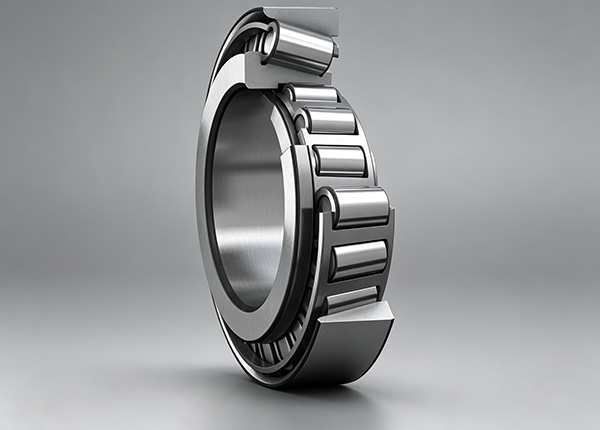
How Crossed Tapered Roller Bearings Differ from Crossed Cylindrical Roller Bearings
Crossed cylindrical roller bearings and crossed tapered roller bearings are often mentioned together, but they serve different purposes and are suited to different applications.
The most visible difference is the roller shape. Crossed cylindrical roller bearings use cylindrical rollers—straight-sided, with parallel axes relative to the bearing axis. Crossed tapered roller bearings use conical rollers, whose axes converge at a point on the bearing centerline.
This geometric difference has practical consequences. Tapered rollers, by virtue of their conical shape, can accommodate a greater degree of angular misalignment without edge loading. The line contact between a tapered roller and its raceway is more uniformly loaded along the roller length, which reduces stress concentrations and extends bearing life in applications where deflection cannot be entirely eliminated.
The load-carrying characteristics also differ. Crossed cylindrical roller bearings are excellent for applications requiring high radial stiffness and moderate axial capacity. Crossed tapered roller bearings, on the other hand, excel in applications where high axial loads and overturning moments dominate—precisely the conditions found in many machine tool rotary tables.
For machine tool builders, the choice between the two often comes down to the specific load profile of the application. When the dominant loads are axial and moment loads, crossed tapered roller bearings offer superior performance. When radial stiffness is the primary concern and axial loads are moderate, crossed cylindrical roller bearings may be the more cost-effective solution.
| Feature | Crossed Tapered Roller Bearings | Crossed Cylindrical Roller Bearings |
|---|---|---|
| Roller Shape | Conical (tapered) | Cylindrical (straight) |
| Roller Axis | Converge at a common point on bearing centerline | Parallel to bearing axis |
| Load Capacity | High axial, high moment, moderate radial | High radial, moderate axial |
| Tilting Stiffness | Excellent | Good |
| Misalignment Tolerance | Better (tapered geometry reduces edge loading) | Moderate |
| Typical Application | Machine tool rotary tables, vertical boring mills, gear grinding machines | General rotary tables, robotic joints, precision indexers |
| Precision Grades | P5, P4, P2 | P5, P4, P2 |
Why Machine Tool Rotary Tables Demand Crossed Tapered Roller Bearings
Machine tool rotary tables present a unique combination of requirements that few bearing types can satisfy simultaneously.
High Rigidity Under Combined Loads: A rotary table must support the weight of the workpiece, resist cutting forces from multiple directions, and maintain precise angular positioning—all at the same time. The bearing must be rigid enough to prevent deflection that would cause dimensional errors, yet compact enough to fit within the machine's design envelope. Crossed tapered roller bearings, including the BXR series from BY Bearings, achieve this balance through their line-contact geometry and integrated multi-row construction.
High Tilting Stiffness: The most demanding load on a rotary table bearing is often the overturning moment. When a heavy workpiece is mounted off-center, or when cutting forces act at a distance from the table's center of rotation, the bearing experiences a tilting moment that attempts to rotate the table out of alignment. Crossed tapered roller bearings resist this moment through the wide effective spread of their roller contact points. Because the tapered rollers converge at a common apex, the bearing's effective moment arm is significantly longer than its physical width would suggest, providing exceptional tilting stiffness within a compact cross-section.
Precision Rotational Accuracy: Machine tool rotary tables must position workpieces at precise angles, often within arc-seconds. Any runout—radial or axial—translates directly into positioning error. Crossed tapered roller bearings are manufactured to precision grades up to P2, with runout controlled to micron or sub-micron levels. The line contact between rollers and raceways also contributes to smooth, consistent rotation without the stick-slip behavior that can occur in point-contact bearings.
Compact Cross-Section: Space within a machine tool rotary table is limited. The bearing must fit within the available envelope without compromising load capacity or rigidity. Crossed tapered roller bearings offer a high load capacity-to-size ratio, allowing designers to achieve the required performance within a compact design.
Long Service Life: Machine tools operate for years, often in continuous production environments. The bearing must maintain its precision over millions of operating cycles. The tapered roller geometry distributes load evenly across the roller length, reducing fatigue stress and extending service life compared to bearings with less optimal load distribution.
Key Applications of Crossed Tapered Roller Bearings in Machine Tools
Vertical Boring Mills and Vertical Grinding Machines
Vertical boring mills and vertical grinding machines represent the most demanding application for crossed tapered roller bearings. In these machines, the rotary table must support workpieces weighing anywhere from a few hundred kilograms to several tons, while maintaining flatness and concentricity within microns.
The crossed tapered roller bearing is particularly well-suited to this application because of its ability to handle the massive axial loads and overturning moments generated by large, heavy workpieces. The bearing's high tilting stiffness prevents the table from sagging or tilting under load, ensuring that the machined surface remains flat and parallel to the table face.
The tapered roller geometry also contributes to thermal stability. As the machine warms up during operation, the bearing's internal clearance changes. Crossed tapered roller bearings can be preloaded to compensate for thermal expansion, maintaining consistent preload and accuracy across the operating temperature range.
Vertical Turning Centers and Vertical Lathes
Vertical turning centers (VTCs) and vertical lathes share many characteristics with vertical boring mills, but they are typically optimized for higher-speed turning operations. The rotary table in a VTC must rotate at higher speeds while maintaining the precision required for turning operations.
Crossed tapered roller bearings are used in these applications because they combine the load capacity needed for heavy cutting with the speed capability required for efficient turning. The tapered roller design minimizes friction and heat generation, allowing higher rotational speeds than would be possible with less efficient bearing types.
In direct-drive VTCs, where the table is driven by a torque motor without a gearbox, the bearing must also accommodate the motor's rotor and provide a large through-bore for cables and coolant lines. Crossed tapered roller bearings can be manufactured with large internal diameters to meet these requirements while maintaining the rigidity needed for precise turning.
Gear Hobbing and Gear Grinding Machines
Gear manufacturing requires precise synchronization between the cutting tool and the workpiece. In gear hobbing and gear grinding machines, the rotary table must rotate the workpiece in precise relationship to the cutter or grinding wheel.
Crossed tapered roller bearings are used in these applications because they provide the high rotational accuracy and stiffness needed to maintain synchronization. Any angular error in the workpiece rotation translates directly into tooth profile errors, lead errors, or pitch errors. The bearing's precision and rigidity are essential for achieving the tight tolerances required in modern gear manufacturing.
The high tilting stiffness of crossed tapered roller bearings is also important in gear grinding, where the grinding wheel exerts significant forces on the workpiece. Without adequate tilting stiffness, the workpiece could deflect under the grinding force, causing profile errors and inconsistent surface finish.
Precision Indexing Tables and Rotary Tables
Precision indexing tables and rotary tables are used in a wide range of machine tools for positioning workpieces at precise angles. These applications require bearings with zero backlash, high rigidity, and exceptional rotational accuracy.
Crossed tapered roller bearings meet these requirements through their preloaded construction and line-contact geometry. The preload eliminates internal clearance, ensuring that the table positions accurately without lost motion. The line contact provides the rigidity needed to resist cutting forces without deflection.
In applications where the table must index rapidly between positions, the bearing's low friction and smooth rotation contribute to fast, accurate positioning. The tapered roller geometry reduces the risk of roller skewing and edge loading during rapid accelerations and decelerations, maintaining precision over millions of indexing cycles.
Key Selection Criteria for Machine Tool Rotary Table Bearings
Selecting the appropriate crossed tapered roller bearing for a machine tool rotary table requires careful evaluation of several factors.
Load Analysis: Calculate the maximum axial, radial, and moment loads the bearing will encounter during operation. Consider both static loads (weight of the table, fixture, and workpiece) and dynamic loads (cutting forces during machining). Use these values to determine the required bearing size and load rating. For machine tool applications, a safety factor of 2 to 3 is typically applied to account for shock loads and unexpected conditions.
Precision Grade Selection: Match the bearing's precision grade to the application's accuracy requirements. P5 grade is suitable for general machining where moderate accuracy is acceptable. P4 grade is recommended for high-precision machining where consistent accuracy is required. P2 grade is reserved for the most demanding applications, such as precision gear grinding and high-precision boring.
Preload Configuration: Preload eliminates internal clearance and enhances rigidity. The optimal preload level balances stiffness requirements against acceptable friction torque and temperature rise. For machine tool rotary tables, moderate preload is typically used to provide the rigidity needed for precise machining without generating excessive heat.
Installation Space: Evaluate the available space for the bearing in the rotary table assembly. Consider the bearing's outer diameter, inner diameter, and axial height. Crossed tapered roller bearings offer compact designs, but the specific dimensions must match the available envelope. For direct-drive applications, a large through-bore may be required to accommodate cables and coolant lines.
Lubrication and Sealing: Select a lubrication method appropriate for the application. Grease lubrication is common for most machine tool applications, but oil lubrication may be required for high-speed or high-temperature applications. Effective sealing is essential to prevent contamination from cutting chips and coolant, which can accelerate wear and reduce bearing life.
Thermal Considerations: Machine tools generate heat during operation, causing thermal expansion that can affect bearing preload and accuracy. The bearing's internal clearance and preload should be specified to maintain consistent performance across the expected temperature range.
BY Bearings: Precision Crossed Tapered Roller Bearing Solutions
BY Bearings (Luoyang Boying Bearing Co., Ltd.) specializes in the manufacturing of high-precision crossed roller bearings, crossed tapered roller bearings, and rotary table bearings for machine tools, robotics, and industrial automation systems. With over 16 years of industry experience, the company has established itself as a reliable partner for precision motion control applications.
The BXR series of crossed tapered roller bearings from BY Bearings is specifically designed for machine tool rotary table applications. These bearings feature tapered rollers arranged in a cross-wise pattern, providing high tilting stiffness and multi-directional load capacity within a compact cross-section. The BXR series is available in precision grades up to P2, with every unit undergoing 100% inspection on runout, dimensional accuracy, and rotational torque consistency before shipment.
For machine tool builders, BY Bearings provides customization services including precision grade selection, preload optimization, sealing configurations, and lubrication solutions tailored to specific application requirements. The company's engineering team offers load calculation, model selection, and installation guidance to ensure that bearings are properly matched to each rotary table design.
With exports to over 100 countries, BY Bearings delivers reliable solutions for machine tools, robotics, and precision instrumentation worldwide.
Need precision crossed tapered roller bearings for your machine tool rotary table?Contact BY Bearings today for technical consultation and find the optimal bearing solution for your specific requirements.
FAQs About Crossed Tapered Roller Bearings
Q1: What is the difference between crossed tapered roller bearings and crossed cylindrical roller bearings?
Crossed tapered roller bearings use conical rollers whose axes converge at a common point, providing higher tilting stiffness and better performance under combined axial and moment loads. Crossed cylindrical roller bearings use straight rollers and are preferred for applications where radial stiffness is the primary requirement.
Q2: When should I choose a crossed tapered roller bearing over a crossed cylindrical roller bearing?
Choose crossed tapered roller bearings when the application involves high axial loads, significant overturning moments, or the need for high tilting stiffness in a compact space. Machine tool rotary tables, particularly those in vertical boring mills and gear grinding machines, are typical applications.
Q3: What precision grade is required for machine tool rotary table bearings?
The precision grade depends on the application's accuracy requirements. P5 is suitable for general machining. P4 is recommended for high-precision work. P2 offers the highest level of accuracy for the most demanding applications, such as precision gear grinding and high-precision boring.
Q4: How does preload affect the performance of a crossed tapered roller bearing?
Preload eliminates internal clearance and enhances rigidity, which is essential for maintaining zero backlash and precise positioning. However, excessive preload increases friction and heat generation. The optimal preload balances stiffness requirements against acceptable thermal effects.
Q5: Can BY Bearings provide customized crossed tapered roller bearings for specific machine tool designs?
Yes. BY Bearings offers custom dimension tailoring, preload optimization, sealing configurations, and lubrication solutions based on equipment structure, load requirements, and installation space. The engineering team works directly with customers to develop bearing solutions that match specific machine tool rotary table designs.
 +8618939019135
 sales@bybearings.com
 +8618939019135