Excavator Slew Bearings: Ball or Roller for Digging?
Ball or Roller: The Direct Answer for Excavation Duty
For excavator designers and rebuilders, the first question is not simply whether a bearing can rotate the upper structure through 360 degrees. The real question is whether the raceway configuration can carry repeated digging forces, boom-side loads, bucket shock, and overturning moments without creating excessive clearance or unstable swing behavior.
Excavator slew bearings with ball raceways are often a practical choice for moderate-duty machines, general excavation, and applications where compact structure and smooth rotation are priorities. Roller raceways are generally more suitable where heavy digging, repeated shock loading, high overturning moment, or a high-duty-cycle work pattern places greater demand on contact area and stiffness.
The choice is not absolute. A properly selected ball arrangement can serve demanding work when machine loads, mounting structure, lubrication, and duty cycle are suitable. Likewise, a roller design is not automatically the best answer for every excavator because it can require closer attention to mounting accuracy, friction, and total system cost. Buyers comparing Slew Bearings should begin with the machine’s real load directions and working cycle rather than selecting solely by outside diameter or an existing part number.
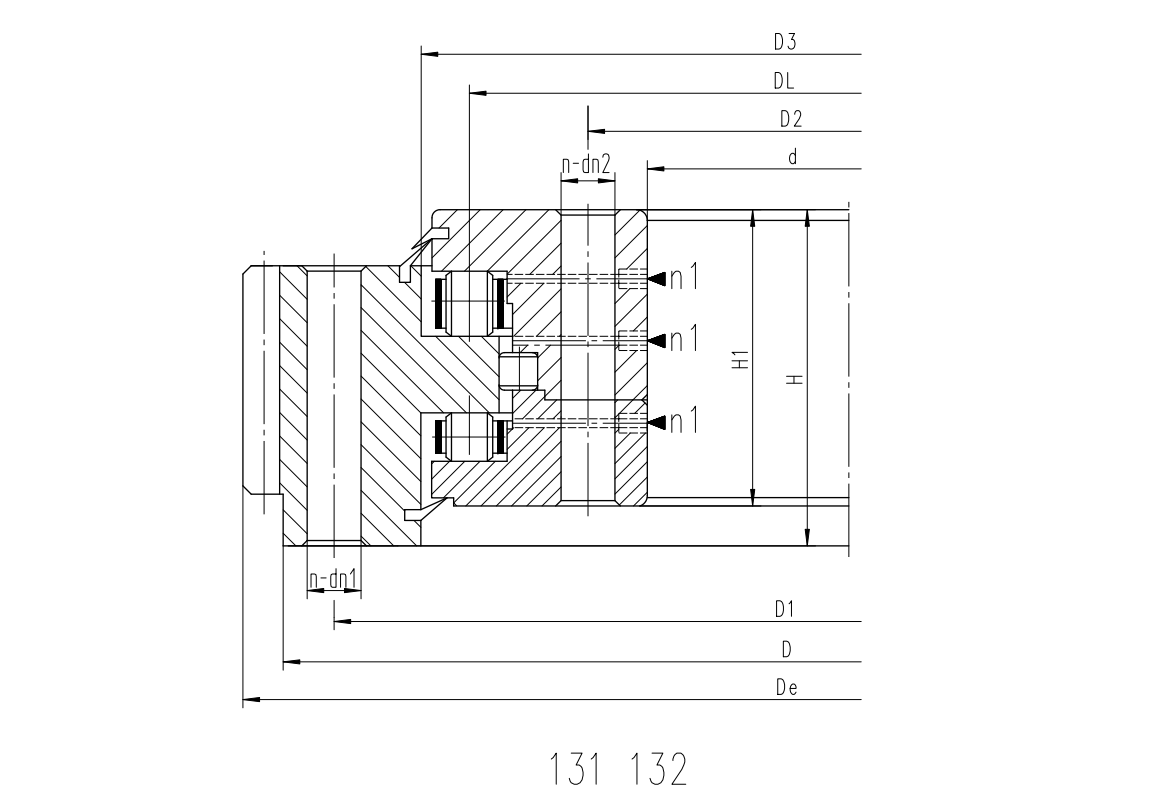
BY Bearings supplies slew bearings alongside crossed roller bearings, crossed tapered roller bearings, rotary table bearings, thin section bearings, spherical roller bearings, cylindrical roller bearings, thrust bearings, and harmonic drive bearings. For OEM and rebuild projects, we support flexible customization and no MOQ, allowing buyers to evaluate the raceway arrangement against the mounting and operating conditions of a specific machine.
Duty Cycle and Load Direction: When Ball or Roller Raceways Fit Excavation Work
The most useful ball vs roller slew ring comparison starts with what the excavator does during each shift. Digging does not apply one steady load. The bearing sees radial load from side reach, axial load from the upper structure, and overturning moment when the boom and bucket are extended away from the centerline. Shock is added when the bucket contacts compact ground, rock, debris, or a hard stop.
| Operating condition | Dominant bearing demand | Ball raceway fit | Roller raceway fit | Selection limit to check |
|---|---|---|---|---|
| General excavation with normal bucket loads and intermittent swing | Mixed axial, radial, and moment loading at a moderate cycle rate | Often suitable where compact design and smooth swing are valued | Can be selected, but may add cost or complexity without a clear duty benefit | Confirm actual peak moment, not only machine operating weight |
| Repeated trenching at long reach | High overturning moment from boom extension and loaded bucket | May work if the calculated raceway capacity and mounting stiffness are adequate | Usually the stronger candidate because line contact distributes heavy loads differently | Check boom geometry, bucket load, reach, and upper-frame deflection together |
| Rock digging, demolition, or hard-ground breakout | Shock loading plus changing radial and moment directions | Can be affected by concentrated contact stress if duty is underestimated | Often preferred when repeated shock and high load demand greater contact support | Roller selection does not remove the need for a stiff mounting structure |
| Frequent swing cycles with lighter material handling | Rotation frequency, friction behavior, and stable feel during swing | Often a sensible option for smooth rotation and standard service conditions | Suitable when load demand remains high, but friction and drive sizing should be reviewed | Assess swing motor torque and lubrication condition |
| Large attachment with off-center working load | High tilting moment and uneven loading around the ring | Requires careful capacity verification and close mounting control | Often appropriate where sustained moment loading governs the design | Review bolt pattern, ring support, and frame flatness |
Clear conclusion: choose a ball arrangement when the machine sees moderate mixed loads and the swing system benefits from a compact, smooth-running solution. Choose a roller arrangement when the operating pattern is dominated by sustained heavy digging, large overturning moments, or repeated shock. This is a duty-based decision, not a rule that every large excavator must use rollers.
The limit is equally important. If the upper frame or carbody mounting faces deform under load, a higher-capacity raceway alone will not correct the issue. Uneven support can create localized loading around either ball or roller elements. The bearing, fasteners, ring gear, mounting faces, and swing drive must be treated as one load path.
What Ball and Roller Contact Actually Changes in Service
Ball raceways: compact rotation under mixed loads
A ball excavator slew bearing typically uses balls running between raceways that are designed to accept combined loading. In a four-point-contact arrangement, the ball-raceway geometry enables axial, radial, and moment loads to be carried within one bearing structure. This makes the format useful for many excavator swing bearing types where design space and smooth rotation matter.
The practical benefit is a relatively simple arrangement for machines with balanced working conditions. During normal digging, the bearing can support the upper structure while allowing controlled swing. For an OEM building a compact excavator or a rebuilder matching an established machine design, a ball configuration may be the correct technical and commercial fit.
The trade-off is that contact occurs over a smaller area than a roller line contact. As digging force and overturning moment rise, contact stress and raceway demand can rise sharply. That does not mean ball designs are unsuitable for hard work; it means the bearing must be selected from verified load cases rather than from a broad machine-tonnage label.
Roller raceways: higher support for sustained moment loading
A roller excavator slew bearing uses cylindrical or tapered roller elements, depending on the bearing structure. The roller contact form creates a different load-carrying relationship from a ball design. In excavation work, that can be beneficial where the machine repeatedly works at extended reach, uses a heavy attachment, or experiences high overturning loads through much of its cycle.
Three-row roller structures separate load paths into different roller rows. One row can be arranged for axial loading in one direction, another for the opposite axial direction, and another for radial loading. This type of separation helps engineers address demanding combined loads, especially when moment load is a major selection driver. See the bearing arrangement used in a Three-row Roller Slewing Bearing when reviewing configurations intended for heavy load distribution.
The trade-off is that roller solutions should not be treated as drop-in upgrades. They can place higher expectations on mounting face preparation, bolt integrity, lubrication practice, swing-drive torque, and assembly control. If the customer’s priority is light-duty rotation with limited moment loading, the added configuration may not produce a useful return.
How Load Direction, Swing Resistance, and Mounting Stiffness Interact
A common selection mistake is to classify the machine only as “heavy duty” or “light duty.” That phrase does not identify the direction of the governing load. The following relationships should be reviewed before selecting a bearing:
- Axial load: This is the vertical force acting through the upper structure, boom, attachment, and payload. It affects raceway loading even when the excavator is not digging. A larger counterweight or attachment can change this condition.
- Radial load: This acts across the bearing centerline, often increasing when the boom reaches sideways or when the machine works on uneven ground. Radial demand affects raceway selection and can be amplified by structural movement.
- Overturning moment: This is usually the deciding load in long-reach digging. It increases as the bucket force and load move farther from the bearing center. A bearing that appears adequate under vertical load alone may not be adequate under this moment.
- Shock load: Sudden bucket breakout or impact can raise local stress. The issue is not only peak force; repeated shock can accelerate clearance growth and raceway damage if the bearing is undersized or poorly supported.
- Swing resistance: Friction torque influences swing-motor demand and operator feel. A bearing selected only for capacity may still create an unsuitable drive requirement if torque is not reviewed with the swing system.
These factors interact. For example, an excavator that frequently digs at maximum reach creates high moment loading. If it also rotates while carrying a loaded bucket, the ring sees a changing load zone rather than a stationary one. If the mounting frame flexes, the load is no longer shared evenly around the raceway. In this condition, selecting a bigger bearing without checking mounting stiffness can lead to the wrong root-cause decision.
For this reason, a drawing review should include the bearing seat diameter, bolt circle, gear location, mounting face dimensions, frame support arrangement, attachment weight, maximum reach, working orientation, and expected cycle pattern. If any of these inputs are unavailable, a definitive ball-versus-roller recommendation is premature.
Common Misunderstandings That Lead to the Wrong Bearing Choice
- “Roller always means better.” Roller raceways may better suit high sustained loads, but they are not automatically the right choice for a moderate-duty excavator. Use rollers when duty and load direction justify them, not as a default upgrade.
- “The replacement bearing only needs matching dimensions.” Bore, outside diameter, height, gear data, bolt hole arrangement, and raceway type all matter. A dimensional match without equivalent load capability can create a service problem.
- “Machine weight tells us the bearing load.” Machine weight is only one input. Bucket force, boom reach, attachment type, work angle, travel on slopes, and digging impacts can govern the actual bearing condition.
- “A bearing failure proves the raceway type was wrong.” It may instead point to loose bolts, insufficient lubrication, contaminated grease, distorted mounting faces, or swing-drive problems. Inspect the complete assembly before changing bearing configuration.
- “Higher preload is always safer.” Excessive preload can raise friction and heat. The intended internal setting must match the bearing design and application requirements.
Verification should be practical. Ask the supplier for the bearing drawing, load-rating basis, gear information, mounting requirements, lubrication points, and inspection documents. For a replacement program, compare the removed bearing’s raceway pattern and failure location with the excavator’s actual working behavior. Damage concentrated in one sector can indicate a recurring load direction or insufficient support in that area.
BY Bearings uses GCr15 bearing steel verified through spectrographic analysis and applies 100% inspection before shipment under its ISO 9001 quality system. Buyers can review our Quality Control approach when their project requires documented checks before bearing installation. Material and inspection control support bearing consistency, but correct application selection remains the buyer’s and supplier’s shared engineering task.
A Practical Selection Procedure for Designers and Rebuilders
- Define the work cycle. Record whether the machine mainly performs bulk earthmoving, trenching, long-reach excavation, lifting, demolition, or attachment-driven work. Identify how often it swings under load.
- Map the load directions. Separate axial load, radial load, overturning moment, and shock events. Do not combine them into one vague “heavy-load” description.
- Identify the governing condition. Determine which event creates the highest moment or repeated shock: full bucket at reach, side digging, breakout, lifting, or travel on uneven ground.
- Review the mounting system. Check ring support, frame rigidity, mounting face condition, bolt pattern, and gear engagement. A correctly selected bearing can still perform poorly on an unsuitable support structure.
- Compare ball and roller configurations. Select ball raceways for suitable moderate-duty mixed-load conditions; move toward roller raceways where sustained moment and shock dominate the duty cycle.
- Check swing drive compatibility. Review expected friction behavior with the swing motor, gearbox, and control requirements. Capacity and rotation resistance should be assessed together.
- Request a drawing-based review. Provide the existing bearing drawing or machine interface drawing, operating description, attachment details, and target replacement requirements.
A useful example is a rebuilder replacing a bearing on a machine used for standard earthmoving but occasionally fitted with a heavier attachment. The correct answer may not be an immediate change from a ball ring to a roller ring. First compare attachment load, maximum working radius, duty percentage, mounting interface, and swing-drive capability. If the heavy attachment is used only occasionally, a suitable ball configuration may remain valid. If it is used through repeated long-reach, high-resistance digging cycles, the roller option deserves deeper calculation and drawing review.
For applications where high moment stiffness is required in other rotating equipment, BY Bearings also manufactures Crossed Tapered Roller Bearings and Rotary Table Bearings. These products serve different equipment interfaces from excavator slew rings, but they reflect the same selection principle: rolling-element geometry must match load direction, stiffness demand, and operating cycle.
What to Include in an RFQ for the Right Raceway Recommendation
To answer “which slew bearing suits heavy digging” accurately, a supplier needs more than an excavator model name. Include the items below in the RFQ:
| Information to provide | Why it matters |
|---|---|
| Existing bearing drawing or part dimensions | Confirms the mounting envelope, gear arrangement, bolt layout, and replacement constraints. |
| Machine model and operating weight | Provides initial context, but should not be used as the only capacity input. |
| Boom, arm, bucket, and attachment details | Helps identify changes in reach, payload, and overturning moment. |
| Main work type and shift pattern | Distinguishes occasional heavy work from repeated high-duty excavation. |
| Photos of mounting faces and removed bearing condition | Can reveal support issues, bolt concerns, localized damage, or gear wear. |
| Required documentation and customization needs | Allows the supplier to prepare the correct drawing review and inspection scope. |
For an OEM project or rebuild assessment, submit your bearing drawing, load details, and duty cycle to get a quote and receive selection advice on ball or roller raceway options.
 +8618939019135
 sales@bybearings.com
 +8618939019135