OEM BRT Table Bearings: A Guide to Quote Cost Drivers
Why Do BRT Rotary Table Bearing Quotes Vary So Widely?
As a sourcing manager or design engineer, you've likely faced this scenario: you send out an RFQ for BRT series rotary table bearings and receive quotes with significant price differences, even for what appear to be dimensionally identical parts. This variance isn't arbitrary. It stems from critical, often unstated, factors that directly influence performance, lifespan, and ultimately, your total cost of ownership. Choosing the cheapest option without understanding these drivers can lead to premature failure, costly machine downtime, and compromised final product quality.
As a specialized BRT Rotary Table Bearings manufacturer with over 15 years of experience, we help engineering teams specify and source bearings that meet both performance and budget targets. The key is to look beyond the unit price and evaluate the technical and commercial components that constitute a comprehensive quotation. This guide breaks down the primary cost drivers so you can compare supplier proposals effectively and make a fully informed purchasing decision.
Deconstructing Your Quotation: A Landed-Cost Breakdown Model
A bearing quote is more than a single number. It's a combination of manufacturing choices, quality assurances, and logistical considerations. Understanding these components allows you to negotiate better and ensure you are paying for the level of performance your application truly requires. Here is a breakdown of the elements that determine your final landed cost.
Use this model to dissect and compare quotes from different suppliers:
| Cost Component | Description & Impact on Price |
|---|---|
| Base Bearing Specification | This includes the core design, dimensions, and material. We use high-grade GCr15 (SAE 52100) bearing steel as a standard, but custom materials or coatings for corrosive environments will increase the base cost. |
| Accuracy Grade (P5, P4, P2) | This is a major cost driver. Higher precision requires tighter manufacturing tolerances, more advanced grinding processes, and more intensive measurement. A P2 grade bearing can cost significantly more than a P5 grade due to the precision involved. For example, our work with a client in Mexico on P2 rotary table bearings for gear grinding applications demanded the highest accuracy to achieve their required surface finish. |
| Seals & Lubrication | Standard seals (e.g., NBR) offer a baseline cost. Requirements for high-temperature (Viton) or low-friction seals, along with special-purpose greases (e.g., cleanroom, high-speed), add to the unit price. |
| Inspection & Documentation Level | Our standard process includes 100% pre-shipment runout inspection. However, requests for detailed material certificates, full dimensional reports for every unit, or specific torque testing protocols will increase labor and documentation costs. |
| Minimum Order Quantity (MOQ) | As a manufacturer offering no MOQ, we provide flexibility. However, like any production process, larger batch sizes (e.g., 100+ units) enable more efficient machine setup and material purchasing, which can lower the per-unit cost compared to a one-off prototype order. |
| Packaging | Standard industrial packaging is included. Custom requirements like individual vacuum-sealed bags, anti-corrosion VCI paper, or custom-branded wooden crates for heavy bearings will be quoted separately. |
| Freight & Incoterms | The final landed cost depends heavily on shipping terms (e.g., EXW, FOB, DDP). Air freight is faster but more expensive than sea freight. We provide transparent quotes based on your specified Incoterms to avoid surprise logistical costs. |
How Manufacturing Excellence Reduces Your Total Cost of Ownership
Focusing solely on the initial purchase price is a common mistake. A lower-quality bearing may save money upfront but often leads to higher long-term expenses through frequent replacement, unplanned maintenance, and production losses. True value comes from a manufacturing partner whose processes guarantee reliability and precision, directly lowering your total cost of ownership (TCO).
At BY Bearings, our production philosophy is built on verifiable quality control that translates into tangible performance benefits for our customers. Here’s how our capabilities impact your operational costs:
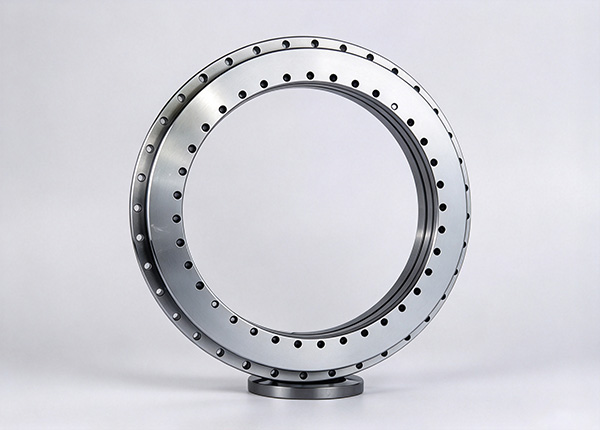
Precision Grinding and Runout Control
In applications like CNC rotary tables and turn-mill centers, bearing runout directly causes spindle chatter and surface finish defects. This leads to scrapped parts and rework. Our grinding processes achieve precision levels up to P2, and we enforce a maximum runout control within 1.5 μm. We verify this with 100% inspection before any bearing leaves our facility. This strict control ensures the bearing you install performs exactly as specified, protecting your machining accuracy and minimizing part rejection rates.
Material Purity and Heat Treatment Integrity
The fatigue life of a bearing is determined by its material and microstructure. We start with premium GCr15 bearing steel, verifying its chemical composition with spectrographic analysis. After processing on our automated heat treatment line, we conduct metallographic examinations. This confirms an optimal hardness (HRC 60-64) and a stable martensitic structure, free from internal defects. This rigorous material science approach prevents premature wear and unexpected bearing failure, extending the service life of your equipment and reducing maintenance intervals.
Compliance and Traceability
Operating within an ISO 9001:2015 certified quality system provides a framework for consistency and continuous improvement. All our processes, from raw material intake to final packaging, are documented and traceable. For clients in regulated industries or those with stringent quality demands, this traceability is essential for validation and compliance. This systematic approach has been a key factor in our success serving over 500 B2B customers across 65+ countries, including demanding markets in Germany and the USA.
Evaluating Your Sourcing Options: OEM Customization vs. Standard Interchange
One of the final decisions in sourcing Rotary Table Bearings is choosing between a standard, off-the-shelf part and a custom-designed OEM solution. The right choice depends on your application's uniqueness, production volume, and cost sensitivity.
When to Choose a Standard Interchangeable Bearing
If your design uses a common bearing size and your performance requirements fall within standard parameters, an interchangeable bearing is often the most efficient choice. This is particularly true when facing supply chain bottlenecks from major brands, who often have lead times of 4–8 months.
- Benefit: Speed and Cost-Effectiveness. We offer full dimensional and functional interchangeability with major Tier-1 brands but with a much faster turnaround of 45-60 days.
- Scenario: Your machine design is complete, and you need a reliable, qualified bearing supplier who can deliver quickly to meet production deadlines without requiring design modifications.
- Our Role: We can provide a direct replacement part that meets or exceeds the original specifications, helping you overcome supply chain delays and reduce costs.
When to Specify an OEM Custom Bearing
Customization becomes necessary when standard bearings cannot meet specific performance or integration challenges. This might involve non-standard dimensions, special mounting holes, integrated gearing, or unique sealing and lubrication requirements.

- Benefit: Optimized Performance and Integration. A custom bearing can solve complex problems like reducing assembly weight in robotics, improving rigidity in a compact space, or achieving specific friction torque characteristics in DD motors.
- Scenario: You are in the early stages of designing a new piece of equipment and want to optimize the bearing system for performance rather than designing around a standard part. For example, a customer developing semiconductor equipment required a custom Precision Crossed Roller Bearings with exceptionally low vibration and specific mounting features, which we successfully engineered and produced.
- Our Role: As an experienced OEM partner, we support custom design and manufacturing. You can submit your drawings, and our engineers will work with you to develop a bearing solution tailored to your exact needs, with flexible MOQs.
Whether you need a fast replacement for a standard part or a fully customized solution for a new design, understanding these options helps you align your sourcing strategy with your project goals.
By understanding the factors that drive the cost of BRT series bearings, you can better evaluate supplier quotes and secure the right balance of performance, quality, and price for your application. If you have a drawing or specific requirements for your next project, our engineering team is ready to provide a detailed, transparent quote.
Ready to discuss your requirements? Send us your technical specifications to get a quote.
 +8618939019135
 sales@bybearings.com
 +8618939019135