Thin Section Bearings Load Limits and FAQs for Engineers
How much load can a bearing with a few millimeters of ring wall really carry, and at what point does it stop being the right choice? That question comes up in almost every design review where space and weight are tight. Thin Section Bearings keep the same cross section across a wide range of bore sizes, which is why they appear in robot joints, medical gantries and compact rotary stages. But a thin ring is a thin ring. This article sets out where the limits sit, which load types cause trouble first, and what to check before you freeze a drawing.

What Load Types Thin Section Bearings Handle Well
Three loads act on a bearing in a compact joint: radial, axial and moment. A thin cross section reduces the room for rolling elements and ring material, so each load type has a ceiling lower than a standard-section bearing of the same bore. Which ceiling you hit first depends on the contact configuration.
| Configuration | Best suited load | Fits when | Limit to watch |
|---|---|---|---|
| Radial contact | Mainly radial, light axial | Light rotating assemblies, low overturning moment | Little tolerance for tilting or combined loads |
| Angular contact (see Type A Thin Section Bearing) | Radial plus thrust in one direction | Paired or preloaded arrangements, axial guidance | Needs a second bearing or a paired layout to take reversing thrust |
| Four point contact | Radial, two-way thrust and modest moment in one unit | Single-bearing joints with space limits | Higher friction torque; moment capacity still bounded by ball contact |
Confirm every load case against the manufacturer's static load rating and apply the safety factor your application requires. Do not rely on the dynamic rating alone if the joint spends most of its life stationary under load, because raceway indentation is a static problem.
When Thin Section Bearings Lose Suitability Under Heavy Duty
Most failures we see discussed in selection reviews are not manufacturing defects. They come from asking a compact ball bearing to do the job of a heavier component. These are the boundaries, stated plainly.
| Condition | Why a thin section struggles | Typical symptom | Better direction |
|---|---|---|---|
| High radial or combined load | Small balls and thin rings give limited contact area | Raceway indentation, rising torque, noise | Precision Crossed Roller Bearings with line contact |
| Shock or impact | Ball point contact concentrates stress at the peak | Brinelling marks, vibration at fixed positions | Roller-based designs, or reduce the shock path |
| Misalignment or poor housing | Thin rings take the shape of the housing and shaft | Torque ripple, uneven wear, early looseness | Tighter housing roundness and flatness, or a stiffer bearing |
| Large overturning moment | Ball contact tilts under offset loads; low tilting stiffness | Wobble, chatter, poor surface finish on machine tools | Rotary Table Bearings or Crossed Tapered Roller Bearings |
| Very large diameter, heavy continuous loads | Section is too small for the structural demand | Ring deformation, fatigue | Slew Bearings |
The short rule: if the moment load is the dominant load, or if shock is part of the duty cycle, a thin section ball bearing is usually the wrong first choice. It fits best when loads are moderate, the envelope is tight, and the housing is accurate.
Where this does not apply: a light, well-supported assembly can use a thin section bearing safely even at a large diameter. Size alone is not the test. The ratio of applied moment to the rated capacity is.
Pre-Selection FAQs on Load, Precision and Fit
Can one thin section bearing carry a moment load on its own?
Only a four point contact or paired layout can, and only to the rated moment load capacity. If an offset tool, arm or payload creates a large overturning moment, move to a crossed roller or rotary table bearing and leave the thin ball design for lighter duty.
Does a thin cross section mean lower precision?
Not by itself. Precision depends on grinding and inspection, not section height. At BY Bearings our grinding reaches P2 class, and bearing runout control holds within 1.5 μm with 100% inspection before shipment. Which grade is available for a given size and series should be confirmed on the drawing, because very thin rings are harder to hold round.
Can I swap a standard bearing for a thin section one to save space?
Yes, if the recalculated loads still pass. Many engineers copy the old bore and shrink the section without rechecking the rating. Rerun the static and moment checks first. If the loads rise above the thin section limits, the saved space will cost you life.
How tight must the housing and shaft be?
Tighter than for a standard bearing. Thin rings follow whatever shape they are pressed into. Out-of-round seats show up as torque ripple, so specify roundness and shoulder squareness on the housing drawing, not just the bore diameter.
Which designs suit harmonic drive and DD motor joints?
That depends on the load. Light, low-moment joints can use thin ball designs. Joints with higher stiffness demands often use crossed roller designs, and we supply harmonic drive bearings and units for Bearings for DD Motors, where low friction torque matters.
Can dimensions or mounting holes be customized?
Yes. We support OEM bearing customization for special dimensions and mounting holes, with flexible order quantities. Share your drawing, and we will tell you plainly whether a thin section ball design suits it or another type is the better fit.
What is the warranty?
12 months from the date of shipment.
A Five Step Check Before You Release the Drawing
- List every load case. Include radial, axial and moment loads, plus start-up, emergency stop and handling peaks.
- Convert to equivalent static load. Compare it with the static rating, using the safety factor your equipment class demands.
- Calculate the overturning moment. Use payload mass times lever arm. If it dominates, evaluate roller-based types.
- Review the housing. Set roundness, flatness and shoulder squareness before locking the bearing choice.
- Decide preload and torque targets. Positioning accuracy and friction torque pull in opposite directions, so state which one wins.
This is the practical core of precision bearing selection. It takes an hour, and it prevents most field returns.
Common Mistakes in Thin Section Selection
- Selecting on bore and OD only. Matching dimensions says nothing about whether the rating fits the loads.
- Ignoring peak loads. Average load looks safe while a single collision exceeds the static rating.
- Using an unmachined or lightly machined housing. The bearing inherits every housing error.
- Applying too much preload. It raises friction torque and heat, which can ruin low-speed smoothness in a DD motor.
- Assuming one type fits all axes. A wrist joint and a base joint on the same robot often need different bearings.
A Worked Scenario Showing the Decision
Consider an illustrative robot wrist with a hollow center for cabling. The designer wants a thin ball bearing at a large bore to save weight. The payload sits 150 mm off the bearing axis, so the dominant load is overturning moment, not radial load. In that case, the thin ball bearing may be tight on moment capacity and tilt stiffness. A crossed roller type with the same envelope usually carries combined loads in one compact unit; the Bearings for Industrial Robotics page covers the common formats. If the wrist carries only a light sensor, though, the thin ball bearing saves weight and cost with no penalty.
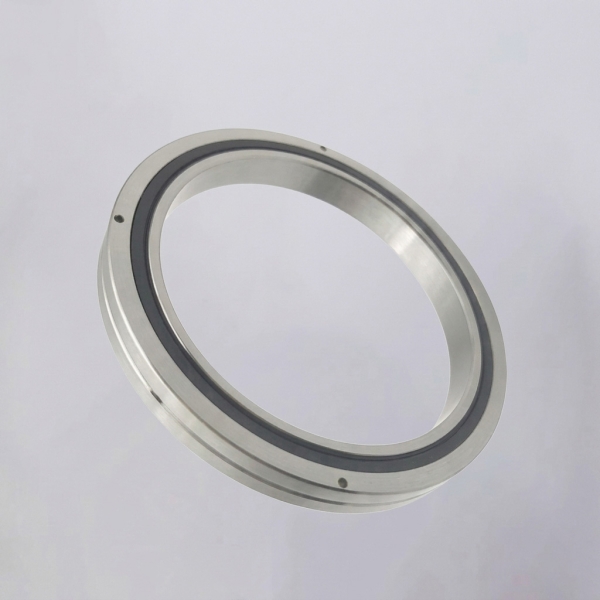
The same logic applies elsewhere. One of our German customers sources crossed roller bearings for semiconductor equipment, where low vibration and stable positioning drive the choice, and a Mexican customer uses our P2 rotary table bearings for gear grinding, where moment loads and runout are the main concern. In both cases the bearing type followed the load, not the envelope alone.
What BY Bearings Verifies Before Shipment
Load limits only matter if the bearing in your machine matches its drawing. Our factory covers 13,500 m² with a CNC workshop and automated heat treatment line, and monthly capacity reaches 15,000 sets. We operate under an ISO 9001 quality system, and our products carry CE and RoHS certification. Material is GCr15 (SAE 52100) bearing steel checked by spectrographic analysis, and after heat treatment we use metallographic examination to confirm hardness of HRC 60 to 64 with a stable martensitic structure. Our Quality Control page lists the inspection steps.
For heavier or moment-dominated duty, our range extends beyond ultra-slim ball types to BRT Rotary Table Bearings and BBH Series Crossed Roller Bearings, so you can compare options from one supplier. You can also review our standard Thin Section Bearings range alongside them.
If you have a joint layout and load data, send the drawing and we will review whether thin section designs hold up or a stiffer type is safer. You can get a quote or request selection advice from our engineering team.
 +8618939019135
 sales@bybearings.com
 +8618939019135