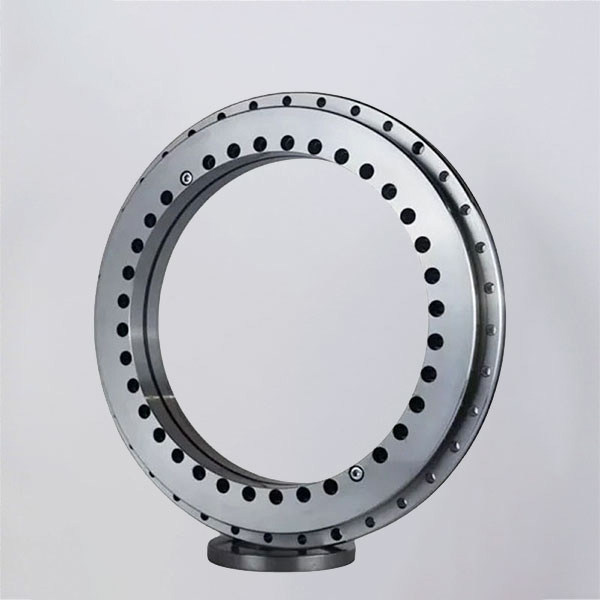
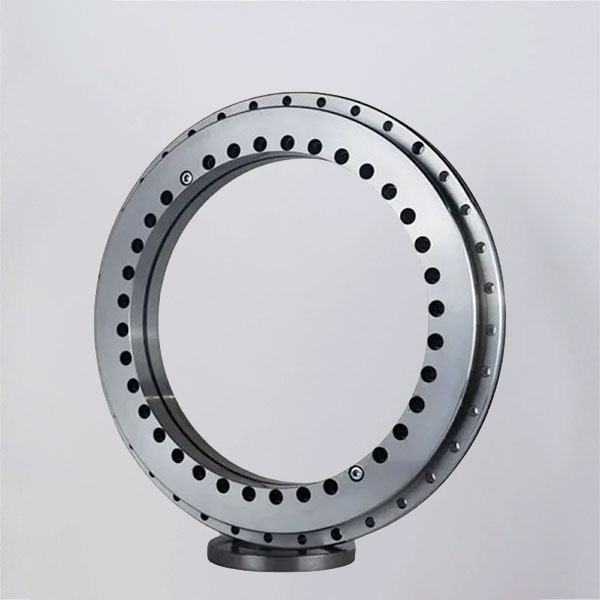

BRTS Series Rotary Table Bearings are identical to the BRT series in terms of external dimensions, mounting sizes, and precision classes. The key distinction lies in the radial rollers, which are equipped with nylon cages to accommodate high-speed rotational requirements. Characterized by high limiting speeds and a consistently low, stable frictional torque, the BRTS series is particularly ideal for applications involving torque motors. Interchangeable with mainstream YRTS type rotary table bearings for industrial robots, rotary tables and precision automation systems.
Equivalent: Compatible with YRTS Series Rotary Table Bearings
Outer Ring Diameter:300mm——600mm
Precision Class: P5/P4/P2
Axial Dynamic Load: 105kN——221kN
Delivery time: In Stock
What is BRTS Series Rotary Table Bearings?
The BRTS Series is a specialized category of high-speed rotary table bearings that shares the same external dimensions, mounting configurations, and precision classes as the standard BRT series. The defining characteristic of the BRTS model is the integration of nylon cages within the radial roller assembly. This structural enhancement is specifically engineered to meet the demands of high-speed rotation, making the BRTS series a seamless upgrade for systems requiring both the robustness of a combined bearing and the agility of a high-speed component.
Features and Advantages
High Limiting Speeds: Thanks to the low-friction nylon cages, the BRTS series can achieve significantly higher RPMs compared to full-complement roller designs.
Low and Stable Frictional Torque: These bearings are designed to provide consistent, minimal resistance during operation, ensuring system stability and preventing thermal build-up.
Optimized for Torque Motors: Due to their smooth rotation and high-speed capabilities, BRTS bearings are exceptionally well-suited for integration with direct-drive torque motors.
Precision and Reliability: Maintains the high axial/radial load capacity of the BRT series while enhancing dynamic performance.
Applications of BRTS Series
The BRTS series is the preferred solution for high-precision and high-dynamic fields, including:
High-Precision Motion Control: CNC rotary tables, indexing plates, and direct-drive (DDR) motors.
Robotics & Automation: Industrial robot joints, automated assembly lines, and harmonic reducers.
Aerospace & Defense: Radar systems, aviation equipment, and aerospace navigational components.
Precision Measurement: High-end metrology instruments and experimental testing stages.
Techspecs (Technical Specifications)
The BRTS Series is engineered to provide a superior balance between high-load capacity and extreme rotational precision. Below are the core technical specifications for our current production line:
Extensive Dimensional Range: Our standard BLTS models accommodate a wide array of industrial scales, with Outer Ring Diameters ranging from 300mm to 600mm. We also offer custom sizing for specialized large-scale projects.
Elite Precision Standards: To meet the diverse accuracy requirements of modern manufacturing, these bearings are available in P5, P4, and ultra-precision P2 grades. This ensures sub-micron run-out performance for the most demanding CNC and metrology applications.
Heavy-Duty Load Capacity: Despite their high-speed design, the BRTS series maintains exceptional structural integrity, supporting an Axial Dynamic Load from 105kN up to 221kN, allowing for stable operation under significant pressure.
Rapid Availability: To minimize lead times for our global partners, all standard models in the BLTS series are maintained In Stock and are available for immediate global shipping from our centralized warehouse.
How to Install BRTS Series Rotary Table Bearings?
Proper assembly is critical for ensuring zero-clearance and high-precision performance. Follow these steps:
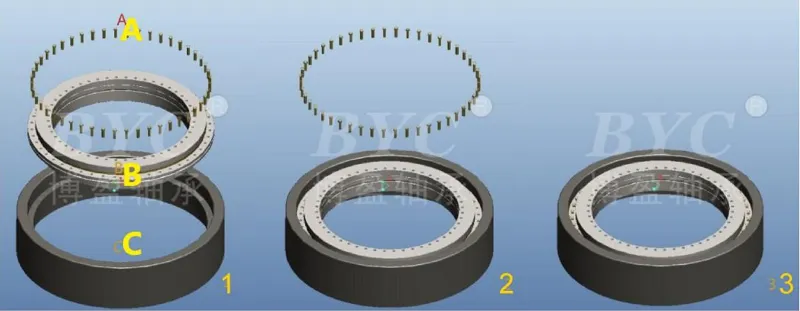
Housing Assembly: Fit the bearing (B) into the bearing housing (C) using the outer ring mounting screws (A).
Outer Ring Fit: A clearance fit should be maintained between the bearing's outer diameter and the housing.
Securing Outer Ring: Tighten the mounting screws in a crosswise pattern.
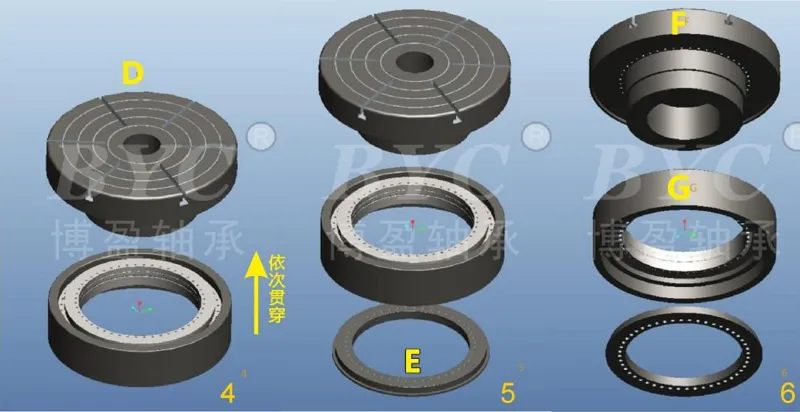
Table Positioning: Press the CNC rotary table surface (D) against the end face of the bearing.
Flange Integration: Install the flange (E/J/N) onto the other end face of the bearing.
Inner Ring Fit: A transition fit is required between the rotary table shaft (F) and the bearing's inner diameter (G).
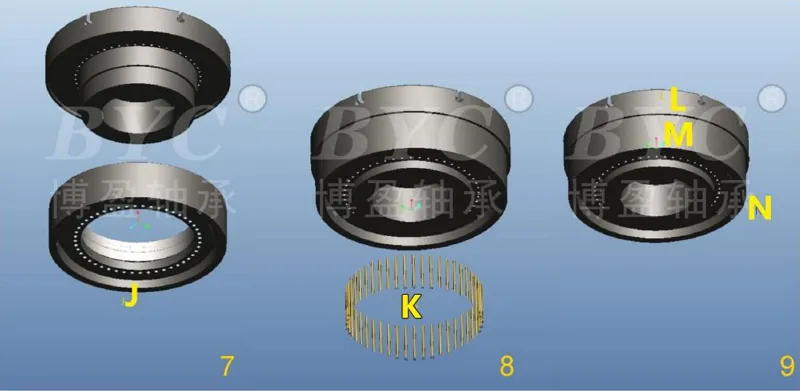
Alignment: Align all mounting holes of the flange, bearing, and table surface.
Securing Inner Ring: Tighten the inner ring connection screws (K) in a crosswise pattern.
Final Locking: Use connection screws to secure the flange and bearing assembly onto the table surface (L/M).
Storage Methods for BRTS Series
To maintain precision and prevent degradation, follow these storage guidelines:
Short-term Storage
Protective Coating: Ensure the factory-applied anti-rust grease remains intact.
Moisture Prevention: Use desiccants if stored in humid environments.
Scientific Placement: Do not store directly on the ground. Handle with care and store flat to avoid ring deformation.
Long-term Storage
Temperature Control: Maintain a warehouse temperature between 0°C and 25°C.
Humidity Management: Keep relative humidity between 45% - 60%.
Warehouse Environment: Store separately from chemical substances (acids, alkalis, etc.). Keep away from heating pipes.
Regular Inspection: Conduct a technical check every 10-12 months. Re-oil and repackage if the seal is compromised.
Price of BRTS Series Rotary Table Bearings
Pricing is determined by dimensions, precision requirements (P4/P2), and signal configurations. Contact our engineering team for a formal quote.
Supplier of BRTS Series Rotary Table Bearings
BYBearings is a national high-tech enterprise specializing in the design, R&D, and manufacturing of precision bearings. Backed by rigorous quality control and technical expertise, we provide more than just products—we provide precision solutions.
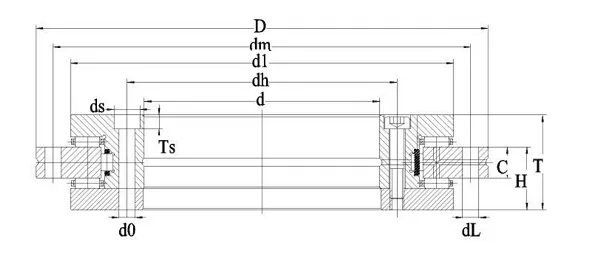
| Model Number | Inner Dia. d (mm) | Outer Dia. D (mm) | Width T (mm) | Height H (mm) | Mounting Dim. C (mm) | d1 (mm) | dn (mm) | dm (mm) | Dyn. Axial Ca (kN) | Stat. Axial Coa (kN) | Dyn. Radial Cr (kN) | Stat. Radial Cor (kN) | Weight (Kg) |
|---|---|---|---|---|---|---|---|---|---|---|---|---|---|
| BRTS200 | 200 | 300 | 45 | 30 | 15 | 274 | 215 | 285 | 105 | 635 | 78 | 202 | 9.7 |
| BRTS260 | 260 | 385 | 55 | 37 | 18 | 345 | 280 | 365 | 131 | 840 | 85 | 275 | 18.3 |
| BRTS325 | 325 | 450 | 60 | 40 | 20 | 415 | 342 | 430 | 191 | 1260 | 108 | 300 | 25 |
| BRTS395 | 395 | 525 | 65 | 42.5 | 20 | 486 | 415 | 505 | 214 | 1540 | 121 | 390 | 33 |
| BRTS460 | 460 | 600 | 70 | 46 | 22 | 560 | 482 | 580 | 221 | 1690 | 168 | 570 | 45 |
Given the structural characteristics of crossed roller bearings (rollers arranged in a 90° cross pattern), our technical team uses 3D CAD and finite element analysis (FEA) software to accurately calculate raceway angles, spacing, and interference.
Customizing products based on customer operating conditions, we benchmark against P2/P4/P5 tolerance classes and simulate post-assembly rotational precision in advance. The blueprint serves as the sole standard guiding all subsequent turning, grinding, and inspection processes.
Turning and grinding are the core processes that determine the bearing's geometric precision. We use high-rigidity CNC lathes for step-by-step ring processing, ensuring basic inner/outer diameter and raceway dimensions through rough, semi-finish, and finish turning while leaving grinding allowances.
We employ plunge grinding with formed grinding wheels for the V-shaped raceways of crossed roller bearings, and perform combination matching for the split inner/outer rings to ensure rotational plane runout meets P5 or higher standards.
The assembly of crossed roller bearings is more delicate than standard bearings: rollers must be arranged in an alternating cross pattern and precisely guided by spacers or cages.
All components are ultrasonically cleaned, dried, and grouped according to measured dimensions. High rigidity and stable torque are then imparted to the crossed roller bearings through negative clearance or preload adjustments. Assembly is completed in a constant temperature and humidity cleanroom to ensure P4/P2 level precision.
As tolerance classes P5, P4, and P2 become progressively stricter, our inspection equipment and processes are upgraded accordingly:
We use high-precision roundness measuring instruments for dimensional tolerances, dial indicators with dedicated test mandrels for radial and axial runout, profilometers and Coordinate Measuring Machines (CMM) to verify raceway profiles and angles, and dedicated clearance and torque testers to determine clearance and starting torque.
The packaging process is equally strict, ensuring zero loss of precision for the crossed roller bearings from the factory until pre-installation.
Eco-friendly anti-rust oil is evenly sprayed to ensure no residual particles in the inner cavity. Each bearing is vacuum-sealed in a thickened PE bag and film for water and dust protection, then boxed using wrapping tape. The outer carton is lined with high-density foam and pearl cotton to prevent transport collisions, and is marked with the model, precision grade (P5/P4/P2), and production batch number.
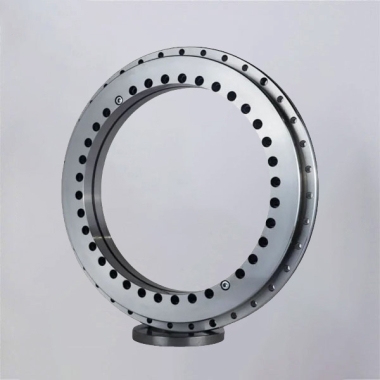
BRT Rotary Table Bearing is a high-performance rotary table ...
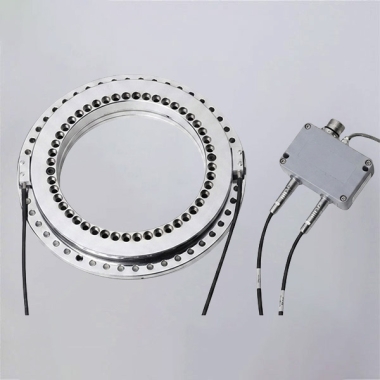
Explore BRTM Rotary Table Bearings with integrated steel gra...
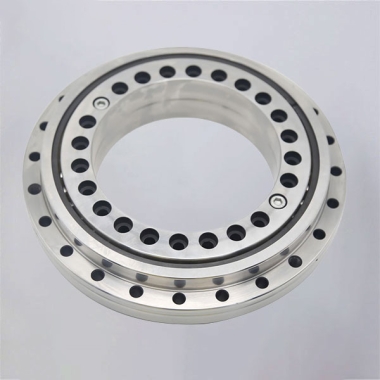
BLDF Series Rotary Table Bearings: Low friction, high-precis...
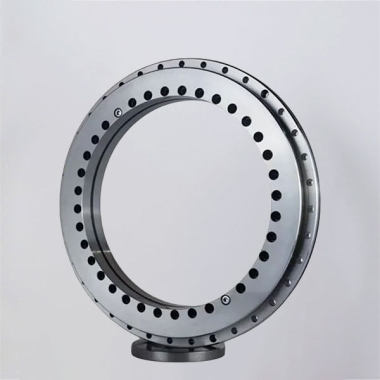
High-speed BRTS Rotary Table Bearings with nylon cages for t...
 +8618939019135
 sales@bybearings.com
 +8618939019135