Excavator Slew Bearings: How They Fail Under Heavy Loads
Why heavy digging loads concentrate damage in the swing bearing
How does an excavator swing bearing fail when the machine is working hard, and which part gives up first? The answer depends on which load path is overstressed. It can be the raceway, the ring body, the gear teeth or the mounting bolts. Excavator slew bearings sit between the undercarriage and the upper structure. They carry everything the boom, stick and bucket produce, and they do it in one large-diameter ring.
Three load types act on that ring at the same time:
Axial load: machine weight plus the vertical component of the digging force.
Radial load: side thrust from swinging against a bank, or from the swing motor reacting to inertia.
Overturning moment: the bucket's reach multiplied by its load. This is usually the dominant one, and it loads one side of the raceway far more than the other.
An excavator slew bearing load capacity figure is a rating under defined conditions. It assumes a flat, stiff supporting structure, correctly tightened bolts, adequate lubrication and loads that stay within the design envelope. Once any of those assumptions breaks, the real stress at the contact zone can be several times what the catalog curve implies. The ring then fails in one specific place, and that place tells you why.
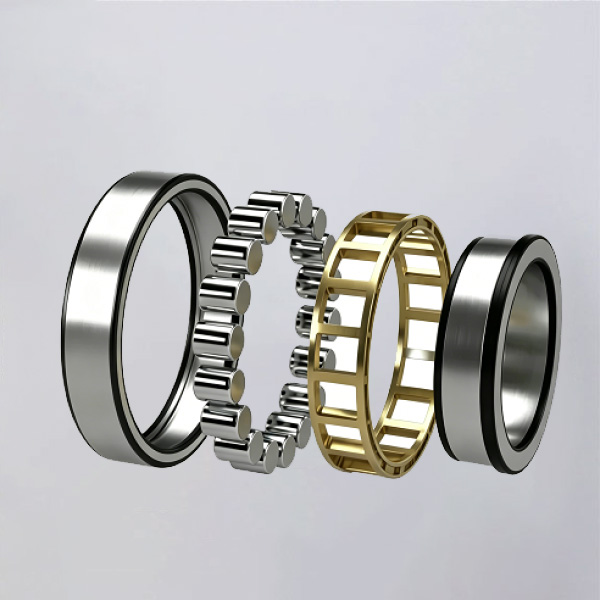
Four failure modes of an excavator slew ring and what each one tells you
Swing bearing load failure rarely looks the same twice. Reading the damage pattern is the fastest way to separate an operating problem from a bearing problem.
| Failure mode | Typical trigger | Early sign | What it points to |
|---|---|---|---|
| Raceway spalling (fatigue) | Sustained high moment load on one sector | Metal flakes in grease, rough swing feel in one arc | Load concentrated in the working sector, or capacity too small for the duty |
| Raceway indentation (brinelling) | Shock loads such as bucket impact or hammer work | Notchy rotation, repeating tight and loose spots | Peak load beyond static capacity, even if only briefly |
| Gear tooth wear, pitting or breakage | Swing motor torque spikes, poor backlash, dry gear teeth | Polished or pitted flanks, cracked teeth near the pinion mesh | Mesh misalignment, or the pinion reacting to ring deflection |
| Bolt loosening or fatigue fracture | Uneven preload, flexible mounting surface, reused bolts | Fretting rust around bolt heads, bolts that need re-torquing | Structure or preload problem, not a raceway problem |
Seal damage and contamination sit behind many of these. Once grit or water reaches the raceway, spalling can begin far below the rated load. A failed seal is often the first event in the chain, so inspect it early.
Boundary: when shock loads, overloads and uneven ground pressure exceed the load path
Every slew ring has a load path: bolts, ring section, raceway, rolling elements, the opposite ring, bolts again. Gear loads add a second path through the tooth root. The weakest link fails first, and it is not always the part that looks damaged. The table below shows where each abnormal condition usually breaks the path, and when a new bearing alone will not fix it.
| Condition | Link in the path that yields first | Evidence you can check | Does a replacement bearing solve it? |
|---|---|---|---|
| Shock loads (bucket strikes, rock breaking, dropping the bucket on hard ground) | Raceway surface and rolling elements: plastic indentation | Evenly spaced dents, vibration at a repeating angle | Only if the duty cycle is also reviewed. The same shocks will dent the new raceway. |
| Sustained overload (lifting or digging beyond the rated reach and load) | Raceway subsurface fatigue, then ring deformation | Spalling concentrated in the loaded sector, increased tilting clearance | Only with a larger-capacity bearing or a revised working limit. |
| Uneven ground pressure (machine tilted, one track high, soft or sloped footing) | Bolts on one side, ring flatness, gear mesh position | One-sided bolt fretting, uneven wear band, localized gear damage | No, not by itself. Site practice and structure alignment need correction. |
| Flexible or distorted mounting structure | Ring section and bolts, with raceway edge loading | Flatness out of tolerance, wear at bolt-hole locations | No. The mounting surface must be checked first. |
| Swing motor torque spikes or emergency stops | Gear teeth, then the ring's gear section | Chipped tooth roots, pinion wear pattern shifted | Partly. Backlash and brake setting must be reviewed too. |
Two practical limits follow from this table:
Do not treat rated capacity as a license for peak loads. Static capacity limits permanent indentation. Fatigue life limits how long the raceway lasts under repeated moment loads. They are separate checks.
Do not expect any ring to compensate for a bad foundation. If the supporting structure is not flat or stiff enough, the bolts and raceway edges carry loads the design never intended.
An illustrative scenario: two replacements in one season
This is a general illustration, not a completed customer project. Suppose a mid-size excavator works on a sloped quarry floor with occasional hydraulic hammer use. The owner replaces the swing bearing twice within one season, and each replacement feels rough again within weeks.
An inspection might find three things:
Raceway indentations spaced like the rolling element pitch, which indicates shock loading.
Bolt fretting on only one side of the ring, which points to uneven ground pressure and tilt during work.
Gear wear concentrated on a short arc, which means the machine always digs in the same swing direction.
Replacing the bearing again addresses none of these. The useful decisions are about operating practice (hammer angle, tilt limits), bolt preload procedure and mounting surface checks. Only after those are confirmed does a capacity upgrade make sense, for example moving to a three-row roller slewing bearing where the available envelope allows it. Treat the example as a method for reading evidence. Your own machine needs its own inspection.
A step-by-step diagnostic before you decide to repair or replace
Record the symptoms. Note when the roughness occurs: at one swing angle, during acceleration, or under load only.
Sample the grease. Metal flakes point to raceway fatigue. Fine grit points to seal failure and contamination.
Measure tilting clearance. Use a dial indicator between the upper and lower structure at several positions, and compare with the manufacturer's wear limit.
Check the bolts. Look for fretting marks, stretched or broken bolts, and uneven torque. Never reuse bolts that have yielded.
Check mounting flatness. Inspect both mating surfaces for distortion, cracks or weld repairs near the ring.
Inspect the gear mesh. Compare the wear band on the ring teeth with the pinion contact pattern and measure backlash.
Review the duty. Compare actual work (hammer use, slope, lift jobs) with what the machine and bearing were specified for.
Common mistakes when investigating repeated swing damage
Replacing without finding the cause. The second bearing inherits the same shock loads or the same distorted mounting surface.
Reading load capacity as a single number. Static capacity, fatigue life and bolt capacity are separate limits.
Re-torquing old bolts and moving on. Loose bolts are usually a symptom of uneven loading or a flexible structure.
Ignoring gear lubrication. Dry or contaminated teeth fail early even when the raceway is fine.
Choosing a replacement by outside dimensions alone. Matching the bolt pattern does not match the raceway type, ring hardness or gear data.
Checklist for replacement and what to send us for selection advice
Replacement is usually justified when you see raceway spalling or deep indentation, tilting clearance beyond the wear limit, or cracked ring sections. Repair or re-inspection is more realistic when the problem is limited to seals, grease and loose bolts, and the raceway is still clean.
At BY Bearings we have more than 15 years of precision bearing manufacturing behind our slew and rotary table lines. Our range covers the four point contact ball slewing bearing, the double row ball slewing bearing and the three-row roller type, with OEM customization for special dimensions and mounting holes. Every bearing goes through 100% inspection before shipment, as described on our quality control page.
Our documented cases are in precision applications: P2 rotary table bearings for gear grinding in Mexico and crossed roller bearings for semiconductor equipment in Germany. They do not show excavator performance, so we do not present them as such. They do show the kind of load and runout discipline we bring to every ring. For machines in earthmoving work, see our notes on bearings for construction machinery.
To assess an excavator slew ring properly, send us:
Machine class, swing speed and the working duty (digging, hammer, lifting).
Ring outer and inner diameter, height, bolt pattern and gear data (teeth, module).
Photos of the raceway, bolts and gear wear, plus the grease sample findings.
Any load figures or tilting clearance measurements you already have.
With that information we can tell you whether the damage points to the bearing, the structure or the operation, and which configuration fits your envelope. Send your drawings or damage photos and get a quote with selection advice from our application team.
 +8618939019135
 sales@bybearings.com
 +8618939019135