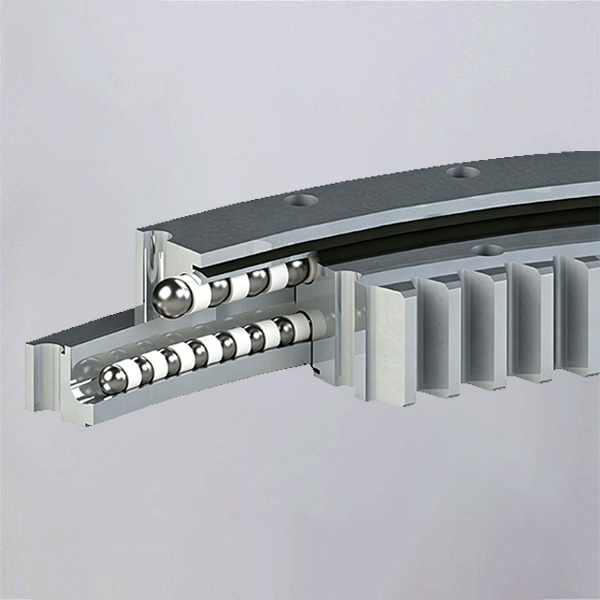
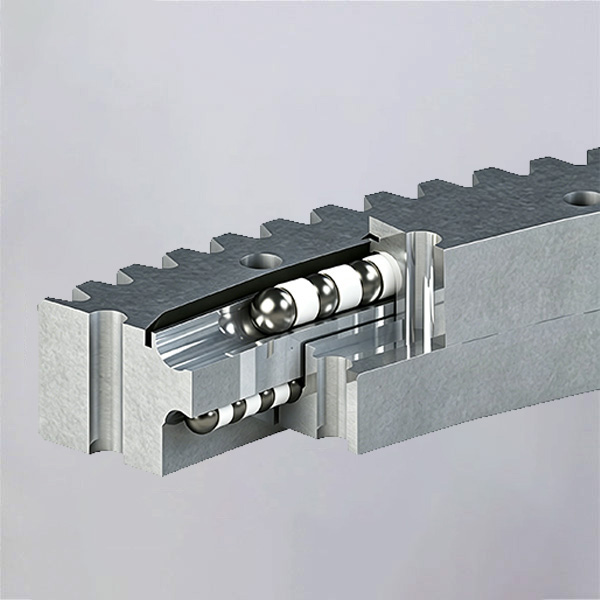
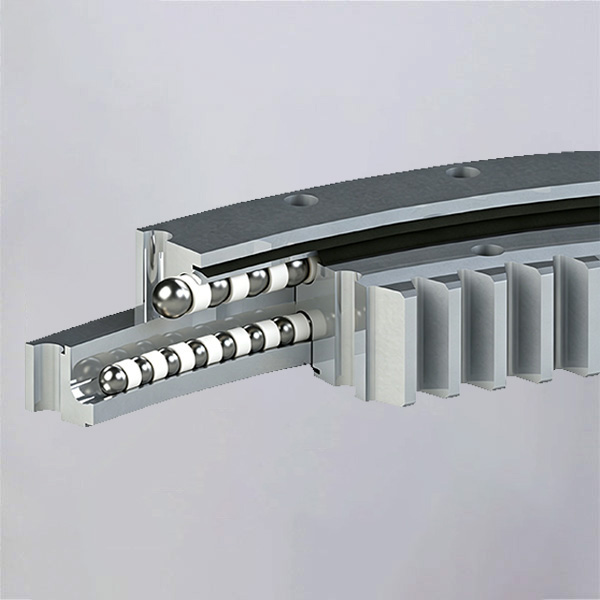
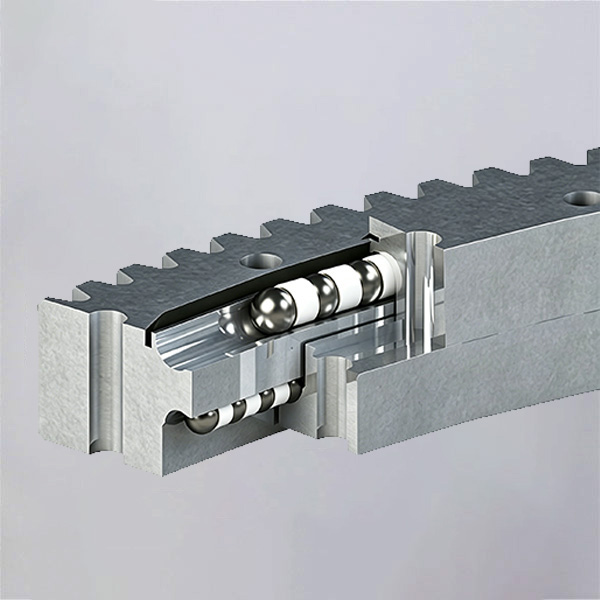

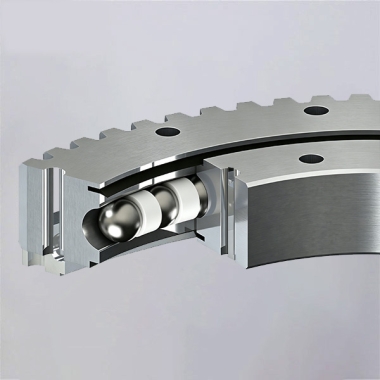
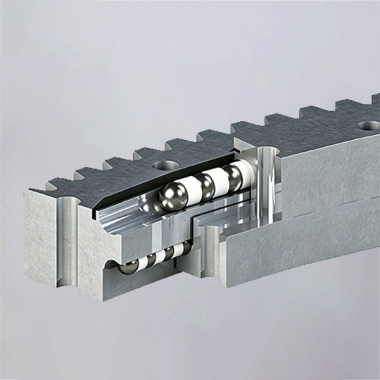
Double row ball slewing bearings are specially designed for heavy-duty applications that require high load capacity, excellent rotational stability, and reliable performance under combined loading conditions. This type of slewing bearing adopts a double-row ball structure with different ball diameters, allowing the bearing to efficiently support axial loads, radial loads, and overturning moments simultaneously.
Due to its compact structure and strong carrying capacity, the bearing is widely used in cranes, offshore equipment, port machinery, excavators, heavy transport systems, and other large rotating equipment.
Raceway Quenching Hardness:HRC 55–62
External Diameter Range:300 mm – 10,000 mm
Gear Type:No Gear / Internal Gear / External Gear
Load Type:Axial, Radial and Overturning Moment
Lead Time:Approximately 30 Days
Ring Material:42CrMo / 50Mn / C45
What Is a Double Row Ball Slewing Bearing?
A double row ball slewing bearing is a large-diameter rotational bearing designed to support heavy axial loads, radial loads, and substantial overturning moments simultaneously. Unlike single-row versions that use only one set of balls, this bearing type incorporates two independent rows of steel balls arranged in parallel raceways. This configuration allows the bearing to handle bidirectional axial forces—meaning it can support thrust loads coming from both directions—while maintaining smooth rotational performance.
Double row ball slewing bearings are typically used as connecting components between two structures that require relative rotation, such as a crane's chassis and its superstructure. Their ability to absorb high moment loads makes them indispensable in heavy machinery where eccentric loading is common.
Thanks to their robust design and high load capacity, double row ball slewing bearings are widely used across various industries, including construction cranes, offshore and marine equipment, port handling machinery, mining equipment, excavators, and industrial automation systems. Whether supporting the rotating house of a hydraulic excavator or enabling the yaw movement of a wind turbine, these bearings deliver reliable performance in the most demanding environments.
Core Structure of a Double Row Ball Slewing Bearing
The double row ball slewing bearing features a sophisticated yet robust structural design. Below are its key structural characteristics:
Three raceway design – Unlike simpler bearings with one or two raceways, this design uses three precision-ground raceways to guide and support the two ball rows separately.
Two rows of steel balls with different diameters – The upper and lower rows are engineered with different ball sizes to optimize load distribution according to specific working conditions.
Integrated inner and outer ring structure – Both rings are manufactured as single-piece components, maximizing structural integrity and eliminating weak points found in segmented designs.
Cage or spacer separation system – Steel balls are separated by cages or individual spacers to prevent ball-to-ball contact, reducing friction and wear.
Optional internal or external gear design – Either the inner or outer ring can be machined with gear teeth (or left gearless) to accommodate various drive systems.
The steel balls and spacers are directly assembled into the upper and lower raceways, a feature that significantly improves load distribution and rotational stability. According to different working conditions, the upper and lower rows are designed with different ball sizes to optimize bearing performance and carrying capacity. This means that a double row ball slewing bearing can be tailored to handle higher axial thrust on one side while maintaining excellent radial support on the other.
Together, the three-raceway layout, differentiated ball sizes, and integrated rings form the structural foundation of a double row ball slewing bearing that excels in demanding environments. However, a robust structure alone is not enough—material quality and heat treatment are what truly determine bearing life and reliability, as detailed in the next section.
Premium Materials & Precision Heat Treatment
The performance and service life of a double row ball slewing bearing depend heavily on two critical factors: the quality of raw materials and the precision of heat treatment. At BY Bearings, both are treated as core competencies.
Material Specifications
At BY Bearings, premium-grade materials are used to ensure durability, wear resistance, and long-term operational reliability. The rings are manufactured from carefully selected materials such as 42CrMo4 and 50Mn, which provide high tensile strength, excellent toughness, and consistent performance across large diameters. These materials are specifically chosen for their ability to withstand the cyclic stresses, impact loads, and environmental exposure common in heavy machinery applications.
Every batch of raw material entering the BY Bearings facility is certified and fully traceable. This means that from the initial steel ingot to the finished bearing, each component can be traced back to its original material certificate. This rigorous traceability guarantees that each double row ball slewing bearing leaving the BY Bearings facility meets the highest quality standards.
In addition to standard grades, BY Bearings offers alternative material options to meet specific application requirements, including corrosion-resistant alloys for marine environments and low-temperature steels for arctic operations. No matter the material choice, the focus remains the same: maximum durability, wear resistance, and long-term reliability.
Heat Treatment
Raw material quality alone is insufficient without proper heat treatment. BY Bearings applies precision heat treatment to every raceway to enhance hardness, fatigue resistance, and wear performance. Through computer-controlled induction hardening, the raceway surfaces achieve a uniform hardness of 55–62 HRC while maintaining a tough, ductile core.
This carefully balanced heat treatment process delivers several critical benefits:
Prevents surface indentation – Hardened raceway surfaces resist brinelling and plastic deformation under heavy rolling contact.
Resists crack propagation – The tough, ductile core absorbs shock loads and prevents cracks from spreading through the ring.
Extends operational life – Proper heat treatment significantly increases the fatigue life (L10 life) of the bearing compared to untreated or poorly treated alternatives.
Ensures consistent performance – Computer-controlled processes eliminate soft spots that can lead to premature localized wear.
For customers requiring specific case depths or alternative hardness profiles, BY Bearings offers fully customized heat treatment parameters to match unique application demands. Whether a bearing needs deeper case hardening for high-impact mining equipment or a specialized hardness profile for offshore cranes, BY Bearings delivers.
Why Material and Heat Treatment Matter
A double row ball slewing bearing with poor material quality or inadequate heat treatment will fail prematurely, regardless of how well it is designed. Spalling, brinelling, and raceway fatigue are almost always traced back to these two factors. By prioritizing premium materials and precision heat treatment, BY Bearings ensures that every bearing delivers the long service life and reliability that customers in construction, mining, offshore, and port industries demand.
Key Features of a Double Row Ball Slewing Bearing
This slewing bearing structure is engineered for demanding industrial applications where high reliability and large load support are essential. Below are its key performance features:
High axial and radial load capacity – The dual-row configuration allows the bearing to support heavy vertical thrust and horizontal radial forces without compromising rotational smoothness.
Excellent resistance to overturning moments – Three raceways working together provide superior stability when loads are applied off-center, a common scenario in crane and excavator operation.
Optimized load distribution design – Different ball diameters for the upper and lower rows ensure that each ball row carries a proportion of the load matched to its position, reducing peak stress points.
Stable low-speed rotation performance – Large-diameter slewing bearings typically rotate at slow speeds (under 10 rpm); this design ensures vibration-free, consistent motion even under full load.
Compact structure with high rigidity – Despite its high load capacity, the double row ball design maintains a relatively low cross-sectional height, saving space in machine design.
Long operational service life – Premium materials, precision heat treatment, and proper sealing contribute to extended maintenance intervals and years of reliable service.
Suitable for heavy-duty working environments – From dust-filled construction sites to corrosive marine atmospheres, these bearings withstand harsh conditions.
Compared with standard single-row slewing bearings, the double-row ball design provides improved structural strength and better operational stability under complex loading conditions. While a single-row bearing might require a larger diameter to achieve the same moment capacity, the double row design achieves it within a more compact and rigid package.
How Does a Double Row Ball Slewing Bearing Work?
The working principle of a double row ball slewing bearing revolves around its ability to distribute loads across two independent ball rows and three raceways.
When an axial load (vertical force) is applied, one ball row compresses while the other may experience unloading. In applications where loads reverse direction—such as a wind turbine yaw bearing subjected to changing wind pressures—the lower ball row handles upward thrust while the upper row handles downward thrust. This bidirectional capability eliminates the need for separate thrust bearings.
Radial loads (horizontal forces) are shared between both ball rows. The angled contact geometry of the raceways ensures that each ball transfers a portion of the radial force into the rings.
Overturning moments—the most challenging load type for slewing bearings—occur when a load is applied at a distance from the bearing's centerline, such as a crane boom lifting a heavy object. The double row design resists this moment by creating opposing force pairs: the upper ball row on one side of the bearing compresses while the lower ball row on the opposite side compresses. This triangulation of forces keeps the rotating platform stable and level.
Rotation is typically achieved through a pinion gear engaging with gear teeth machined into either the inner or outer ring. A hydraulic or electric motor drives the pinion, causing the bearing's rotating ring to turn while the stationary ring remains fixed to the machine's base.
Seals prevent contamination, while grease nipples allow periodic regreasing to maintain a low coefficient of friction between the balls and raceways.
Main Applications of Double Row Ball Slewing Bearings
Double row ball slewing bearings are commonly used in the following industries and equipment:
Construction cranes – Tower cranes, mobile cranes, and crawler cranes rely on these bearings to support the cab and boom while resisting high overturning moments during lifts.
Offshore and marine equipment – Ship cranes, deck machinery, and offshore platform revolving structures benefit from the bearing's corrosion-resistant options and ability to handle wave-induced dynamic loads.
Port handling machinery – Container cranes, ship unloaders, and mobile harbour cranes use double row ball slewing bearings for smooth, reliable rotation under heavy, repetitive cycles.
Mining equipment – Large excavators, bucket wheel reclaimers, and drilling rigs operate in dusty, high-impact environments where bearing robustness is critical.
Heavy-duty rotary platforms – Industrial turntables, radar antennas, and military launcher systems require precise, low-friction rotation supporting heavy payloads.
Excavators and lifting systems – Hydraulic excavators, backhoes, and telescopic handlers use these bearings for the house rotation mechanism.
Industrial automation equipment – Heavy-duty robotic positioners, assembly turntables, and rotating welding fixtures benefit from the bearing's rigidity and low runout.
In each application, the double row ball slewing bearing provides the necessary stability and load capacity to keep machinery operating safely and productively. BY Bearings has supplied custom double row ball slewing bearings to customers across all of these industries, with proven reliability in the most demanding field conditions.
How to Select the Right Double Row Ball Slewing Bearing?
Selecting the correct double row ball slewing bearing requires careful evaluation of several factors:
Load calculations – Determine your maximum axial load, radial load, and overturning moment (static and dynamic). Provide these values to the manufacturer for sizing.
Ball diameter configuration – Decide whether your application requires different ball sizes for the upper and lower rows. This is particularly important for machines with predominantly one-directional axial loads.
Gear requirements – Specify internal gear, external gear, or gearless. If gearing is needed, state the module, number of teeth, pressure angle, and required gear hardness (typically 40–50 HRC).
Mounting bolt pattern – Provide bolt circle diameter, bolt size, grade, and preload torque. The bolt pattern must match your machine's mating flange.
Sealing and environmental protection – Choose seals appropriate for dust, water, or chemical exposure. Double-lip or labyrinth seals offer superior protection.
Rotation speed – Most applications are low-speed (<10 rpm). Higher speeds require special cage designs and continuous lubrication.
Material and heat treatment verification – Confirm that the manufacturer uses premium-grade materials and applies precision heat treatment to raceways. With BY Bearings, you receive certified material reports and complete hardness test records for every bearing.
Certifications – For cranes, wind turbines, or offshore use, ensure the bearing meets ISO 9001, API, or GL standards. BY Bearings maintains full ISO 9001:2015 certification.
Always consult the manufacturer's load capacity tables and request static (C0) and dynamic (C) life calculations. An incorrectly selected bearing can fail prematurely, leading to costly downtime and safety risks.
Common Failures and Maintenance of Double Row Ball Slewing Bearings
Even high-quality double row ball slewing bearings can fail without proper maintenance. Common failure modes include:
Raceway indentation (Brinelling) – Caused by shock loads, vibration during transport, or exceeding static load capacity. Small dents create noise and increased friction.
Spalling and fatigue – Flaking of the raceway surface due to cyclic overloading or inadequate heat treatment. Once spalling begins, it accelerates rapidly.
Wear and scoring – Abrasive particles entering through failed seals grind raceways and balls, increasing clearance and reducing precision.
Corrosion – Moisture ingress leads to rust pitting on raceways and balls, compromising smooth rotation.
Lubrication breakdown – Old, contaminated, or incorrect grease fails to separate balls from raceways, causing metal-to-metal contact.
Bolt loosening or fracture – Mounting bolts lose preload over time under cyclic loads, leading to relative movement between bearing and machine flange.
Preventive maintenance practices:
Regular regreasing – Follow manufacturer intervals (typically every 100–500 operating hours or every 3–6 months). Use recommended EP (extreme pressure) grease.
Bolt torque inspection – Retorque all mounting bolts after the first few operating hours, then periodically per the maintenance schedule.
Rotational torque monitoring – Measure and record the force required to rotate the bearing. A sudden increase indicates possible contamination or raceway damage.
Seal inspection – Check seals for cracking, gaping, or hardening. Replace immediately if compromised.
Axial and radial play measurement – Increased clearance signals raceway or ball wear. Compare to baseline measurements.
Visual inspection – Look for rust, grease leakage (which may indicate seal failure), or unusual noise during rotation.
If any abnormality is detected, stop operation immediately and consult a bearing specialist. Minor surface wear can sometimes be repaired by regrinding raceways and replacing balls, but deep spalling or cracked rings require full replacement.
Customized Slewing Bearing Solutions From BY Bearings
Every heavy machinery application has unique requirements. Standard off-the-shelf bearings often cannot meet specific load conditions, installation space limitations, or environmental challenges. That is why BY Bearings specializes in providing fully customized slewing bearing solutions tailored to your exact needs.
We provide customized slewing bearing solutions based on customer drawings, load requirements, installation dimensions, and operating environments. Whether you need a bearing for a compact industrial turntable or a large offshore crane, our engineering team works closely with you to develop the optimal design.
OEM and ODM services are available, including:
Customized gear design – Internal or external gears with specific module, tooth count, and hardness requirements.
Sealing systems – Enhanced seals for dust, water, extreme temperatures, or chemical exposure.
Lubrication solutions – Custom grease types, lubrication fittings, and distribution channels.
Special material processing – Corrosion-resistant alloys, low-temperature steels, or alternative grades for unique environments.
From initial concept to final production, BY Bearings ensures that every customized bearing meets rigorous quality standards with premium materials and precision heat treatment.
Contact BY Bearings today for technical support, product catalogs, and quotation details. Submit your drawings or load specifications, and our engineering team will respond with a customized solution and competitive quote.
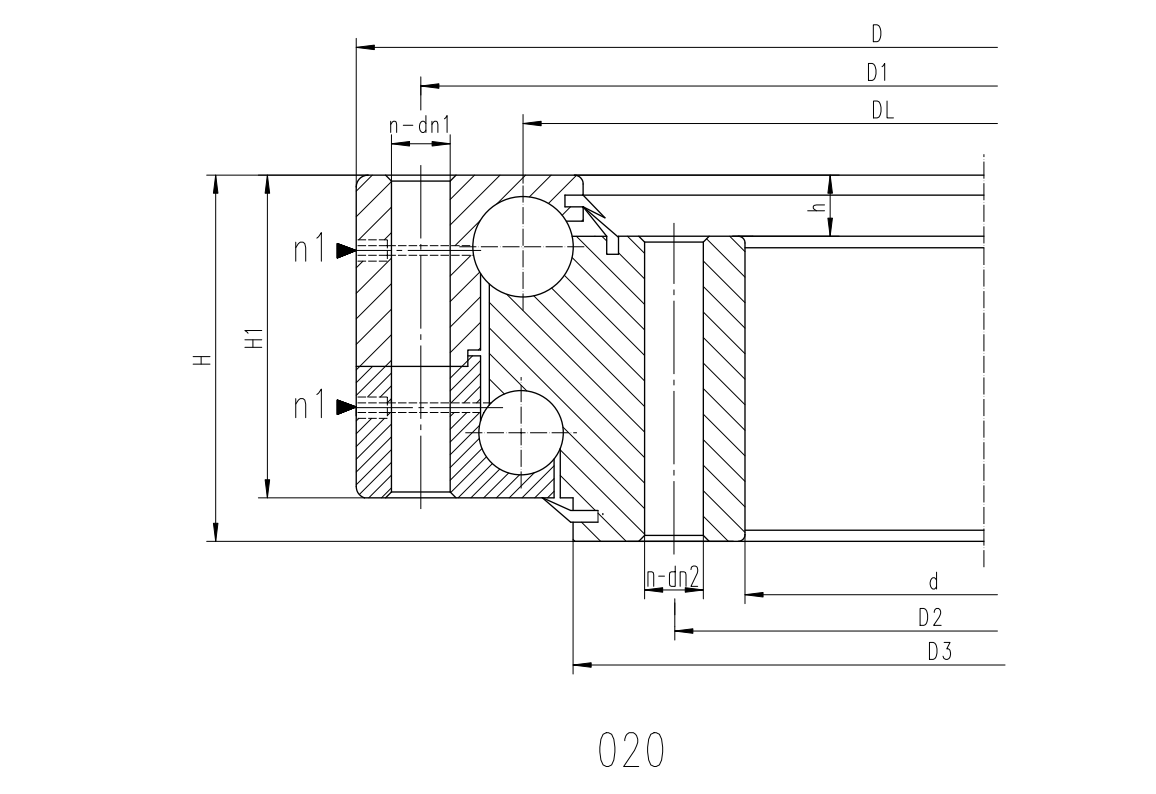
| Non-gear Type | ||||||||||
|---|---|---|---|---|---|---|---|---|---|---|
| Model | D (mm) | d (mm) | H (mm) | D1 (mm) | D2 (mm) | D3 (mm) | d1 (mm) | H1 (mm) | h (mm) | N.W (kg) |
| 020.25.500 | 616 | 384 | 106 | 580 | 420 | 477 | 482 | 96 | 26 | 121 |
| 020.25.560 | 676 | 444 | 106 | 640 | 480 | 537 | 543 | 96 | 26 | 136 |
| 020.25.630 | 746 | 514 | 106 | 710 | 550 | 607 | 613 | 96 | 26 | 152 |
| 020.25.710 | 826 | 594 | 106 | 790 | 630 | 687 | 692 | 96 | 26 | 172 |
| 020.30.800 | 942 | 658 | 124 | 898 | 702 | 771 | 777 | 114 | 29 | 284 |
| 020.30.900 | 1042 | 758 | 124 | 998 | 802 | 871 | 877 | 114 | 29 | 316 |
| 020.30.1000 | 1142 | 858 | 124 | 1098 | 902 | 971 | 977 | 114 | 29 | 349 |
| 020.30.1120 | 1262 | 978 | 124 | 1218 | 1022 | 1091 | 1097 | 114 | 29 | 394 |
| 020.40.1250 | 1426 | 1074 | 160 | 1374 | 1126 | 1214 | 1215 | 150 | 39 | 709 |
| 020.40.1400 | 1576 | 1224 | 160 | 1524 | 1272 | 1364 | 1365 | 150 | 39 | 787 |
| 020.40.1600 | 1776 | 1424 | 160 | 1724 | 1476 | 1564 | 1565 | 150 | 39 | 899 |
| 020.40.1800 | 1976 | 1624 | 160 | 1924 | 1676 | 1764 | 1765 | 150 | 39 | 1018 |
| 020.50.2000 | 2215 | 1785 | 190 | 2149 | 1851 | 1962 | 1965 | 178 | 47 | 1586 |
| 020.50.2240 | 2455 | 2025 | 190 | 2389 | 2091 | 2202 | 2206 | 178 | 47 | 1789 |
| 020.50.2500 | 2715 | 2285 | 190 | 2649 | 2351 | 2462 | 2465 | 178 | 47 | 1990 |
| 020.50.2800 | 3015 | 2585 | 190 | 2949 | 2651 | 2762 | 2765 | 178 | 47 | 2243 |
| 020.60.3150 | 3428 | 2872 | 226 | 3338 | 2962 | 3102 | 3104 | 214 | 56 | 3762 |
| 020.60.3550 | 3828 | 3272 | 226 | 3738 | 3362 | 3502 | 3504 | 214 | 56 | 4272 |
| 020.60.4000 | 4278 | 3722 | 226 | 4188 | 3812 | 3952 | 3954 | 214 | 56 | 4828 |
| 020.60.4500 | 4778 | 4222 | 226 | 4688 | 4312 | 4452 | 4454 | 214 | 56 | 5465 |
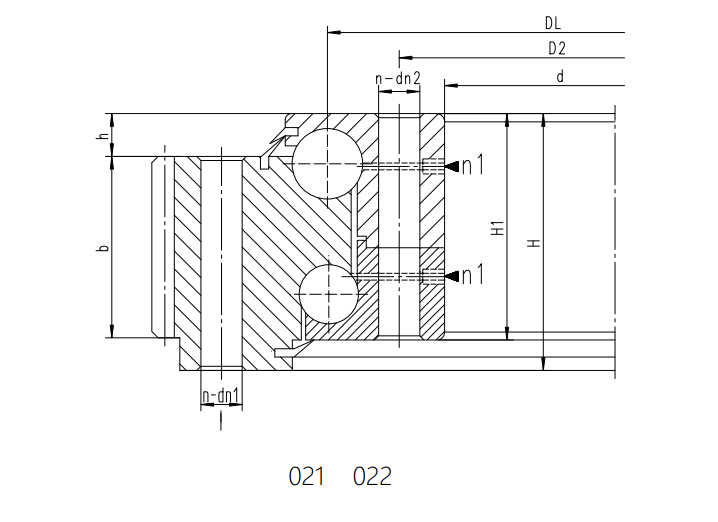
| External Gear Type | ||||||||||
|---|---|---|---|---|---|---|---|---|---|---|
| Model | D (mm) | d (mm) | H (mm) | D1 (mm) | D2 (mm) | D3 (mm) | d1 (mm) | H1 (mm) | h (mm) | N.W (kg) |
| 021.25.500 | 616 | 384 | 106 | 580 | 420 | 523 | 518 | 96 | 26 | 130 |
| 022.25.500 | 616 | 384 | 106 | 580 | 420 | 523 | 518 | 96 | 26 | 130 |
| 021.25.560 | 676 | 444 | 106 | 640 | 480 | 583 | 578 | 96 | 26 | 146 |
| 022.25.560 | 676 | 444 | 106 | 640 | 480 | 583 | 578 | 96 | 26 | 147 |
| 021.25.630 | 746 | 514 | 106 | 710 | 550 | 653 | 648 | 96 | 26 | 173 |
| 022.25.630 | 746 | 514 | 106 | 710 | 550 | 653 | 648 | 96 | 26 | 170 |
| 021.25.710 | 826 | 594 | 106 | 790 | 630 | 733 | 728 | 96 | 26 | 190 |
| 022.25.710 | 826 | 594 | 106 | 790 | 630 | 733 | 728 | 96 | 26 | 187 |
| 021.30.800 | 942 | 658 | 124 | 898 | 702 | 829 | 823 | 114 | 29 | 305 |
| 022.30.800 | 942 | 658 | 124 | 898 | 702 | 829 | 823 | 114 | 29 | 307 |
| 021.30.900 | 1042 | 758 | 124 | 998 | 802 | 929 | 923 | 114 | 29 | 349 |
| 022.30.900 | 1042 | 758 | 124 | 998 | 802 | 929 | 923 | 114 | 29 | 348 |
| 021.30.1000 | 1142 | 858 | 124 | 1098 | 902 | 1029 | 1023 | 114 | 29 | 396 |
| 022.30.1000 | 1142 | 858 | 124 | 1098 | 902 | 1029 | 1023 | 114 | 29 | 391 |
| 021.30.1120 | 1262 | 978 | 124 | 1218 | 1022 | 1148 | 1143 | 114 | 29 | 445 |
| 022.30.1120 | 1262 | 978 | 124 | 1218 | 1022 | 1148 | 1143 | 114 | 29 | 439 |
| 021.40.1250 | 1426 | 1074 | 160 | 1374 | 1126 | 1286 | 1282 | 150 | 39 | 784 |
| 022.40.1250 | 1426 | 1074 | 160 | 1374 | 1126 | 1286 | 1282 | 150 | 39 | 774 |
| 021.40.1400 | 1576 | 1224 | 160 | 1524 | 1272 | 1436 | 1432 | 150 | 39 | 870 |
| 022.40.1250 | 1576 | 1224 | 160 | 1524 | 1272 | 1436 | 1432 | 150 | 39 | 878 |
| 021.40.1600 | 1776 | 1424 | 160 | 1724 | 1476 | 1636 | 1635 | 150 | 39 | 995 |
| 022.40.1600 | 1776 | 1424 | 160 | 1724 | 1476 | 1636 | 1635 | 150 | 39 | 1003 |
| 021.40.1800 | 1976 | 1624 | 160 | 1924 | 1676 | 1836 | 1835 | 150 | 39 | 1147 |
| 022.40.1800 | 1976 | 1624 | 160 | 1924 | 1676 | 1836 | 1835 | 150 | 39 | 1151 |
| 021.50.2000 | 2215 | 1785 | 190 | 2149 | 1851 | 2038 | 2035 | 178 | 47 | 1794 |
| 022.50.2000 | 2215 | 1785 | 190 | 2149 | 1851 | 2038 | 2035 | 178 | 47 | 1780 |
| 021.50.2240 | 2455 | 2025 | 190 | 2389 | 2091 | 2278 | 2275 | 178 | 47 | 2017 |
| 022.50.2240 | 2455 | 2025 | 190 | 2389 | 2091 | 2278 | 2275 | 178 | 47 | 2048 |
| 021.50.2500 | 2715 | 2285 | 190 | 2649 | 2351 | 2538 | 2532 | 178 | 47 | 2246 |
| 022.50.2500 | 2715 | 2285 | 190 | 2649 | 2351 | 2538 | 2532 | 178 | 47 | 2280 |
| 021.50.2800 | 3015 | 2585 | 190 | 2949 | 2651 | 2838 | 2832 | 178 | 47 | 2553 |
| 022.50.2800 | 3015 | 2585 | 190 | 2949 | 2651 | 2838 | 2832 | 178 | 47 | 2563 |
| 021.60.3150 | 3428 | 2872 | 226 | 3338 | 2962 | 3198 | 3196 | 214 | 56 | 4428 |
| 022.60.3150 | 3429 | 2873 | 227 | 3339 | 2963 | 3199 | 3197 | 215 | 57 | 4414 |
| 021.60.3550 | 3828 | 3272 | 226 | 3738 | 3362 | 3598 | 3596 | 214 | 56 | 5012 |
| 022.60.3550 | 3828 | 3272 | 226 | 3738 | 3362 | 3598 | 3596 | 214 | 56 | 4967 |
| 021.60.4000 | 4278 | 3722 | 226 | 4188 | 3812 | 4048 | 4046 | 214 | 56 | 5706 |
| 022.60.4000 | 4278 | 3722 | 226 | 4188 | 3812 | 4048 | 4046 | 214 | 56 | 5656 |
| 021.60.4500 | 4778 | 4222 | 226 | 4688 | 4312 | 4548 | 4546 | 214 | 56 | 6293 |
| 022.60.4500 | 4778 | 4222 | 226 | 4688 | 4312 | 4548 | 4546 | 214 | 56 | 6385 |
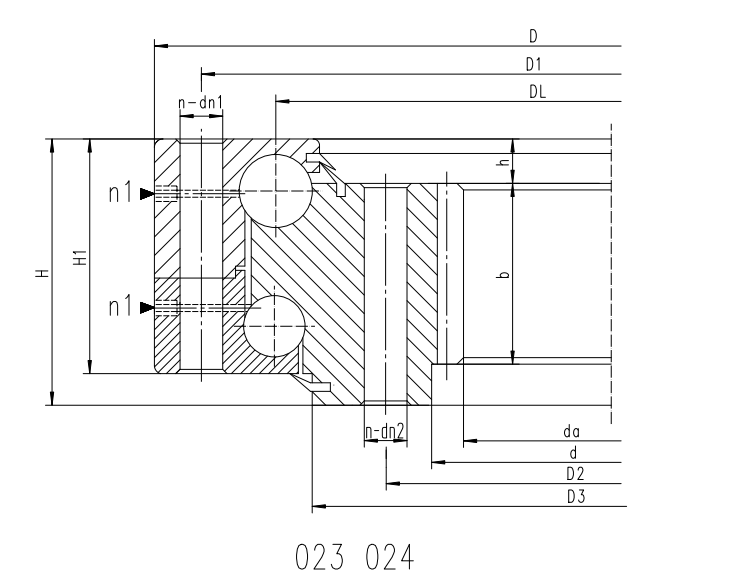
| Internal Gear Type | ||||||||||
|---|---|---|---|---|---|---|---|---|---|---|
| Model | D (mm) | d (mm) | H (mm) | D1 (mm) | D2 (mm) | D3 (mm) | d1 (mm) | H1 (mm) | h (mm) | N.W (kg) |
| 023.25.500 | 616 | 384 | 106 | 580 | 420 | 477 | 482 | 96 | 26 | 126 |
| 024.25.500 | 616 | 384 | 106 | 580 | 420 | 477 | 482 | 96 | 26 | 128 |
| 023.25.560 | 676 | 444 | 106 | 640 | 480 | 537 | 542 | 96 | 26 | 143 |
| 024.25.560 | 676 | 444 | 106 | 640 | 480 | 537 | 542 | 96 | 26 | 144 |
| 023.25.630 | 746 | 514 | 106 | 710 | 550 | 607 | 612 | 96 | 26 | 160 |
| 024.25.630 | 746 | 514 | 106 | 710 | 550 | 607 | 612 | 96 | 26 | 162 |
| 023.25.710 | 826 | 594 | 106 | 790 | 630 | 687 | 692 | 96 | 26 | 183 |
| 024.25.710 | 826 | 594 | 106 | 790 | 630 | 687 | 692 | 96 | 26 | 184 |
| 023.30.800 | 942 | 658 | 124 | 898 | 702 | 771 | 777 | 114 | 29 | 300 |
| 024.30.800 | 942 | 658 | 124 | 898 | 702 | 771 | 777 | 114 | 29 | 301 |
| 023.30.900 | 1042 | 758 | 124 | 998 | 802 | 871 | 877 | 114 | 29 | 337 |
| 024.30.900 | 1042 | 758 | 124 | 998 | 802 | 871 | 877 | 114 | 29 | 335 |
| 023.30.1000 | 1142 | 858 | 124 | 1098 | 902 | 971 | 977 | 114 | 29 | 371 |
| 024.30.1000 | 1142 | 858 | 124 | 1098 | 902 | 971 | 977 | 114 | 29 | 383 |
| 023.30.1120 | 1262 | 978 | 124 | 1218 | 1022 | 1091 | 1097 | 114 | 29 | 429 |
| 024.30.1120 | 1262 | 978 | 124 | 1218 | 1022 | 1091 | 1097 | 114 | 29 | 432 |
| 023.40.1250 | 1426 | 1074 | 160 | 1374 | 1126 | 1214 | 1215 | 150 | 39 | 746 |
| 024.40.1250 | 1426 | 1074 | 160 | 1374 | 1126 | 1214 | 1215 | 150 | 39 | 741 |
| 023.40.1400 | 1576 | 1224 | 160 | 1524 | 1272 | 1364 | 1365 | 150 | 39 | 850 |
| 024.40.1400 | 1576 | 1224 | 160 | 1524 | 1272 | 1364 | 1365 | 150 | 39 | 850 |
| 023.40.1600 | 1776 | 1424 | 160 | 1724 | 1476 | 1564 | 1565 | 150 | 39 | 979 |
| 024.40.1600 | 1776 | 1424 | 160 | 1724 | 1476 | 1564 | 1565 | 150 | 39 | 972 |
| 023.40.1800 | 1976 | 1624 | 160 | 1924 | 1676 | 1764 | 1765 | 150 | 39 | 1117 |
| 024.40.1800 | 1976 | 1624 | 160 | 1924 | 1676 | 1764 | 1765 | 150 | 39 | 1116 |
| 023.50.2000 | 2215 | 1785 | 190 | 2149 | 1851 | 1962 | 1965 | 178 | 47 | 1733 |
| 024.50.2000 | 2215 | 1785 | 190 | 2149 | 1851 | 1962 | 1965 | 178 | 47 | 1732 |
| 023.50.2240 | 2455 | 2025 | 190 | 2389 | 2091 | 2202 | 2206 | 178 | 47 | 1956 |
| 024.50.2240 | 2455 | 2025 | 190 | 2389 | 2091 | 2202 | 2206 | 178 | 47 | 1973 |
| 023.50.2500 | 2715 | 2285 | 190 | 2649 | 2351 | 2462 | 2465 | 178 | 47 | 2164 |
| 024.50.2500 | 2715 | 2285 | 190 | 2649 | 2351 | 2462 | 2465 | 178 | 47 | 2204 |
| 023.50.2800 | 3015 | 2585 | 190 | 2949 | 2651 | 2762 | 2765 | 178 | 47 | 2486 |
| 024.50.2800 | 3015 | 2585 | 190 | 2949 | 2651 | 2762 | 2765 | 178 | 47 | 2485 |
| 023.60.3150 | 3428 | 2872 | 226 | 3338 | 2962 | 3102 | 3104 | 214 | 56 | 4137 |
| 024.60.3150 | 3428 | 2872 | 226 | 3338 | 2962 | 3102 | 3104 | 214 | 56 | 4167 |
| 023.60.3550 | 3828 | 3272 | 226 | 3738 | 3362 | 3502 | 3504 | 214 | 56 | 4700 |
| 024.60.3550 | 3828 | 3272 | 226 | 3738 | 3362 | 3502 | 3504 | 214 | 56 | 4627 |
| 023.60.4000 | 4278 | 3722 | 226 | 4188 | 3812 | 3952 | 3954 | 214 | 56 | 5298 |
| 024.60.4000 | 4278 | 3722 | 226 | 4188 | 3812 | 3952 | 3954 | 214 | 56 | 5309 |
| 023.60.4500 | 4778 | 4222 | 226 | 4688 | 4312 | 4452 | 4454 | 214 | 56 | 5952 |
| 024.60.4500 | 4778 | 4222 | 226 | 4688 | 4312 | 4452 | 4454 | 214 | 56 | 6011 |
BY Bearings: custom 4-point contact slewing bearings for hea...
Double-row ball slewing bearings carry heavy loads. BY Beari...
Three-row roller slewing bearing :structure, features, appli...
 +8618939019135
 sales@bybearings.com
 +8618939019135